




Explain the formation of the $B{{F}_{3}}$ molecule using hybridisation.
Answer
 Verified
572.1k+ views
Hint: We know that hybridization is the mixing of atomic orbitals into new hybrid orbitals. The many types of hybridisation includes $s{{p}^{3}}$, $s{{p}^{2}}$ and sp.
Complete answer:
$\text{B}{{\text{F}}_{\text{3}}}$ molecule has a geometrical shape of “Trigonal Planar”. The bond angle made was ${{120}^{\circ }}$ with Boron at the centre and Fluorine at the 3 vertices forming an equilateral triangle. In case of $\text{B}{{\text{F}}_{\text{3}}}$, the central atom does not have an octet as it has 6 particles. It becomes an octet after addition of more bonds. The structure can be drawn as:
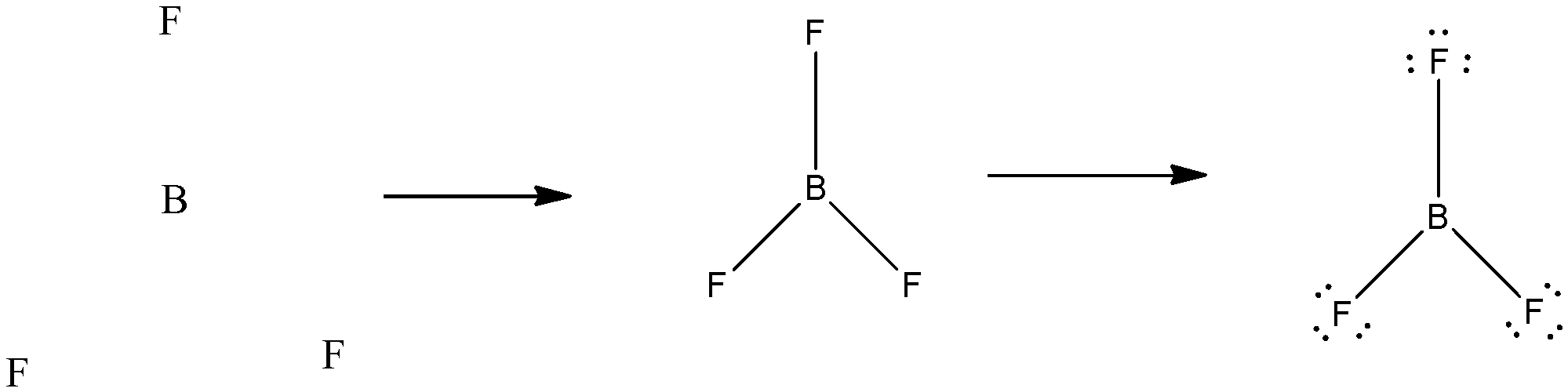
Since, a pi ( $\pi $ ) bond is required for double bond between boron and 3 sigma ($\text{ }\!\!\sigma\!\!\text{ }$) bonds are formed per atom of boron, $B{{F}_{3}}$is $s{{p}^{2}}$ hybridised. The atomic S-orbitals and P-orbitals in the outer shell of Boron mix to form three equivalent $s{{p}^{2}}$ hybrid orbitals.
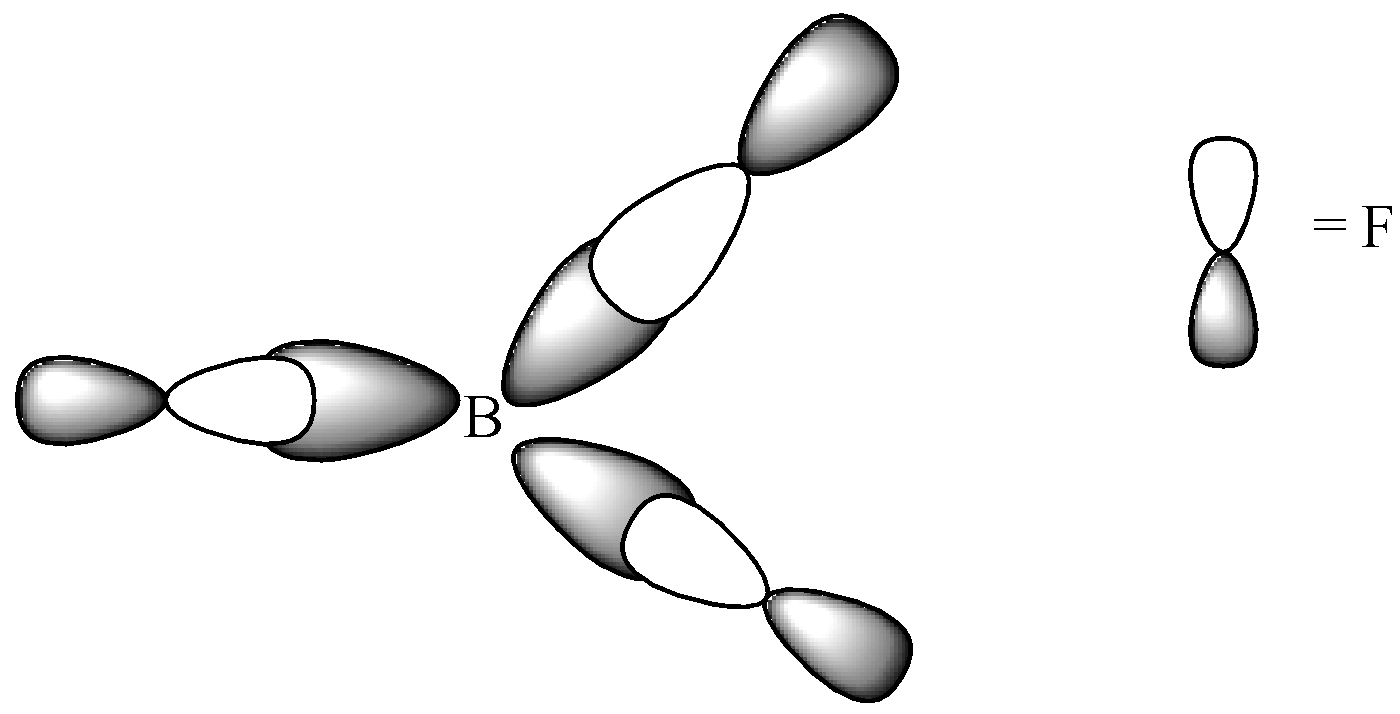
We can see that Boron has an electronic configuration \[\text{1}{{\text{s}}^{\text{2}}}\text{2}{{\text{s}}^{\text{2}}}\text{2}{{\text{p}}_{\text{x}}}^{\text{1}}\] . When it is excited, the electronic configuration changes into \[\text{1}{{\text{s}}^{\text{2}}}\text{ 2}{{\text{s}}^{\text{1}}}\text{ 2p}_{x}^{1}\text{ 2p}_{y}^{1}\] . Three identical B-F bonds are created in $\text{B}{{\text{F}}_{\text{3}}}$ and the excited boron atom undergoes hybridisation. The intermixing and redistribution of 2s, $2{{p}_{x}}$ and $2{{p}_{y}}$ orbitals into three identical orbits form $s{{p}^{2}}$ hybrid orbitals. For minimum repulsion to be present, the angle between two orbitals in the molecule must be ${{120}^{\circ }}$. Each $s{{p}^{2}}$ orbital must receive an electron and then 3 fluorine atoms overlap their $2{{p}_{z}}$ orbitals containing unpaired electrons. Finally, the three $s{{p}^{2}}$ orbitals of boron atoms contained unpaired electrons and formed three sigma-$s{{p}^{2}}$ -p bonds.
Note:
We should know that boron trifluoride is electron poor and has an empty orbital. This enables it to accept a pair of electrons. Thus we can say that it is a Lewis Acid.
Complete answer:
$\text{B}{{\text{F}}_{\text{3}}}$ molecule has a geometrical shape of “Trigonal Planar”. The bond angle made was ${{120}^{\circ }}$ with Boron at the centre and Fluorine at the 3 vertices forming an equilateral triangle. In case of $\text{B}{{\text{F}}_{\text{3}}}$, the central atom does not have an octet as it has 6 particles. It becomes an octet after addition of more bonds. The structure can be drawn as:
Since, a pi ( $\pi $ ) bond is required for double bond between boron and 3 sigma ($\text{ }\!\!\sigma\!\!\text{ }$) bonds are formed per atom of boron, $B{{F}_{3}}$is $s{{p}^{2}}$ hybridised. The atomic S-orbitals and P-orbitals in the outer shell of Boron mix to form three equivalent $s{{p}^{2}}$ hybrid orbitals.
We can see that Boron has an electronic configuration \[\text{1}{{\text{s}}^{\text{2}}}\text{2}{{\text{s}}^{\text{2}}}\text{2}{{\text{p}}_{\text{x}}}^{\text{1}}\] . When it is excited, the electronic configuration changes into \[\text{1}{{\text{s}}^{\text{2}}}\text{ 2}{{\text{s}}^{\text{1}}}\text{ 2p}_{x}^{1}\text{ 2p}_{y}^{1}\] . Three identical B-F bonds are created in $\text{B}{{\text{F}}_{\text{3}}}$ and the excited boron atom undergoes hybridisation. The intermixing and redistribution of 2s, $2{{p}_{x}}$ and $2{{p}_{y}}$ orbitals into three identical orbits form $s{{p}^{2}}$ hybrid orbitals. For minimum repulsion to be present, the angle between two orbitals in the molecule must be ${{120}^{\circ }}$. Each $s{{p}^{2}}$ orbital must receive an electron and then 3 fluorine atoms overlap their $2{{p}_{z}}$ orbitals containing unpaired electrons. Finally, the three $s{{p}^{2}}$ orbitals of boron atoms contained unpaired electrons and formed three sigma-$s{{p}^{2}}$ -p bonds.
Note:
We should know that boron trifluoride is electron poor and has an empty orbital. This enables it to accept a pair of electrons. Thus we can say that it is a Lewis Acid.
Recently Updated Pages
Master Class 11 Social Science: Engaging Questions & Answers for Success

Master Class 11 English: Engaging Questions & Answers for Success
Master Class 11 Maths: Engaging Questions & Answers for Success
Master Class 11 Chemistry: Engaging Questions & Answers for Success
Master Class 11 Biology: Engaging Questions & Answers for Success
Master Class 11 Physics: Engaging Questions & Answers for Success
Trending doubts
One Metric ton is equal to kg A 10000 B 1000 C 100 class 11 physics CBSE
Difference Between Prokaryotic Cells and Eukaryotic Cells
Draw a diagram of a plant cell and label at least eight class 11 biology CBSE
Two of the body parts which do not appear in MRI are class 11 biology CBSE
Which gas is abundant in air class 11 chemistry CBSE
10 examples of friction in our daily life