




Explain the following reactions of chloroform
(i)Effect of air and sunlight (ii) Reimer-Tiemann reaction
Answer
 Verified
618k+ views
Hint: Chloroform is a volatile, colorless, sweet-smelling liquid used as a solvent and formerly as an anesthetic. It is a man-made by-product when formed chlorine is used to disinfect the water
Complete step by step answer:
(i)Effect of air and sunlight:
Chloroform(\[CHC{{l}_{3}}\]) on the exposure of air and sunlight gives Phosgene gas and hydrochloric acid due to the oxidation of chloroform, which is used in the production of urethanes and polycarbonate plastics. In order to avoid this reaction, the chloroform is kept in dark bottles to prevent this oxidation. The reaction is given below;
\[\Rightarrow 2CHC{{l}_{3}}+{{O}_{2}}\xrightarrow[Sunlight]{Air}2COC{{l}_{2}}+HCl\]
Phosgene gas(\[COC{{l}_{2}}\]) is a colorless, poisonous gas. Formerly it used to defeat the enemies at the time of the first world war
(ii)Reimer-Tiemann reaction:
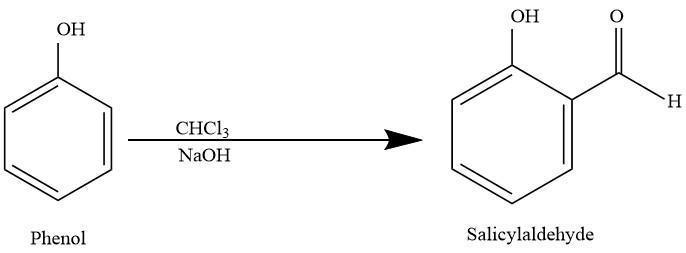
Reimer-Tiemann reaction is a type of substitution reaction. It is generally used for the ortho-formylation of phenols. The simplest example for the Reimer-Tiemann reaction is the conversion of phenol into salicylaldehyde. The reaction is discovered by Karl Reimer and Ferdinand Tiemann Reaction: When phenols is treated with chloroform in the presence of sodium hydroxide, an aldehyde group is introduced at the ortho-position of the benzene ring leading to the formation of o-hydroxybenzaldehyde(salicylaldehyde). The reaction is given below;
Note:
Hydroxide is not readily soluble in chloroform. So Reimer-tiemann's reaction is generally occurring in the bi-phasic system. Simply, an aqueous hydroxide solution phase and organic solution phase containing chloroform. These two reagents have to separate and must bring together to proceed this reaction.
Complete step by step answer:
(i)Effect of air and sunlight:
Chloroform(\[CHC{{l}_{3}}\]) on the exposure of air and sunlight gives Phosgene gas and hydrochloric acid due to the oxidation of chloroform, which is used in the production of urethanes and polycarbonate plastics. In order to avoid this reaction, the chloroform is kept in dark bottles to prevent this oxidation. The reaction is given below;
\[\Rightarrow 2CHC{{l}_{3}}+{{O}_{2}}\xrightarrow[Sunlight]{Air}2COC{{l}_{2}}+HCl\]
Phosgene gas(\[COC{{l}_{2}}\]) is a colorless, poisonous gas. Formerly it used to defeat the enemies at the time of the first world war
(ii)Reimer-Tiemann reaction:
Reimer-Tiemann reaction is a type of substitution reaction. It is generally used for the ortho-formylation of phenols. The simplest example for the Reimer-Tiemann reaction is the conversion of phenol into salicylaldehyde. The reaction is discovered by Karl Reimer and Ferdinand Tiemann Reaction: When phenols is treated with chloroform in the presence of sodium hydroxide, an aldehyde group is introduced at the ortho-position of the benzene ring leading to the formation of o-hydroxybenzaldehyde(salicylaldehyde). The reaction is given below;
Note:
Hydroxide is not readily soluble in chloroform. So Reimer-tiemann's reaction is generally occurring in the bi-phasic system. Simply, an aqueous hydroxide solution phase and organic solution phase containing chloroform. These two reagents have to separate and must bring together to proceed this reaction.
Recently Updated Pages
Master Class 12 Business Studies: Engaging Questions & Answers for Success

Master Class 12 Chemistry: Engaging Questions & Answers for Success
Master Class 12 Biology: Engaging Questions & Answers for Success
Class 12 Question and Answer - Your Ultimate Solutions Guide
Master Class 11 English: Engaging Questions & Answers for Success
Master Class 11 Social Science: Engaging Questions & Answers for Success
Trending doubts
Which are the Top 10 Largest Countries of the World?
Draw a labelled sketch of the human eye class 12 physics CBSE
Differentiate between homogeneous and heterogeneous class 12 chemistry CBSE
Differentiate between Pyramid of energy and pyramid class 12 biology CBSE
Why is the cell called the structural and functional class 12 biology CBSE
Draw the diagram of the pyramid of energy Explain In class 12 biology CBSE