




Explain the chemical constituents of DNA.
Answer
 Verified
615.6k+ views
Hint: DNA consists of polynucleotides that coil around each other to form a double helix that contains genetic instructions for all known species and many viruses to grow, work, expand, and reproduce. What allows the two strands of DNA to stay together are the bases. In DNA, there are four bases.
Complete answer:
Deoxyribonucleic acid is DNA. This involves genetic material.
A double-stranded DNA is composed of 2 antiparallel helices. It is made up of a monomer called nucleotides. It consists of 3 elements, namely a group of sugars, a group of phosphates, and a nitrogen base.
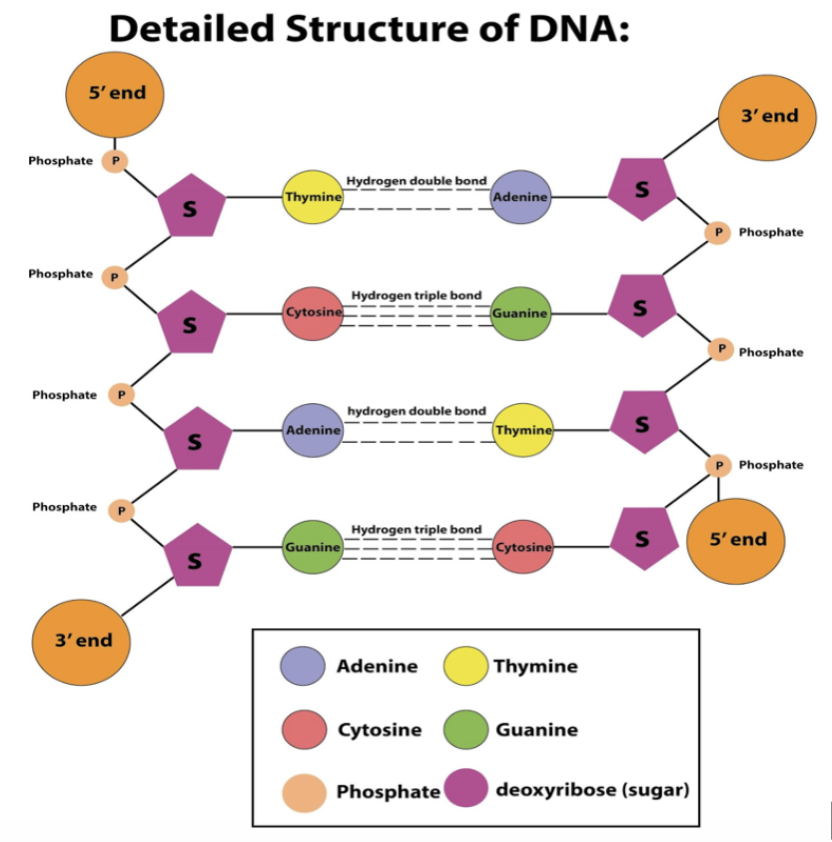
A nucleoside is considered a nucleotide without a phosphate group. In DNA, deoxyribose sugar is the sugar present. The backbone of the DNA molecule is made up of sugar and phosphate groups.
There are two kinds of bases of nitrogen present. These are pyrimidine and purine. There are four different bases to which the sugar group can probably be connected. They are purines: adenine (A) and guanine (G), and thymine (T) and cytosine (C) are pyrimidines. The bond of hydrogen between these bases keeps together the two strands. There are 2 bonds of hydrogen between adenine and thymine and 3 bonds of hydrogen between guanine and cytosine are present. Hence, complementary pairs are called adenine and thymine. Similarly, complementary pairs are called guanine and cytosine.
Note: In multicellular species, DNA is contained in the nucleus of cells and was first isolated by the Swiss physician Friedrich Miescher in 1869. The DNA (deoxyribonucleic acid) double helix model consists of two intertwined strands. Because of the structures of the various bases, strong intermolecular forces called hydrogen bonds between the bases on opposing strands are responsible for this.
Complete answer:
Deoxyribonucleic acid is DNA. This involves genetic material.
A double-stranded DNA is composed of 2 antiparallel helices. It is made up of a monomer called nucleotides. It consists of 3 elements, namely a group of sugars, a group of phosphates, and a nitrogen base.
A nucleoside is considered a nucleotide without a phosphate group. In DNA, deoxyribose sugar is the sugar present. The backbone of the DNA molecule is made up of sugar and phosphate groups.
There are two kinds of bases of nitrogen present. These are pyrimidine and purine. There are four different bases to which the sugar group can probably be connected. They are purines: adenine (A) and guanine (G), and thymine (T) and cytosine (C) are pyrimidines. The bond of hydrogen between these bases keeps together the two strands. There are 2 bonds of hydrogen between adenine and thymine and 3 bonds of hydrogen between guanine and cytosine are present. Hence, complementary pairs are called adenine and thymine. Similarly, complementary pairs are called guanine and cytosine.
Note: In multicellular species, DNA is contained in the nucleus of cells and was first isolated by the Swiss physician Friedrich Miescher in 1869. The DNA (deoxyribonucleic acid) double helix model consists of two intertwined strands. Because of the structures of the various bases, strong intermolecular forces called hydrogen bonds between the bases on opposing strands are responsible for this.
Recently Updated Pages
Master Class 12 Business Studies: Engaging Questions & Answers for Success

Master Class 12 Chemistry: Engaging Questions & Answers for Success
Master Class 12 Biology: Engaging Questions & Answers for Success
Class 12 Question and Answer - Your Ultimate Solutions Guide
Master Class 11 English: Engaging Questions & Answers for Success
Master Class 11 Social Science: Engaging Questions & Answers for Success
Trending doubts
Which are the Top 10 Largest Countries of the World?
Draw a labelled sketch of the human eye class 12 physics CBSE
Differentiate between homogeneous and heterogeneous class 12 chemistry CBSE
Differentiate between Pyramid of energy and pyramid class 12 biology CBSE
Why is the cell called the structural and functional class 12 biology CBSE
Draw the diagram of the pyramid of energy Explain In class 12 biology CBSE