




Explain the cardiac cycle with the help of diagrams.
Answer
 Verified
599.7k+ views
Hint:The cardiac cycle is the performance of the human heart from the end to the next beginning of a single heartbeat. It consists mainly of two stages: one during which the heart muscle relaxes and fills with blood after the blood is pumped in the second stage. Relaxation and contraction of the atria and ventricles of the heart last about 0.8 seconds.
Complete answer:
There are two stages of the cardiac cycle, namely diastole, and systole.
Diastole is a phase in which the superior and inferior Vena cava returns blood to the heart and flows it to the right atrium. Owing to a large amount of blood flow, the pressure in the right atrium increases and the right ventricle pressure increases. As a result, the tricuspid valve opens and allows the blood to flow into the right ventricle. Oxygenated blood from the lungs flows into the left atrium and the mitral valve also opens as the left atrial pressure increases and blood flows into the left ventricle.
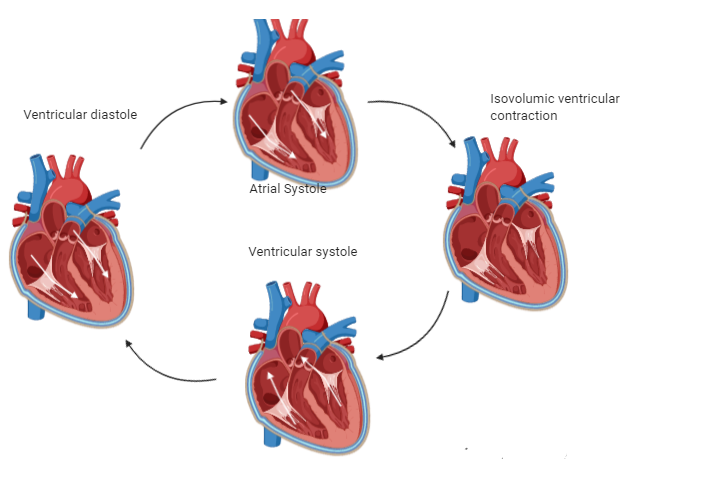
In the systolic phase, blood flows from the pair of atria into their respective ventricles. Due to the depolarization of the atria, the blood flow occurs as a result of the contraction of the atrial muscle. As the ventricular muscle contracts and induces pressure in the ventricle, the semilunar valves are opened. The diastole process continues until the heart muscle is relaxed again.
Note: Isovolumetric contraction is the period during the cardiac cycle in which the ventricles contract because the pulmonary and aortic valves are closed. The heartbeat is a result of a cardiac loop. Two common sounds are known as "lub" and "dub". It is the sound produced during the opening and closing of the valves.
Complete answer:
There are two stages of the cardiac cycle, namely diastole, and systole.
Diastole is a phase in which the superior and inferior Vena cava returns blood to the heart and flows it to the right atrium. Owing to a large amount of blood flow, the pressure in the right atrium increases and the right ventricle pressure increases. As a result, the tricuspid valve opens and allows the blood to flow into the right ventricle. Oxygenated blood from the lungs flows into the left atrium and the mitral valve also opens as the left atrial pressure increases and blood flows into the left ventricle.
In the systolic phase, blood flows from the pair of atria into their respective ventricles. Due to the depolarization of the atria, the blood flow occurs as a result of the contraction of the atrial muscle. As the ventricular muscle contracts and induces pressure in the ventricle, the semilunar valves are opened. The diastole process continues until the heart muscle is relaxed again.
Note: Isovolumetric contraction is the period during the cardiac cycle in which the ventricles contract because the pulmonary and aortic valves are closed. The heartbeat is a result of a cardiac loop. Two common sounds are known as "lub" and "dub". It is the sound produced during the opening and closing of the valves.
Recently Updated Pages
Master Class 11 English: Engaging Questions & Answers for Success

Master Class 11 Social Science: Engaging Questions & Answers for Success
Master Class 11 Maths: Engaging Questions & Answers for Success
Master Class 11 Biology: Engaging Questions & Answers for Success
Master Class 11 Physics: Engaging Questions & Answers for Success
Master Class 11 Chemistry: Engaging Questions & Answers for Success
Trending doubts
One Metric ton is equal to kg A 10000 B 1000 C 100 class 11 physics CBSE
Difference Between Prokaryotic Cells and Eukaryotic Cells
Two of the body parts which do not appear in MRI are class 11 biology CBSE
Find the value of the expression given below sin 30circ class 11 maths CBSE
Draw a diagram of a plant cell and label at least eight class 11 biology CBSE
10 examples of friction in our daily life