




Explain the carbon cycle with the help of a simplified model.
Answer
 Verified
627.9k+ views
Hint: The carbon cycle is a gaseous cycle. There is recycling of carbon elements in the atmosphere from abiotic and biotic organisms. The carbon is very abundant and majorly found in dissolved form in oceans.
Complete step by step answer:
-The movement of the nutrients through living and nonliving components is called nutrient cycling. This nutrient cycle associated with the recycling of the carbon is known as carbon cycle.
-The carbon cycle is a gaseous cycle where the reservoir of carbon is in air or water. The carbon constitutes about 49 percent of dry weight of an organism as the body is made up of hydrocarbons. The reservoir of carbon is the oceans where there is carbon. The carbon dioxide released by humans is assimilated by plants when they consume carbon dioxide and release oxygen. This assimilates carbon is returned back to the soil when the plant dies. The carbon is also transferred to soil when animals are dead and is decomposed by microbes.
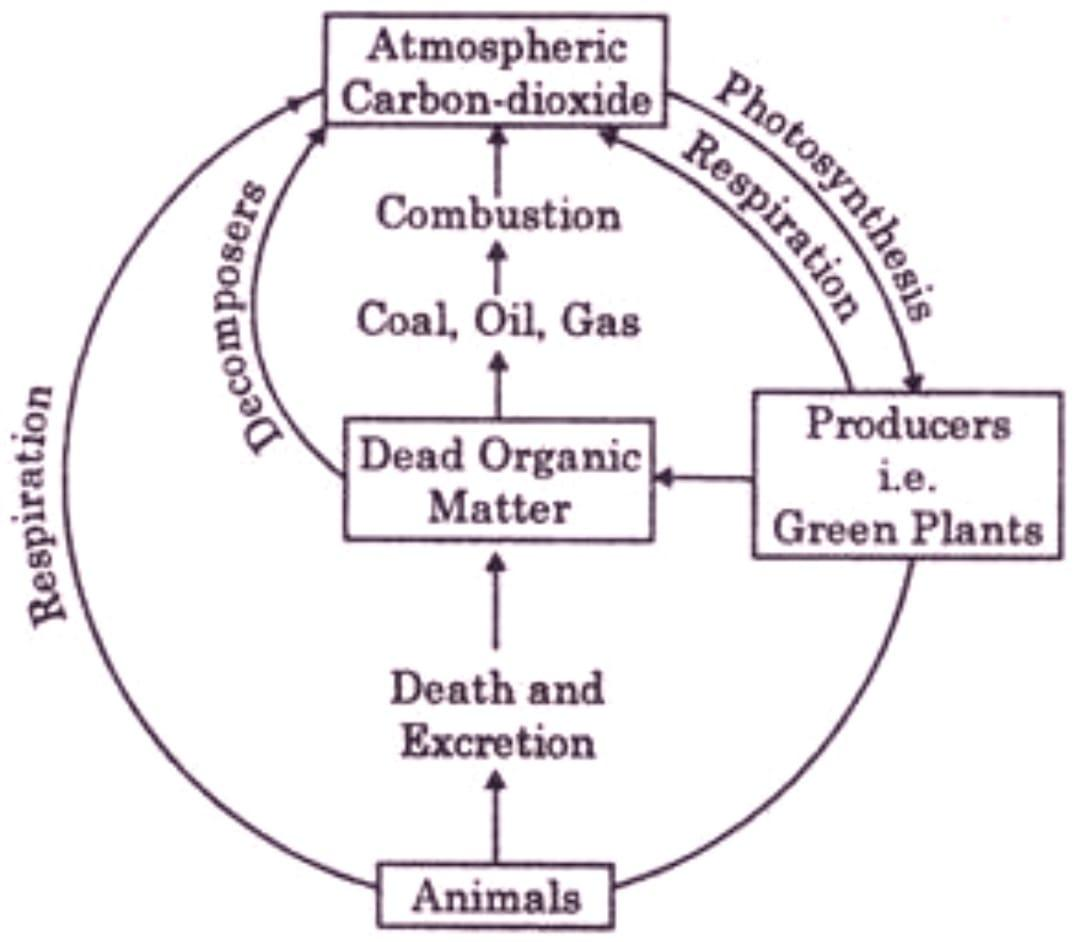
The main sources of carbon are air, oceans, fossil fuel and rocks.
Note:
The nutrient cycle shows that the elements are recycled and used and neither of the elements are created in the process. This maintains the balance of nutrients in the environment.
Complete step by step answer:
-The movement of the nutrients through living and nonliving components is called nutrient cycling. This nutrient cycle associated with the recycling of the carbon is known as carbon cycle.
-The carbon cycle is a gaseous cycle where the reservoir of carbon is in air or water. The carbon constitutes about 49 percent of dry weight of an organism as the body is made up of hydrocarbons. The reservoir of carbon is the oceans where there is carbon. The carbon dioxide released by humans is assimilated by plants when they consume carbon dioxide and release oxygen. This assimilates carbon is returned back to the soil when the plant dies. The carbon is also transferred to soil when animals are dead and is decomposed by microbes.
The main sources of carbon are air, oceans, fossil fuel and rocks.
Note:
The nutrient cycle shows that the elements are recycled and used and neither of the elements are created in the process. This maintains the balance of nutrients in the environment.
Recently Updated Pages
Master Class 12 Business Studies: Engaging Questions & Answers for Success

Master Class 12 Chemistry: Engaging Questions & Answers for Success
Master Class 12 Biology: Engaging Questions & Answers for Success
Class 12 Question and Answer - Your Ultimate Solutions Guide
Master Class 11 English: Engaging Questions & Answers for Success
Master Class 11 Social Science: Engaging Questions & Answers for Success
Trending doubts
Which are the Top 10 Largest Countries of the World?
Draw a labelled sketch of the human eye class 12 physics CBSE
Differentiate between homogeneous and heterogeneous class 12 chemistry CBSE
Why is the cell called the structural and functional class 12 biology CBSE
When was the first election held in India a 194748 class 12 sst CBSE
Draw ray diagrams each showing i myopic eye and ii class 12 physics CBSE