




Explain the analytical method for vector addition to find the resultant vector.
Answer
 Verified
608.7k+ views
Hint: Analytical methods of vector addition and subtraction use geometry and basic trigonometry. Part of the graphical approach is preserved, because for simple visualization, vectors are still represented by arrows.
Complete answer:
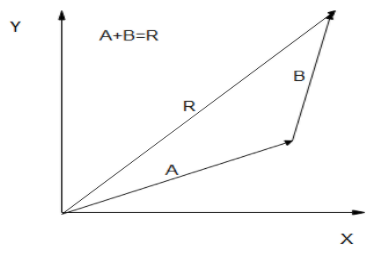
If $A$ and $B$ represent two legs of a walk (two displacements), then $R$ is the total displacement. The person taking the walk ends up at the tip of $\mathrm{R}$. There are many ways to arrive at the same point. In particular, the person could have walked first in the x-direction and then in the $y$ -direction. Those paths are the $x$ - and $y$ components of the resultant, $R_{x}$ and $R_{y} .$ If we know $R_{x}$ and $R_{y},$ we can find $R$ and $\theta$ using the equations $A=\sqrt{A_{x}^{2}+A_{y}^{2}}$ and $\theta ={{\tan }^{-1}}\left( \dfrac{{{A}_{Y}}}{{{A}_{x}}} \right).$ When you use the analytical method of vector addition, you can determine the components or the magnitude and direction of a vector.
Steps To be Followed:
1.Identify the $x$ - and $y$ -axes that will be used in the problem. Then, find the components of each vector to be added along the chosen perpendicular axes. Use the equations $A_{x}=A \cos \theta$ and $A_{y}=A \sin \theta$ to find the components. In Figure, these components are $A_{x}, A_{y}, B_{x},$ and $B_{y} .$ The angles that vectors $A$ and $B$ make with the $x$ -axis are $\theta_{A}$ and $\theta_{B},$ respectively.
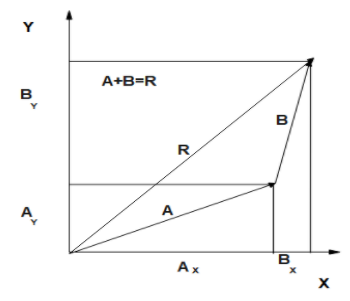
2.Find the resulting components along each axis by adding the individual vector components along that axis.
$R_{x}=A_{x}+B_{x}$
$R_{y}=A_{y}+B_{y}$
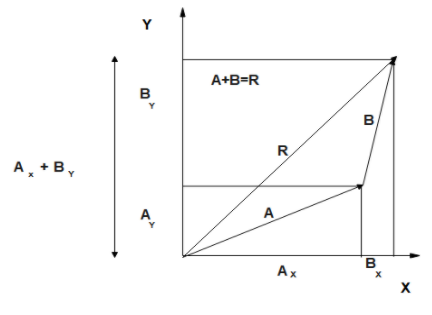
3.To get the magnitude $R$ of the resultant, use the Pythagorean theorem:
$R=\sqrt{R_{x}^{2}+R_{y}^{2}}$
4. To get the direction of the resultant:
$\theta ={{\tan }^{-1}}\left( \dfrac{{{R}_{Y}}}{{{R}_{X}}} \right)$
\[\therefore \] The resultant vector using the analytical method for vector addition is $R=\sqrt{R_{x}^{2}+R_{y}^{2}}$
Note:
Analytical methods, however, are more succinct, descriptive, and reliable than graphical methods, which are constrained by the precision with which a drawing can be produced. Only the precision and accuracy with which physical quantities are understood is constrained by analytical methods.
Complete answer:
If $A$ and $B$ represent two legs of a walk (two displacements), then $R$ is the total displacement. The person taking the walk ends up at the tip of $\mathrm{R}$. There are many ways to arrive at the same point. In particular, the person could have walked first in the x-direction and then in the $y$ -direction. Those paths are the $x$ - and $y$ components of the resultant, $R_{x}$ and $R_{y} .$ If we know $R_{x}$ and $R_{y},$ we can find $R$ and $\theta$ using the equations $A=\sqrt{A_{x}^{2}+A_{y}^{2}}$ and $\theta ={{\tan }^{-1}}\left( \dfrac{{{A}_{Y}}}{{{A}_{x}}} \right).$ When you use the analytical method of vector addition, you can determine the components or the magnitude and direction of a vector.
Steps To be Followed:
1.Identify the $x$ - and $y$ -axes that will be used in the problem. Then, find the components of each vector to be added along the chosen perpendicular axes. Use the equations $A_{x}=A \cos \theta$ and $A_{y}=A \sin \theta$ to find the components. In Figure, these components are $A_{x}, A_{y}, B_{x},$ and $B_{y} .$ The angles that vectors $A$ and $B$ make with the $x$ -axis are $\theta_{A}$ and $\theta_{B},$ respectively.
2.Find the resulting components along each axis by adding the individual vector components along that axis.
$R_{x}=A_{x}+B_{x}$
$R_{y}=A_{y}+B_{y}$
3.To get the magnitude $R$ of the resultant, use the Pythagorean theorem:
$R=\sqrt{R_{x}^{2}+R_{y}^{2}}$
4. To get the direction of the resultant:
$\theta ={{\tan }^{-1}}\left( \dfrac{{{R}_{Y}}}{{{R}_{X}}} \right)$
\[\therefore \] The resultant vector using the analytical method for vector addition is $R=\sqrt{R_{x}^{2}+R_{y}^{2}}$
Note:
Analytical methods, however, are more succinct, descriptive, and reliable than graphical methods, which are constrained by the precision with which a drawing can be produced. Only the precision and accuracy with which physical quantities are understood is constrained by analytical methods.
Recently Updated Pages
Master Class 11 English: Engaging Questions & Answers for Success

Master Class 11 Social Science: Engaging Questions & Answers for Success
Master Class 11 Maths: Engaging Questions & Answers for Success
Master Class 11 Biology: Engaging Questions & Answers for Success
Master Class 11 Physics: Engaging Questions & Answers for Success
Master Class 11 Chemistry: Engaging Questions & Answers for Success
Trending doubts
One Metric ton is equal to kg A 10000 B 1000 C 100 class 11 physics CBSE
Difference Between Prokaryotic Cells and Eukaryotic Cells
Find the value of the expression given below sin 30circ class 11 maths CBSE
1 ton equals to A 100 kg B 1000 kg C 10 kg D 10000 class 11 physics CBSE
Two of the body parts which do not appear in MRI are class 11 biology CBSE
What are hard magnetic materials class 11 physics CBSE