




Explain pair production and also explain the annihilation of matter?
Answer
 Verified
658.8k+ views
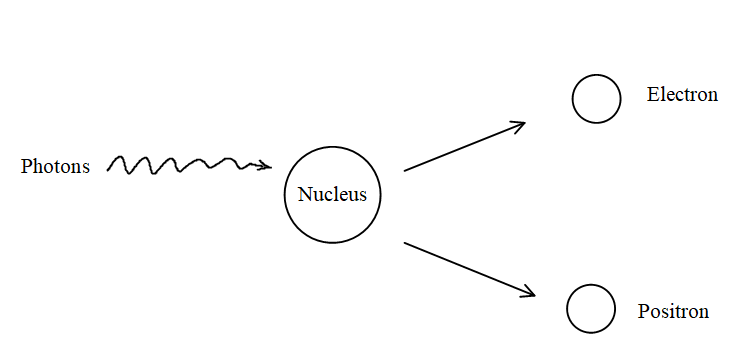
Hint: Pair production is the process in which the photons fall on a nucleus and there is the formation of electron and positron pair, where positron is the charge having a mass equal to that of the electron but possess positive charge, on the other hand, annihilation is the process in which the electron and positron collide and forms photons.
Complete Step by Step Answer:
Pair production:
Pair production is a process in which the electron and positron are formed by an incident photon on the nucleus. When a gamma-ray of threshold frequency falls on the nucleus the formation of electron and positron takes place, the gamma rays should be of at least has energy equivalent to the mass of two electrons as calculated by the energy equation $E = m{c^2}$, here the energy of photons should be at least 1.02 MeV. The positron formed disappears by combining with an electron in the environment and this process is called annihilation of matter.
Annihilation of the matter:
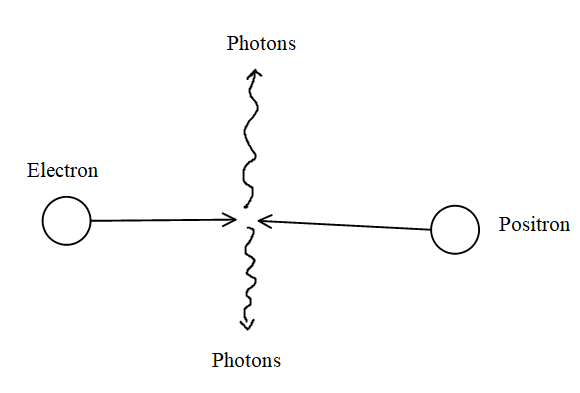
Annihilation is a process in which the electron and positron combine to form a photon, it can also be called as the reverse process of pair production, as in pair production the photons split into electron and positron, and in the annihilation of matter, the electron and positron combine to form photons. In the annihilation process, a low energy electron combines with a low energy positron and forms photons, in this process, there is also the liberation of energy.
Note:
In the pair production process, the photons fall on a nucleus and electron and positron is formed γ $\to$ $e^-+e^+$, while in annihilation the reverse process of pair production takes place $e^-+e^+$$\to$ γ.
Complete Step by Step Answer:
Pair production:
Pair production is a process in which the electron and positron are formed by an incident photon on the nucleus. When a gamma-ray of threshold frequency falls on the nucleus the formation of electron and positron takes place, the gamma rays should be of at least has energy equivalent to the mass of two electrons as calculated by the energy equation $E = m{c^2}$, here the energy of photons should be at least 1.02 MeV. The positron formed disappears by combining with an electron in the environment and this process is called annihilation of matter.
Annihilation of the matter:
Annihilation is a process in which the electron and positron combine to form a photon, it can also be called as the reverse process of pair production, as in pair production the photons split into electron and positron, and in the annihilation of matter, the electron and positron combine to form photons. In the annihilation process, a low energy electron combines with a low energy positron and forms photons, in this process, there is also the liberation of energy.
Note:
In the pair production process, the photons fall on a nucleus and electron and positron is formed γ $\to$ $e^-+e^+$, while in annihilation the reverse process of pair production takes place $e^-+e^+$$\to$ γ.
Recently Updated Pages
What is BLO What is the full form of BLO class 8 social science CBSE

Explain the Treaty of Vienna of 1815 class 10 social science CBSE
10 examples of friction in our daily life
Draw a diagram of nephron and explain its structur class 11 biology CBSE
Write structures of the following compounds i 2 Chloro3methylpentane class 11 chemistry CBSE
A Paragraph on Pollution in about 100-150 Words
Trending doubts
Draw a labelled sketch of the human eye class 12 physics CBSE
Which are the Top 10 Largest Countries of the World?
Differentiate between homogeneous and heterogeneous class 12 chemistry CBSE
Draw ray diagrams each showing i myopic eye and ii class 12 physics CBSE
Which is the correct genotypic ratio of mendel dihybrid class 12 biology CBSE
What is the Full Form of PVC, PET, HDPE, LDPE, PP and PS ?