




Explain nucleophilic substitution of alkyl halides?
Answer
 Verified
563.1k+ views
Hint: Alkyl halides are the chemical compounds that are consisting of alkyl groups bonded to the halogen atom. Due to the polarity halogen group can be displaced by the nucleophiles like hydroxide and undergoes a nucleophilic substitution which are of two types namely unimolecular and bi-molecular substitution reactions.
Complete answer:
Halogen atoms are fluorine, chlorine, bromine, and iodine. These are non-metals and has high electronegativity values. When alkyl groups are bonded with these halogens. The compounds were named as alkyl halides.
Due to the difference in the electronegativity and polarity between the alkyl groups and halogen atoms. Halogen atoms can be displaced by other nucleophiles like hydroxide in two ways.
One is \[S{N^1}\] which can be known as a unimolecular nucleophilic substitution reaction. It can take place in two steps. One step is generation of carbocation and the second step is attacking nucleophiles on carbocation. Tertiary alkyl halide undergoes this type of mechanism. Tertiary carbocation is more stable than secondary and primary carbocations.
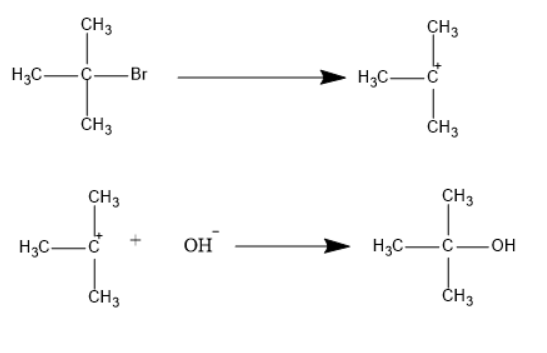
Another type is \[S{N^2}\] which can be known as bimolecular nucleophilic substitution reaction. It can take place in single steps. Transition state will be formed in this reaction that leads to the inversion configuration of the product. Primary alkyl halides undergo this type of mechanism.
Note:
Mostly tertiary alkyl halides undergo unimolecular nucleophilic substitution as the tertiary carbocation is more stable. Primary alkyl halides undergo bimolecular nucleophilic substitution. Whereas secondary alkyl halides undergo both the mechanisms depending upon the conditions of chemical reaction.
Complete answer:
Halogen atoms are fluorine, chlorine, bromine, and iodine. These are non-metals and has high electronegativity values. When alkyl groups are bonded with these halogens. The compounds were named as alkyl halides.
Due to the difference in the electronegativity and polarity between the alkyl groups and halogen atoms. Halogen atoms can be displaced by other nucleophiles like hydroxide in two ways.
One is \[S{N^1}\] which can be known as a unimolecular nucleophilic substitution reaction. It can take place in two steps. One step is generation of carbocation and the second step is attacking nucleophiles on carbocation. Tertiary alkyl halide undergoes this type of mechanism. Tertiary carbocation is more stable than secondary and primary carbocations.
Another type is \[S{N^2}\] which can be known as bimolecular nucleophilic substitution reaction. It can take place in single steps. Transition state will be formed in this reaction that leads to the inversion configuration of the product. Primary alkyl halides undergo this type of mechanism.
Note:
Mostly tertiary alkyl halides undergo unimolecular nucleophilic substitution as the tertiary carbocation is more stable. Primary alkyl halides undergo bimolecular nucleophilic substitution. Whereas secondary alkyl halides undergo both the mechanisms depending upon the conditions of chemical reaction.
Recently Updated Pages
If x a + bt + ct2 where x is in meters and t is in class 11 physics CBSE

A car covers the first half distance between two places class 11 physics CBSE
The resultant of two vectors overrightarrow P and overrightarrow class 11 physics CBSE
Find the value of cos 135 class 11 maths CBSE
A mass M is held in place by an applied force F and class 11 physics CBSE
A solution of glucose in water is labelled as 10 dfracwv class 11 chemistry CBSE
Trending doubts
One Metric ton is equal to kg A 10000 B 1000 C 100 class 11 physics CBSE
Find the value of the expression given below sin 30circ class 11 maths CBSE
What do you mean by retardation What is its SI uni class 11 physics CBSE
Draw a diagram of nephron and explain its structur class 11 biology CBSE
10 examples of friction in our daily life
Difference between physical and chemical change class 11 chemistry CBSE