




Explain Newton's experiment by which he proved that white light is made up of light of seven colors.
Answer
 Verified
505.2k+ views
Hint: Newton used prism, a source of white light. His experiment was based on the bending or refraction of light while going from one medium to another. The reason why we see a rainbow is due to this phenomenon that Newton proved by his experiment.
Complete answer:
Newton was tremendously interested in learning everything about light and colors. Newton darkened his room and cut a hole in his window shutter one bright sunny day, enabling only one beam of sunshine to penetrate. He put a glass prism into the sunbeam. The end product was a stunning rainbow-like multicolored ribbon of light.
Newton believed that all of the colors he saw came from the sunlight streaming into his room. He reasoned that if he could combine the spectrum's colors, he should be able to restore the light's whiteness. To test this, he placed an upside-down prism in front of the first prism. He was correct. And all of the colors blended to make white light. Newton was the first to show that white light is made up of all the colours that can be seen.
Dispersion is the name given to this phenomenon. It is the separation of white light into its spectrum of colors (in sequence violet, indigo, blue, green, yellow, orange, and red) when it travels through a glass prism. In the figure, we have shown the topmost and the bottom-most color. all other color rays disperse just like this in between them.
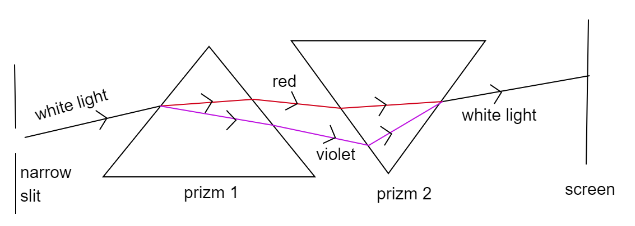
This was Newton's experiment by which he proved that white light is made up of light of seven colors.
Note:
He noticed that different wavelengths of light cause different colors of the spectrum to bend differently. Because of their shorter and longer wavelengths, in this experiment, he saw that violet bent the most out of all colors so it has a short wavelength, and red bent the least so it has a long wavelength.
Complete answer:
Newton was tremendously interested in learning everything about light and colors. Newton darkened his room and cut a hole in his window shutter one bright sunny day, enabling only one beam of sunshine to penetrate. He put a glass prism into the sunbeam. The end product was a stunning rainbow-like multicolored ribbon of light.
Newton believed that all of the colors he saw came from the sunlight streaming into his room. He reasoned that if he could combine the spectrum's colors, he should be able to restore the light's whiteness. To test this, he placed an upside-down prism in front of the first prism. He was correct. And all of the colors blended to make white light. Newton was the first to show that white light is made up of all the colours that can be seen.
Dispersion is the name given to this phenomenon. It is the separation of white light into its spectrum of colors (in sequence violet, indigo, blue, green, yellow, orange, and red) when it travels through a glass prism. In the figure, we have shown the topmost and the bottom-most color. all other color rays disperse just like this in between them.
This was Newton's experiment by which he proved that white light is made up of light of seven colors.
Note:
He noticed that different wavelengths of light cause different colors of the spectrum to bend differently. Because of their shorter and longer wavelengths, in this experiment, he saw that violet bent the most out of all colors so it has a short wavelength, and red bent the least so it has a long wavelength.
Recently Updated Pages
Master Class 12 Business Studies: Engaging Questions & Answers for Success

Master Class 12 Biology: Engaging Questions & Answers for Success
Master Class 12 Chemistry: Engaging Questions & Answers for Success
Class 12 Question and Answer - Your Ultimate Solutions Guide
Master Class 11 Social Science: Engaging Questions & Answers for Success
Master Class 11 English: Engaging Questions & Answers for Success
Trending doubts
Which are the Top 10 Largest Countries of the World?
Draw a labelled sketch of the human eye class 12 physics CBSE
Name the crygenes that control cotton bollworm and class 12 biology CBSE
Differentiate between homogeneous and heterogeneous class 12 chemistry CBSE
Ribosomal RNA is actively synthesised in A Nucleoplasm class 12 biology CBSE
How many molecules of ATP and NADPH are required information class 12 biology CBSE