




Explain in brief the structure of the retina of the human eye.
Answer
 Verified
599.7k+ views
Hint: The retina is a thin tissue film that covers the interior of the back of the eye. It is positioned next to the optic nerve. The aim of the retina is to absorb light directed by the lens, translate the light into neural signals, and transmit these signals for visual recognition to the brain.
Complete answer:
The retina is a complex translucent tissue that consists of many layers, only one of which includes photoreceptor cells which are sensitive to light. To meet the photoreceptor cells, which are of two types, rods and cones, light must pass through the overlying membranes, which are structurally distinguished by their characteristic shapes and functionally by their exposure to various kinds of light. Rods predominate in nocturnal species and are more vulnerable to diminished light intensity; they provide night vision and visual awareness assistance in humans. In humans and other species who are involved throughout the day and have a precise vision (as for reading) and colour, cones are more prominent.
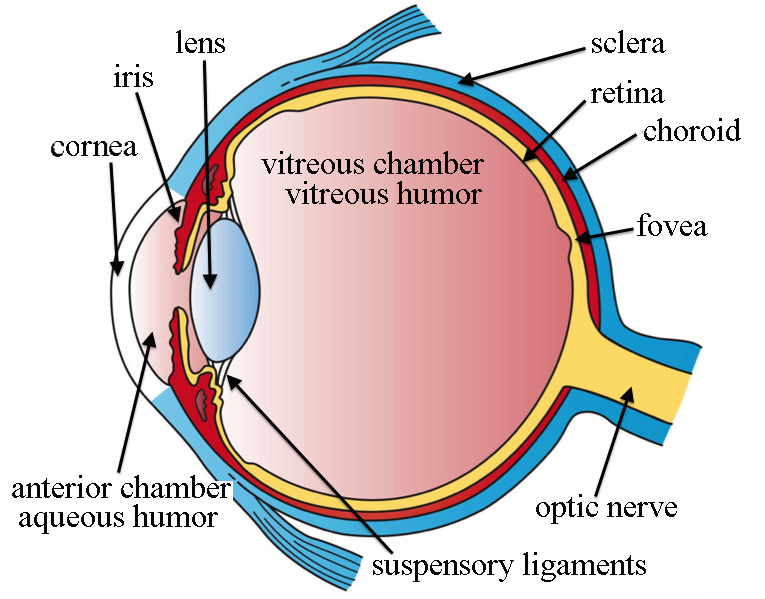
The further cones per unit area of the retina, the finer the detail that can be discriminated against by that area in general. Rods are fairly well spread over the whole retina, but cones appear to be clustered at two sites: fovea centralis, a pit at the back of the retina that does not include rods and contains the densest distribution of cones in the eye, and macula lutea, a circular area of yellow-pigmented tissue about 0.2 to 0.24 inches (5 to 6 mm) in diameter.
Note: Rods are in control of vision at low levels of light (scotopic vision). They do not mediate the perception of colour, and they have poor spatial acuity. At higher light levels (photopic vision), cones are involved, are capable of colour vision, and are responsible for high spatial acuity. The central fovea is filled by cones exclusively.
Complete answer:
The retina is a complex translucent tissue that consists of many layers, only one of which includes photoreceptor cells which are sensitive to light. To meet the photoreceptor cells, which are of two types, rods and cones, light must pass through the overlying membranes, which are structurally distinguished by their characteristic shapes and functionally by their exposure to various kinds of light. Rods predominate in nocturnal species and are more vulnerable to diminished light intensity; they provide night vision and visual awareness assistance in humans. In humans and other species who are involved throughout the day and have a precise vision (as for reading) and colour, cones are more prominent.
The further cones per unit area of the retina, the finer the detail that can be discriminated against by that area in general. Rods are fairly well spread over the whole retina, but cones appear to be clustered at two sites: fovea centralis, a pit at the back of the retina that does not include rods and contains the densest distribution of cones in the eye, and macula lutea, a circular area of yellow-pigmented tissue about 0.2 to 0.24 inches (5 to 6 mm) in diameter.
Note: Rods are in control of vision at low levels of light (scotopic vision). They do not mediate the perception of colour, and they have poor spatial acuity. At higher light levels (photopic vision), cones are involved, are capable of colour vision, and are responsible for high spatial acuity. The central fovea is filled by cones exclusively.
Recently Updated Pages
Master Class 11 English: Engaging Questions & Answers for Success

Master Class 11 Social Science: Engaging Questions & Answers for Success
Master Class 11 Maths: Engaging Questions & Answers for Success
Master Class 11 Biology: Engaging Questions & Answers for Success
Master Class 11 Physics: Engaging Questions & Answers for Success
Master Class 11 Chemistry: Engaging Questions & Answers for Success
Trending doubts
One Metric ton is equal to kg A 10000 B 1000 C 100 class 11 physics CBSE
Difference Between Prokaryotic Cells and Eukaryotic Cells
Two of the body parts which do not appear in MRI are class 11 biology CBSE
Find the value of the expression given below sin 30circ class 11 maths CBSE
Draw a diagram of a plant cell and label at least eight class 11 biology CBSE
10 examples of friction in our daily life