




Explain hybridisation of $ I{F_7} $ and $ Cl{F_3} $ with electronic configuration and structure.
Answer
 Verified
568.2k+ views
Hint: Hybridisation is the mixing of two pure orbitals of different energy to form a hybrid set of new orbitals of equivalent energy. We have to find the hybridisation following the set of rules according to the valence bond electron pair repulsion theory.
Complete Step By Step Answer:
We know that the hybridisation is mixing of two pure orbitals of different energy to form a hybrid set of new orbitals of equivalent energy.
We have to find the hybridisation of iodine heptafluoride . So first we find the hybridisation of the given molecule
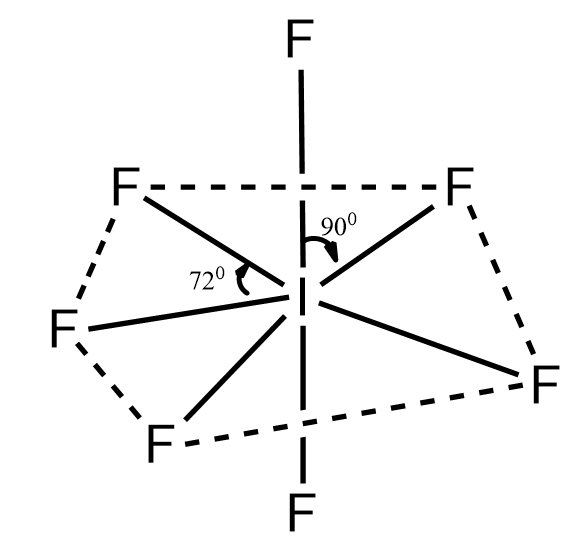
So in the molecule the number of valence electrons in a central metal atom is seven.
Number of bond pairs is equal to seven
So number of lone pairs would be $ 7 - 7 = 0 $
So the total pair is seven. So for seven pairs the hybridisation would be $ s{p^3}{d^3} $ and for the given hybridisation with zero lone pairs the structure would be pentagonal bipyramidal structure.
Now we have chlorine trifluoride molecules.
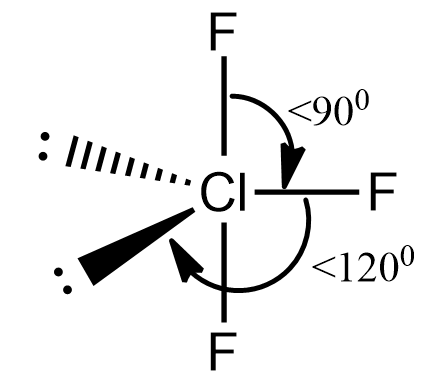
So in the molecule the number of valence electrons in a central metal atom is seven.
Number of bond pairs is equal to three
So the number of lone pairs would be $ 7 - 3 = 4 $ which in pairs means two lone pairs.
So the total pair is five which is the hybridisation $ s{p^3}d $ so the given hybridisation with two lone pairs would yield a t shape molecule.
Note:
Due to the presence of lone pairs the actual geometry changes which would be there if there was no lone pair present. The electron geometry and the shape varies for such cases. It also affects the bond angle and all such properties of the molecules.
Complete Step By Step Answer:
We know that the hybridisation is mixing of two pure orbitals of different energy to form a hybrid set of new orbitals of equivalent energy.
We have to find the hybridisation of iodine heptafluoride . So first we find the hybridisation of the given molecule
So in the molecule the number of valence electrons in a central metal atom is seven.
Number of bond pairs is equal to seven
So number of lone pairs would be $ 7 - 7 = 0 $
So the total pair is seven. So for seven pairs the hybridisation would be $ s{p^3}{d^3} $ and for the given hybridisation with zero lone pairs the structure would be pentagonal bipyramidal structure.
Now we have chlorine trifluoride molecules.
So in the molecule the number of valence electrons in a central metal atom is seven.
Number of bond pairs is equal to three
So the number of lone pairs would be $ 7 - 3 = 4 $ which in pairs means two lone pairs.
So the total pair is five which is the hybridisation $ s{p^3}d $ so the given hybridisation with two lone pairs would yield a t shape molecule.
Note:
Due to the presence of lone pairs the actual geometry changes which would be there if there was no lone pair present. The electron geometry and the shape varies for such cases. It also affects the bond angle and all such properties of the molecules.
Recently Updated Pages
Master Class 11 English: Engaging Questions & Answers for Success

Master Class 11 Social Science: Engaging Questions & Answers for Success
Master Class 11 Maths: Engaging Questions & Answers for Success
Master Class 11 Chemistry: Engaging Questions & Answers for Success
Master Class 11 Biology: Engaging Questions & Answers for Success
Master Class 11 Physics: Engaging Questions & Answers for Success
Trending doubts
Difference Between Prokaryotic Cells and Eukaryotic Cells
Draw a diagram of nephron and explain its structur class 11 biology CBSE
Net gain of ATP in glycolysis a 6 b 2 c 4 d 8 class 11 biology CBSE
Difference between physical and chemical change class 11 chemistry CBSE
Which of the following is the hottest month AMay BJune class 11 social science CBSE
How do I convert ms to kmh Give an example class 11 physics CBSE