



Explain how a square is:
(i) a quadrilateral (ii) a parallelogram (iii) a rhombus (iv) a rectangle
Answer
 Verified
621.3k+ views
Hint: As we know that, in square all sides are equal in length and each angle is equal to. The diagonals are equal and bisect each other.
Complete step-by-step solution:
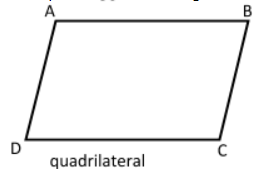
(i) Properties of quadrilateral:
(a) A quadrilateral should be closed shaped with $4$sides.
(b) The sum of angle is${360^o}$.
Properties of square:
(a) square has also $4$sides.
(b) Each angle is ${90^o}$ i.e. sum of the angle is${360^o}$.
$\therefore $Square is a quadrilateral.
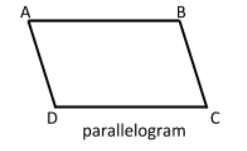
(ii) Properties of parallelogram:
(a) A parallelogram has both pairs of opposite sides are equal in length and parallel.
(b) Diagonal bisect each other.
Properties of square:
(a) A square with both pairs of opposite sides are equal in length and parallel.
(b) Diagonal bisect each other at${90^o}$.
$\therefore $Square is also a parallelogram.
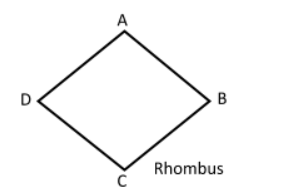
(iii) Properties of rhombus:
(a) A rhombus is a parallelogram.
(b) All sides are equal.
(c) Diagonals bisect each other at ${90^o}$.
Properties of square:
(a) A square is a parallelogram.
(b) All sides are equal.
(c) Diagonal bisect each other at ${90^o}$.
$\therefore $ A square is a rhombus.
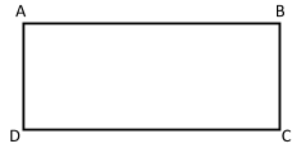
(iv) Properties of rectangle:
(a) All angles are equal i.e. ${90^o}$.
(b) Diagonals bisect each other.
(c) It is a parallelogram.
Properties of square:
(a) All angles are equal i.e.${90^o}$.
(b) Diagonals bisect each other at${90^o}$.
(c) It is also a parallelogram.
$\therefore $A square is a rectangle.
Note:As we know that a quadrilateral is a $4$sided \[2 - \]dimensional figure whose sum of internal angles is ${360^o}$.
Complete step-by-step solution:
(i) Properties of quadrilateral:
(a) A quadrilateral should be closed shaped with $4$sides.
(b) The sum of angle is${360^o}$.
Properties of square:
(a) square has also $4$sides.
(b) Each angle is ${90^o}$ i.e. sum of the angle is${360^o}$.
$\therefore $Square is a quadrilateral.
(ii) Properties of parallelogram:
(a) A parallelogram has both pairs of opposite sides are equal in length and parallel.
(b) Diagonal bisect each other.
Properties of square:
(a) A square with both pairs of opposite sides are equal in length and parallel.
(b) Diagonal bisect each other at${90^o}$.
$\therefore $Square is also a parallelogram.
(iii) Properties of rhombus:
(a) A rhombus is a parallelogram.
(b) All sides are equal.
(c) Diagonals bisect each other at ${90^o}$.
Properties of square:
(a) A square is a parallelogram.
(b) All sides are equal.
(c) Diagonal bisect each other at ${90^o}$.
$\therefore $ A square is a rhombus.
(iv) Properties of rectangle:
(a) All angles are equal i.e. ${90^o}$.
(b) Diagonals bisect each other.
(c) It is a parallelogram.
Properties of square:
(a) All angles are equal i.e.${90^o}$.
(b) Diagonals bisect each other at${90^o}$.
(c) It is also a parallelogram.
$\therefore $A square is a rectangle.
Note:As we know that a quadrilateral is a $4$sided \[2 - \]dimensional figure whose sum of internal angles is ${360^o}$.
Recently Updated Pages
Master Class 11 English: Engaging Questions & Answers for Success

Master Class 11 Social Science: Engaging Questions & Answers for Success
Master Class 11 Maths: Engaging Questions & Answers for Success
Master Class 11 Chemistry: Engaging Questions & Answers for Success
Master Class 11 Biology: Engaging Questions & Answers for Success
Master Class 11 Physics: Engaging Questions & Answers for Success
Trending doubts
Find the sum of series 1 + 2 + 3 + 4 + 5 + + 100 class 9 maths CBSE
Difference Between Plant Cell and Animal Cell
Fill the blanks with the suitable prepositions 1 The class 9 english CBSE
What is pollution? How many types of pollution? Define it
What is the Full Form of ICSE / ISC ?
Name 10 Living and Non living things class 9 biology CBSE