



Explain how a square is a,
( a ) quadrilateral
( b ) parallelogram
( c ) rhombus
( d ) rectangle
Answer
 Verified
653.4k+ views
Hint: One object is the same as another object if they both possess the same properties. What we will do is discuss properties of parallelogram, quadrilateral, rhombus and rectangle and check whether squares satisfy all these properties or not.
Complete step-by-step answer:
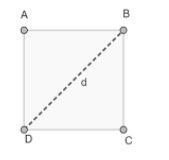
A square is a four sided polygon whose all four sides are the same and all four angles made by adjacent sides are equal to ${{90}^{{}^\circ }}$ .
Now from the diagram, let there be a square ABCD with four sides namely AB, BC, CD and DA with diagonal d and angles $\angle ABC,\angle BCD,\angle CDA,\angle DAC$ .
Now, we have to prove that the square is quadrilateral, parallelogram, rhombus and rectangle.
What we will do is we will check whether the square satisfies all minimum required properties to be , parallelogram, rhombus and rectangle.
Now, what quadrilateral is, it is a polygon with four sides and four vertices. Quadrilaterals can take any shape but the only condition is that the polygon must have four sides and four vertices.
Now, from the figure we can see that square ABCD has four sides namely AB, BC, CD and DA and four vertices namely A, B, C and D. Hence, the square is quadrilateral.
Now, parallelogram is a quadrilateral with two pairs of parallel sides, the opposite facing sides are equal and the opposite angles of a parallelogram are of equal measure. Now, in square all four sides are the same hence all opposite sides are equal and all sides are of angle ${{90}^{{}^\circ }}$ so opposite angles are also equal. Hence, the square is a parallelogram.
Now, rhombus is quadrilateral whose all four sides are equal and opposite angles are equal. In square, all four sides are equal and opposite sides are also equal whose measure is ${{90}^{{}^\circ }}$. Hence, the square is rhombus.
Now, the rectangle is a quadrilateral whose opposite sides are equal and all four angles are of ${{90}^{{}^\circ }}$ in measure. Since, all sides of the square are equal so opposite sides are equal and the measure of all four angles are equal to ${{90}^{{}^\circ }}$. Hence, the square is a rectangle.
Note: Properties of square, parallelogram, quadrilateral, rhombus and rectangle must be kept in mind. We need to satisfy only those conditions of parallelogram, quadrilateral, rhombus and rectangle for squares which are minimum required.
Complete step-by-step answer:
A square is a four sided polygon whose all four sides are the same and all four angles made by adjacent sides are equal to ${{90}^{{}^\circ }}$ .
Now from the diagram, let there be a square ABCD with four sides namely AB, BC, CD and DA with diagonal d and angles $\angle ABC,\angle BCD,\angle CDA,\angle DAC$ .
Now, we have to prove that the square is quadrilateral, parallelogram, rhombus and rectangle.
What we will do is we will check whether the square satisfies all minimum required properties to be , parallelogram, rhombus and rectangle.
Now, what quadrilateral is, it is a polygon with four sides and four vertices. Quadrilaterals can take any shape but the only condition is that the polygon must have four sides and four vertices.
Now, from the figure we can see that square ABCD has four sides namely AB, BC, CD and DA and four vertices namely A, B, C and D. Hence, the square is quadrilateral.
Now, parallelogram is a quadrilateral with two pairs of parallel sides, the opposite facing sides are equal and the opposite angles of a parallelogram are of equal measure. Now, in square all four sides are the same hence all opposite sides are equal and all sides are of angle ${{90}^{{}^\circ }}$ so opposite angles are also equal. Hence, the square is a parallelogram.
Now, rhombus is quadrilateral whose all four sides are equal and opposite angles are equal. In square, all four sides are equal and opposite sides are also equal whose measure is ${{90}^{{}^\circ }}$. Hence, the square is rhombus.
Now, the rectangle is a quadrilateral whose opposite sides are equal and all four angles are of ${{90}^{{}^\circ }}$ in measure. Since, all sides of the square are equal so opposite sides are equal and the measure of all four angles are equal to ${{90}^{{}^\circ }}$. Hence, the square is a rectangle.
Note: Properties of square, parallelogram, quadrilateral, rhombus and rectangle must be kept in mind. We need to satisfy only those conditions of parallelogram, quadrilateral, rhombus and rectangle for squares which are minimum required.
Recently Updated Pages
Master Class 12 Economics: Engaging Questions & Answers for Success

Master Class 12 Social Science: Engaging Questions & Answers for Success
Master Class 12 English: Engaging Questions & Answers for Success
Master Class 12 Maths: Engaging Questions & Answers for Success
Master Class 12 Physics: Engaging Questions & Answers for Success
Master Class 12 Biology: Engaging Questions & Answers for Success
Trending doubts
How many sides does a circle have a 10 sides b 20 sides class 8 maths CBSE
What is BLO What is the full form of BLO class 8 social science CBSE
What does the color green in the national flag of India class 8 social science CBSE
Citizens of India can vote at the age of A 18 years class 8 social science CBSE
Full form of STD, ISD and PCO
One cusec is equal to how many liters class 8 maths CBSE