




Explain how a potential barrier is developed in a p-n junction diode.
Answer
 Verified
656.7k+ views
Hint:- First of all we will see the p-type semiconductor and n-type semiconductors and then and then the diode. The potential barrier in the P-N junction diode is the barrier in which additional force is required to cross the barrier.
Step By Step Answer:
As the semiconductor material of form P and N is put together, the gradient of very large density charge carriers is generated on both the side area P and N.
P-type semiconductors are those which have higher number of holes and these are formed by doping of semiconductors material with trivalent impurities like aluminum.
N-type is those which have higher numbers of free electrons and are formed with doping of pentavalent impurities like phosphorus with semiconductors.
The N-side free electrons traverse the area and continue to merge with the holes, leaving behind the immobile positive donor ions. Furthermore, the P-region holes fuse with the N-region electrons and leave behind the negative acceptor ions. The cycle is continued until there are enough charge carriers for the P and N regions to resist the corresponding electrons and holes.
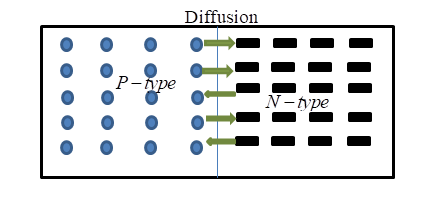
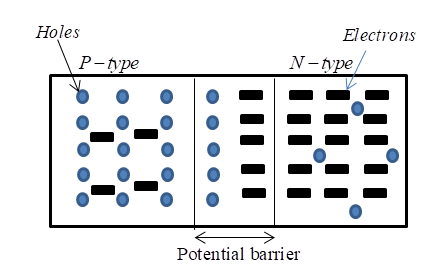
Thus when these electrons flow, positive charge leave behind and also holes leaving negative charge on its own side thus two different charge accumulate forming a layer as shown in figure known as depletion layer.
Note- As depletion layer is formed also now constitutes an electric field thus another form of current starts flowing due to this in the opposite direction of diffusion current and drift current. In unbiased condition these two current (diffusion and drift) are same and opposite in direction thus net current is zero.
Step By Step Answer:
As the semiconductor material of form P and N is put together, the gradient of very large density charge carriers is generated on both the side area P and N.
P-type semiconductors are those which have higher number of holes and these are formed by doping of semiconductors material with trivalent impurities like aluminum.
N-type is those which have higher numbers of free electrons and are formed with doping of pentavalent impurities like phosphorus with semiconductors.
The N-side free electrons traverse the area and continue to merge with the holes, leaving behind the immobile positive donor ions. Furthermore, the P-region holes fuse with the N-region electrons and leave behind the negative acceptor ions. The cycle is continued until there are enough charge carriers for the P and N regions to resist the corresponding electrons and holes.
Thus when these electrons flow, positive charge leave behind and also holes leaving negative charge on its own side thus two different charge accumulate forming a layer as shown in figure known as depletion layer.
Note- As depletion layer is formed also now constitutes an electric field thus another form of current starts flowing due to this in the opposite direction of diffusion current and drift current. In unbiased condition these two current (diffusion and drift) are same and opposite in direction thus net current is zero.
Recently Updated Pages
Master Class 12 Economics: Engaging Questions & Answers for Success

Master Class 12 Social Science: Engaging Questions & Answers for Success
Master Class 12 English: Engaging Questions & Answers for Success
Master Class 12 Maths: Engaging Questions & Answers for Success
Master Class 12 Physics: Engaging Questions & Answers for Success
Master Class 12 Biology: Engaging Questions & Answers for Success
Trending doubts
Draw a labelled sketch of the human eye class 12 physics CBSE
Which are the Top 10 Largest Countries of the World?
Draw ray diagrams each showing i myopic eye and ii class 12 physics CBSE
Which is the correct genotypic ratio of mendel dihybrid class 12 biology CBSE
Differentiate between homogeneous and heterogeneous class 12 chemistry CBSE
Which animal never drinks water in its entire life class 12 biology CBSE