




Explain different components of ‘Electric motor’.
Answer
 Verified
587.7k+ views
Hint: Electric motor is an electric machine which converts electrical energy into mechanical energy. The principle of working of an electric motor is when a current carrying conductor is placed in a magnetic field, it experiences some force due to which the motor starts rotating continuously.
Complete answer:
An electric motor is a device which converts electrical energy into mechanical energy. There are mainly two types of electric motors: A DC motor or an AC motor, depending upon their power supplies. When electric current is passed into a rectangular coil, the current produces a magnetic field around that coil.
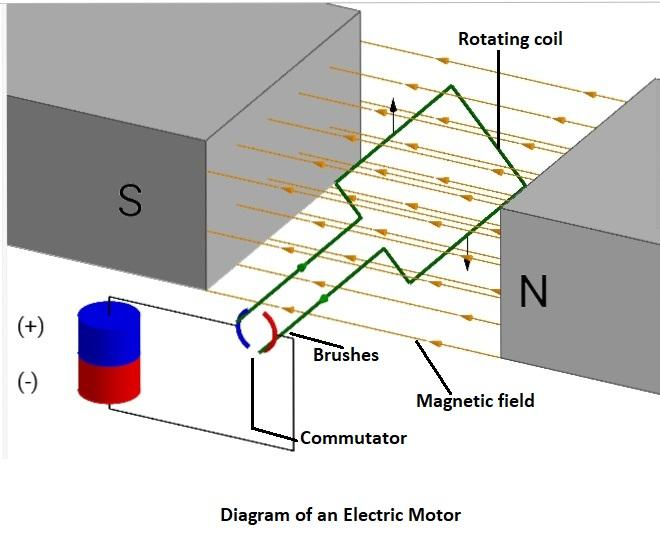
Components of an Electric motor:
1.Power supply – The power supply of an electric motor is the component in which the operating power source is generated. The emphasis on the power supply is always the same.
2.Commutator – Commutator is the electrical motor part that aids in the direction of the electrical source provided by the power source unit. It works as a rotary switch which has the capability of reversing the direction of the electric current between the external source and the rotor.
3.Rotor armature – The rotor or armature of an electrical motor has a continuous rotation while the motor is running. The right side of a rotor displays electrical pin contacts and the left side displays electrical contacts.
4.Axle – The axle of an electric motor contains part of the main power source that provides the ability of direction of the motor.
5.Field Magnet – A field magnet provides a magnetic field that enables the inner coil wire within a motor to rotate.
6.Brushes – Brushes in an electric motor conduct current between stationary wires and moving parts of the motor, mainly rotating shafts.
Note:
The direction of motion of an electric motor can be determined using Fleming’s left hand rule. The first finger points in the direction of Magnetic field. The second finger points in the direction of the current. The thumb points in the direction of the motion. Remember you have to use your left hand not the right hand.
Complete answer:
An electric motor is a device which converts electrical energy into mechanical energy. There are mainly two types of electric motors: A DC motor or an AC motor, depending upon their power supplies. When electric current is passed into a rectangular coil, the current produces a magnetic field around that coil.
Components of an Electric motor:
1.Power supply – The power supply of an electric motor is the component in which the operating power source is generated. The emphasis on the power supply is always the same.
2.Commutator – Commutator is the electrical motor part that aids in the direction of the electrical source provided by the power source unit. It works as a rotary switch which has the capability of reversing the direction of the electric current between the external source and the rotor.
3.Rotor armature – The rotor or armature of an electrical motor has a continuous rotation while the motor is running. The right side of a rotor displays electrical pin contacts and the left side displays electrical contacts.
4.Axle – The axle of an electric motor contains part of the main power source that provides the ability of direction of the motor.
5.Field Magnet – A field magnet provides a magnetic field that enables the inner coil wire within a motor to rotate.
6.Brushes – Brushes in an electric motor conduct current between stationary wires and moving parts of the motor, mainly rotating shafts.
Note:
The direction of motion of an electric motor can be determined using Fleming’s left hand rule. The first finger points in the direction of Magnetic field. The second finger points in the direction of the current. The thumb points in the direction of the motion. Remember you have to use your left hand not the right hand.
Recently Updated Pages
Basicity of sulphurous acid and sulphuric acid are

Master Class 12 Economics: Engaging Questions & Answers for Success
Master Class 12 Biology: Engaging Questions & Answers for Success
Master Class 11 English: Engaging Questions & Answers for Success
Master Class 11 Physics: Engaging Questions & Answers for Success
Master Class 11 Computer Science: Engaging Questions & Answers for Success
Trending doubts
What is the Total Duration of Football Match?
Explain the Treaty of Vienna of 1815 class 10 social science CBSE
In football, which nation is called "La Roja"?
Why is there a time difference of about 5 hours between class 10 social science CBSE
10 examples of evaporation in daily life with explanations
What is the full form of POSCO class 10 social science CBSE