



Explain Clemmensen’s reduction with an example.
Answer
 Verified
598.5k+ views
Hint: Clemmensen’s reduction reaction is named after Erik Christian Clemmensen who was a Danish chemist. In Clemmesen’s reduction, the reduction process takes place in aldehydes or ketone in the presence of catalyst and acid. This reaction is mostly effective for the reduction of cyclic ketone.
Complete step by step answer:
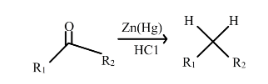
The reaction where reduction of ketones or aldehydes takes place to form an alkane with the help of hydrochloric acid and zinc amalgam is known as Clemmensen’s reduction reaction.
In other words, In Clemmensen Reduction, deoxygenation of aldehyde or ketones takes place to form a hydrocarbon.
The general Clemmensen’s reduction reaction is shown below.
Example:
The reduction of phenyl ethanone to 1-phenyl ethane is shown below.
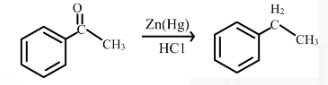
In this reaction phenyl ethanone reacts with hydrochloric acid and zinc amalgam to form 1-phenyl ethane.
The mechanism of the reaction is not till completely understood but based on the observations, there are two proposals,
According to the Carbenoid mechanism which is a radical process, the reduction process takes place at the surface of the zinc catalyst. Alcohols containing groups are not suggested as an intermediate because when the alcohols are used in the same conditions it does not lead to the formation of alkane.
According to the carbanionic mechanism, the zinc attacks the protonated carbon directly.
Note:
In Clemmensen reduction, the substrate used should be stable to strong acids. The Clemmensen reduction reaction is complementary with the Wolff-Kishner Reduction. In Wolff-Kishner reaction strong basic condition is used to carry out the reaction.
Complete step by step answer:
The reaction where reduction of ketones or aldehydes takes place to form an alkane with the help of hydrochloric acid and zinc amalgam is known as Clemmensen’s reduction reaction.
In other words, In Clemmensen Reduction, deoxygenation of aldehyde or ketones takes place to form a hydrocarbon.
The general Clemmensen’s reduction reaction is shown below.
Example:
The reduction of phenyl ethanone to 1-phenyl ethane is shown below.
In this reaction phenyl ethanone reacts with hydrochloric acid and zinc amalgam to form 1-phenyl ethane.
The mechanism of the reaction is not till completely understood but based on the observations, there are two proposals,
According to the Carbenoid mechanism which is a radical process, the reduction process takes place at the surface of the zinc catalyst. Alcohols containing groups are not suggested as an intermediate because when the alcohols are used in the same conditions it does not lead to the formation of alkane.
According to the carbanionic mechanism, the zinc attacks the protonated carbon directly.
Note:
In Clemmensen reduction, the substrate used should be stable to strong acids. The Clemmensen reduction reaction is complementary with the Wolff-Kishner Reduction. In Wolff-Kishner reaction strong basic condition is used to carry out the reaction.
Recently Updated Pages
Master Class 12 Business Studies: Engaging Questions & Answers for Success

Master Class 12 Chemistry: Engaging Questions & Answers for Success
Master Class 12 Biology: Engaging Questions & Answers for Success
Class 12 Question and Answer - Your Ultimate Solutions Guide
Master Class 11 English: Engaging Questions & Answers for Success
Master Class 11 Social Science: Engaging Questions & Answers for Success
Trending doubts
Which are the Top 10 Largest Countries of the World?
Draw a labelled sketch of the human eye class 12 physics CBSE
The end of compass needle which points towards north class 12 physics CBSE
Differentiate between homogeneous and heterogeneous class 12 chemistry CBSE
Why is the cell called the structural and functional class 12 biology CBSE
When was the first election held in India a 194748 class 12 sst CBSE