




Explain carbon cycle in ecosystem. Give a linear diagram of carbon cycle.
Answer
 Verified
618.6k+ views
Hint: The carbon cycle is a gaseous cycle and there is a recycling of carbon elements present in the atmosphere from abiotic as well as biotic organisms.
Complete answer:
Nutrient cycling is the movement or exchange of nutrients from the living and nonliving components and this nutrient cycle is associated with the recycling of the carbon element known as the carbon cycle. Carbon is very abundant and it is majorly found in the dissolved form in oceans.
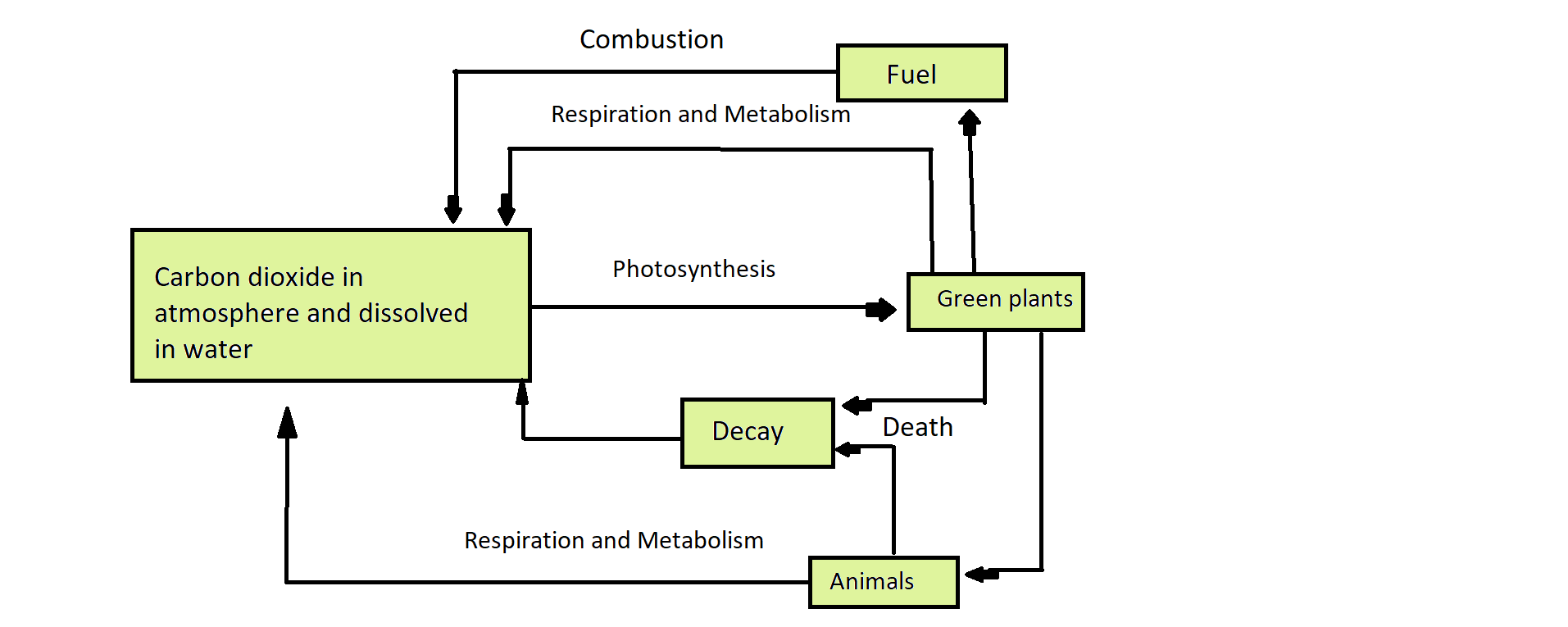
This carbon cycle is a gaseous cycle whose reservoir is either in the air or water. Carbon is an essential element in the human body, which constitutes 49 percent of the dry weight of an organism as the body is made up of hydrocarbons. A reservoir of carbon is an ocean where there is carbon. Carbon released by the human body is taken up or assimilates by photosynthetic organisms and then consumed by the plants as a result oxygen is being released out. This absorbed carbon is then returned back to the soil when the plant dies. Carbon is also transferred to the soil when animals are dead and is decomposed by the microbes which also contribute substantially to the carbon dioxide pool.
Burning of wood, combustion of organic matter, fossil fuels, forest fire, volcanic activities are additional sources for the increase of carbon dioxide in the atmosphere, and carbon is also stored in the rocks and sediments.
Linear diagram showing carbon cycle:
Note:
The nutrient cycle shows that the elements are recycled, used, and neither of the elements is created in this process and it maintains the balance of nutrients in the environment.
Complete answer:
Nutrient cycling is the movement or exchange of nutrients from the living and nonliving components and this nutrient cycle is associated with the recycling of the carbon element known as the carbon cycle. Carbon is very abundant and it is majorly found in the dissolved form in oceans.
This carbon cycle is a gaseous cycle whose reservoir is either in the air or water. Carbon is an essential element in the human body, which constitutes 49 percent of the dry weight of an organism as the body is made up of hydrocarbons. A reservoir of carbon is an ocean where there is carbon. Carbon released by the human body is taken up or assimilates by photosynthetic organisms and then consumed by the plants as a result oxygen is being released out. This absorbed carbon is then returned back to the soil when the plant dies. Carbon is also transferred to the soil when animals are dead and is decomposed by the microbes which also contribute substantially to the carbon dioxide pool.
Burning of wood, combustion of organic matter, fossil fuels, forest fire, volcanic activities are additional sources for the increase of carbon dioxide in the atmosphere, and carbon is also stored in the rocks and sediments.
Linear diagram showing carbon cycle:
Note:
The nutrient cycle shows that the elements are recycled, used, and neither of the elements is created in this process and it maintains the balance of nutrients in the environment.
Recently Updated Pages
Basicity of sulphurous acid and sulphuric acid are

Master Class 12 Economics: Engaging Questions & Answers for Success
Master Class 12 Biology: Engaging Questions & Answers for Success
Master Class 11 English: Engaging Questions & Answers for Success
Master Class 11 Physics: Engaging Questions & Answers for Success
Master Class 11 Computer Science: Engaging Questions & Answers for Success
Trending doubts
Draw a labelled sketch of the human eye class 12 physics CBSE
The chemical formula of tear gas is A CO Cl 2 B C 10 class 12 chemistry CBSE
Draw ray diagrams each showing i myopic eye and ii class 12 physics CBSE
Which are the Top 10 Largest Countries of the World?
Differentiate between homogeneous and heterogeneous class 12 chemistry CBSE
Which is the correct genotypic ratio of mendel dihybrid class 12 biology CBSE