




Explain Binary fission in Amoeba.
Answer
 Verified
583.2k+ views
Hint: Amoeba is a single-celled organism, belonging to the kingdom Protista. It is a unicellular eukaryote. It has a well-defined nucleus in the cell. It reproduces asexually.
Complete answer:
The mode of reproduction in Amoeba is Binary fission. The process is an example of asexual reproduction. It is a process by which a parent cell gets divided equally to form two daughter cells. During this process, the nucleus of the parent cell lengthens and stretches. The elongated nucleus divides into two, the method is known as karyokinesis. Later the cytoplasm of the parent cells starts dividing, forming a ridge. These later forms two identical daughter amoebic cells.
During the process of binary fission, there are mainly four steps. The first step is the Replication of the DNA and the amount of genetic material doubles. The second step is cell growth, where the cytoplasmic content increases, the amount and size of organelles also increases. The next step is DNA segregation, where the cell elongates by producing a furrow at the center. The chromosomes separate. Finally, the cells are split forming two daughter cells that are identical to the parent cell.
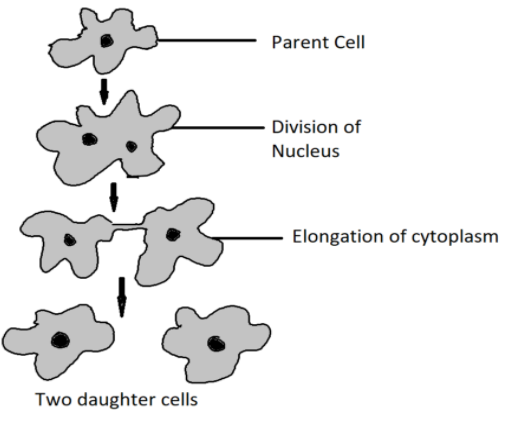
Figure: Binary fission in Amoeba
Note:There are four different types of binary fission, depending on the differences in the plane of division. These are longitudinal binary fission, oblique binary fission, simple binary fission, and transverse binary fission. It is the most common method of reproduction among prokaryotic organisms and certain eukaryotes as well.
Complete answer:
The mode of reproduction in Amoeba is Binary fission. The process is an example of asexual reproduction. It is a process by which a parent cell gets divided equally to form two daughter cells. During this process, the nucleus of the parent cell lengthens and stretches. The elongated nucleus divides into two, the method is known as karyokinesis. Later the cytoplasm of the parent cells starts dividing, forming a ridge. These later forms two identical daughter amoebic cells.
During the process of binary fission, there are mainly four steps. The first step is the Replication of the DNA and the amount of genetic material doubles. The second step is cell growth, where the cytoplasmic content increases, the amount and size of organelles also increases. The next step is DNA segregation, where the cell elongates by producing a furrow at the center. The chromosomes separate. Finally, the cells are split forming two daughter cells that are identical to the parent cell.
Figure: Binary fission in Amoeba
Note:There are four different types of binary fission, depending on the differences in the plane of division. These are longitudinal binary fission, oblique binary fission, simple binary fission, and transverse binary fission. It is the most common method of reproduction among prokaryotic organisms and certain eukaryotes as well.
Recently Updated Pages
Master Class 11 English: Engaging Questions & Answers for Success

Master Class 11 Social Science: Engaging Questions & Answers for Success
Master Class 11 Maths: Engaging Questions & Answers for Success
Master Class 11 Biology: Engaging Questions & Answers for Success
Master Class 11 Physics: Engaging Questions & Answers for Success
Master Class 11 Chemistry: Engaging Questions & Answers for Success
Trending doubts
One Metric ton is equal to kg A 10000 B 1000 C 100 class 11 physics CBSE
Difference Between Prokaryotic Cells and Eukaryotic Cells
Find the value of the expression given below sin 30circ class 11 maths CBSE
Difference between physical and chemical change class 11 chemistry CBSE
Two of the body parts which do not appear in MRI are class 11 biology CBSE
Draw a diagram of a plant cell and label at least eight class 11 biology CBSE