




Explain application of ohm’s law to a complete circuit.
Answer
 Verified
584.4k+ views
Hint:Ohm’s have given a relationship between three quantities: the current, voltage and resistance of the circuit. Ohm’s law states that the voltage or potential difference between two points is directly proportional to the current in the circuit. Draw a linear circuit containing battery and resistance, and determine the current in the circuit.
Complete Step by Step Answer:
We have Ohm’s law which states that the voltage or potential difference between two points is directly proportional to the current in the circuit. Therefore, we can express the Ohm’s law as,
\[V \propto I\]
\[ \Rightarrow V = IR\]
Where V is the voltage, I is the current passing through the circuit. The constant of proportionality is the resistance R of the circuit.
The German scientist George Simon Ohm has discovered the relationship between current, voltage and resistance in the circuit.Using Ohm’s law, we can determine the current flowing through the circuit if the resistance in the circuit and the emf of the supply is known to us. For example, let’s consider the circuit below.
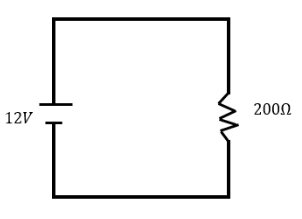
In the above circuit, the resistance R is connected in series with the DC battery of emf 12 V. By using Ohm’s law, we can calculate the current in the above circuit as,
\[V = IR\]
\[ \Rightarrow 12 = \left( I \right)\left( {200} \right)\]
\[ \therefore I = 0.06\,{\text{A}}\]
Thus, the unknown current is 0.06 ampere.
Additional Information:
We know as per the Ohm’s law voltage/current=$a$constant and that constant is resistance. But resistance does not remain constant all the time. When the temperature of material changes the resistance also changes. The law is not applicable to unilateral networks. Unilateral networks allow the current to flow in one direction. Ohm’s law is also not applicable to non-linear elements. The relation between V and I depends on the sign of V where V is voltage and I is current in circuit.
Note: Ohm’s law is not applicable to unilateral networks which involve diode and transmitter, etc. If we have a number of resistors in the circuit, the Ohm’s law is still applicable. To determine the current, the first thing that we have to do is to determine the total resistance in the circuit. If there are two emfs in the circuit, we cannot follow Ohm's law.
Complete Step by Step Answer:
We have Ohm’s law which states that the voltage or potential difference between two points is directly proportional to the current in the circuit. Therefore, we can express the Ohm’s law as,
\[V \propto I\]
\[ \Rightarrow V = IR\]
Where V is the voltage, I is the current passing through the circuit. The constant of proportionality is the resistance R of the circuit.
The German scientist George Simon Ohm has discovered the relationship between current, voltage and resistance in the circuit.Using Ohm’s law, we can determine the current flowing through the circuit if the resistance in the circuit and the emf of the supply is known to us. For example, let’s consider the circuit below.
In the above circuit, the resistance R is connected in series with the DC battery of emf 12 V. By using Ohm’s law, we can calculate the current in the above circuit as,
\[V = IR\]
\[ \Rightarrow 12 = \left( I \right)\left( {200} \right)\]
\[ \therefore I = 0.06\,{\text{A}}\]
Thus, the unknown current is 0.06 ampere.
Additional Information:
We know as per the Ohm’s law voltage/current=$a$constant and that constant is resistance. But resistance does not remain constant all the time. When the temperature of material changes the resistance also changes. The law is not applicable to unilateral networks. Unilateral networks allow the current to flow in one direction. Ohm’s law is also not applicable to non-linear elements. The relation between V and I depends on the sign of V where V is voltage and I is current in circuit.
Note: Ohm’s law is not applicable to unilateral networks which involve diode and transmitter, etc. If we have a number of resistors in the circuit, the Ohm’s law is still applicable. To determine the current, the first thing that we have to do is to determine the total resistance in the circuit. If there are two emfs in the circuit, we cannot follow Ohm's law.
Recently Updated Pages
Master Class 12 Business Studies: Engaging Questions & Answers for Success

Master Class 12 Biology: Engaging Questions & Answers for Success
Master Class 12 Chemistry: Engaging Questions & Answers for Success
Class 12 Question and Answer - Your Ultimate Solutions Guide
Master Class 11 Social Science: Engaging Questions & Answers for Success
Master Class 11 English: Engaging Questions & Answers for Success
Trending doubts
Explain the Treaty of Vienna of 1815 class 10 social science CBSE
Which Indian city is known as the "City of Victory"?
Which instrument is used to measure the Blood Pressure?
Who Won 36 Oscar Awards? Record Holder Revealed
What is the median of the first 10 natural numbers class 10 maths CBSE
Why is it 530 pm in india when it is 1200 afternoon class 10 social science CBSE