




What is excretion? How do unicellular organisms remove their wastes?
Answer
 Verified
635.7k+ views
Hint: Besides the useful products, the metabolic reactions also produce some waste products that are sometimes harmful to the organisms and their accumulation inside the body of organisms affects their other life processes.
Complete answer:
In simple terms, excretion can be defined as the removal of those substances from the body of an organism which is no more useful to the organism or simply waste for the organism. Thus, it is a process that helps to remove the metabolic wastes out from the body of an organism.
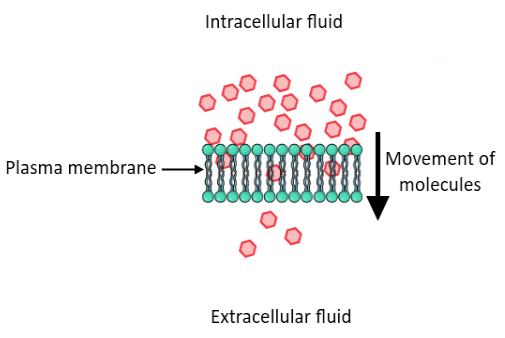
While the multicellular forms have adapted many complex modes of excretion depending upon their habitat and the type of waste material, in simple unicellular forms, it occurs through simple diffusion. Small unicellular forms use the properties of substances as an aid to the excretion in which they move from a region of higher concentration to a region of lower concentration according to their concentration gradient. Due to the metabolic activities of the organism, the concentration of the wastes is much greater than that of the surrounding and hence it easily diffuses across the cell membrane of the organism to the external environment. A simple diffusion has been shown below –
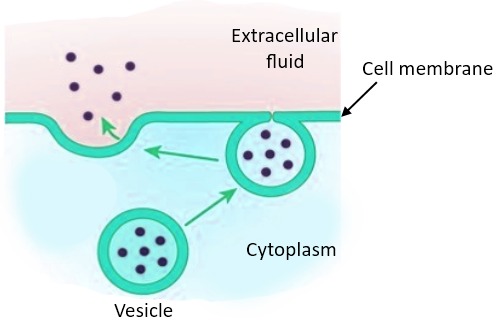
Note: Even though they are simple, some unicellular forms also have special types of vacuoles that help in osmoregulation as well as excretion. Amoeba is one example of such a unicellular organism in which a contractile vacuole is found. Here, as the wastes enter the contractile vacuole, it moves close to the plasma membrane and bursts to release the contents outside the cell body. Lysosomes present in the amoeba help in digesting the material received in the vacuole.
Complete answer:
In simple terms, excretion can be defined as the removal of those substances from the body of an organism which is no more useful to the organism or simply waste for the organism. Thus, it is a process that helps to remove the metabolic wastes out from the body of an organism.
While the multicellular forms have adapted many complex modes of excretion depending upon their habitat and the type of waste material, in simple unicellular forms, it occurs through simple diffusion. Small unicellular forms use the properties of substances as an aid to the excretion in which they move from a region of higher concentration to a region of lower concentration according to their concentration gradient. Due to the metabolic activities of the organism, the concentration of the wastes is much greater than that of the surrounding and hence it easily diffuses across the cell membrane of the organism to the external environment. A simple diffusion has been shown below –
Note: Even though they are simple, some unicellular forms also have special types of vacuoles that help in osmoregulation as well as excretion. Amoeba is one example of such a unicellular organism in which a contractile vacuole is found. Here, as the wastes enter the contractile vacuole, it moves close to the plasma membrane and bursts to release the contents outside the cell body. Lysosomes present in the amoeba help in digesting the material received in the vacuole.
Recently Updated Pages
Master Class 11 English: Engaging Questions & Answers for Success

Master Class 11 Social Science: Engaging Questions & Answers for Success
Master Class 11 Maths: Engaging Questions & Answers for Success
Master Class 11 Biology: Engaging Questions & Answers for Success
Master Class 11 Physics: Engaging Questions & Answers for Success
Master Class 11 Chemistry: Engaging Questions & Answers for Success
Trending doubts
One Metric ton is equal to kg A 10000 B 1000 C 100 class 11 physics CBSE
Difference Between Prokaryotic Cells and Eukaryotic Cells
Find the value of the expression given below sin 30circ class 11 maths CBSE
Difference between physical and chemical change class 11 chemistry CBSE
Two of the body parts which do not appear in MRI are class 11 biology CBSE
Draw a diagram of a plant cell and label at least eight class 11 biology CBSE