




How do you evaluate the integral $\sin \left( {{x}^{2}}+{{y}^{2}} \right)dr$ where r is the region $9\le {{x}^{2}}+{{y}^{2}}\le 64$in the polar form?
Answer
 Verified
559.5k+ views
Hint: In 2 dimensional we convert into polar coordinate as $\left( r,\theta \right)$ where r is the distance from origin to the point (x,y) ,$\theta $ is the angle between positive x axis and line joining origin and the point (x,y) . So the value of r is $\sqrt{{{x}^{2}}+{{y}^{2}}}$ . First we will convert the equation we have to integrate into polar form and then we can write $dxdy$ as $rdrd\theta $ and change the limits
Complete step by step answer:
We have to integrate $\sin \left( {{x}^{2}}+{{y}^{2}} \right)$ in the region $9\le {{x}^{2}}+{{y}^{2}}\le 64$
We can write $\int{\sin \left( {{x}^{2}}+{{y}^{2}} \right)}dxdy$ in the region $9\le {{x}^{2}}+{{y}^{2}}\le 64$
Drawing the region in graph
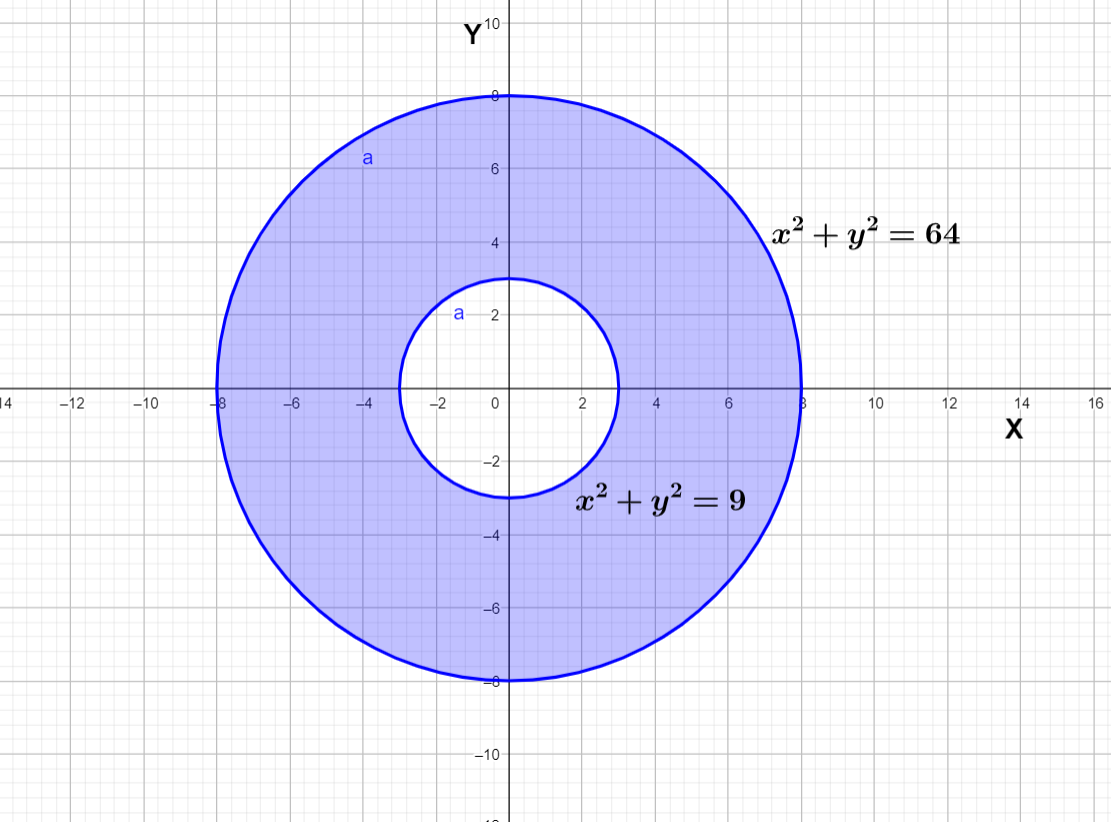
We can see that all quadrants have same area and all are symmetric so we can compute the integration for first quadrant and multiply it by 4
If we convert the region in parametric form then it would be $rdrd\theta $ where r is from 3 to 8 and $\theta $ is from 0 to $\dfrac{\pi }{2}$
We can write ${{x}^{2}}+{{y}^{2}}={{r}^{2}}$
So $\int{\sin \left( {{x}^{2}}+{{y}^{2}} \right)}dxdy$ in the region $9\le {{x}^{2}}+{{y}^{2}}\le 64$ = $4\times \int\limits_{\theta =0}^{\theta =\dfrac{\pi }{2}}{\int\limits_{r=3}^{r=8}{\sin {{r}^{2}}rdrd\theta }}$
First we will integrate with respect to r and then with respect to $\theta $
We can integrate $\sin {{r}^{2}}rdr$ by taking ${{r}^{2}}$ as t so the value of $rdr$ will be equal to $\dfrac{dt}{2}$
So we can write $\int{\sin {{r}^{2}}rdr=\int{\dfrac{1}{2}\sin t}dt}$
The value of $\int{\dfrac{1}{2}\sin tdt}$ is equal to $-\dfrac{1}{2}\cos t$ , replacing t with ${{r}^{2}}$ we get $-\dfrac{1}{2}\cos {{r}^{2}}$
So the value of $\int\limits_{r=3}^{r=8}{\sin {{r}^{2}}rdr}$ is equal to $-\dfrac{1}{2}\left[ \cos \left( {{8}^{2}} \right)-\cos \left( {{3}^{2}} \right) \right]$ = $\dfrac{1}{2}\left[ \cos \left( {{3}^{2}} \right)-\cos \left( {{8}^{2}} \right) \right]$
We can write $4\times \int\limits_{\theta =0}^{\theta =\dfrac{\pi }{2}}{\int\limits_{r=3}^{r=8}{\sin {{r}^{2}}drd\theta }}$ as $4\times \int\limits_{\theta =0}^{\theta =\dfrac{\pi }{2}}{\dfrac{1}{2}\left[ \cos \left( {{3}^{2}} \right)-\cos \left( {{8}^{2}} \right) \right]d\theta }$
$\Rightarrow 4\times \int\limits_{\theta =0}^{\theta =\dfrac{\pi }{2}}{\dfrac{1}{2}\left[ \cos \left( {{3}^{2}} \right)-\cos \left( {{8}^{2}} \right) \right]d\theta }=2\left[ \cos \left( {{3}^{2}} \right)-\cos \left( {{8}^{2}} \right) \right]\int\limits_{\theta =0}^{\theta =\dfrac{\pi }{2}}{d\theta }$
$\Rightarrow 4\times \int\limits_{\theta =0}^{\theta =\dfrac{\pi }{2}}{\dfrac{1}{2}\left[ \cos \left( {{3}^{2}} \right)-\cos \left( {{8}^{2}} \right) \right]d\theta }=2\times \dfrac{\pi }{2}\left[ \cos \left( {{3}^{2}} \right)-\cos \left( {{8}^{2}} \right) \right]=\pi \left[ \cos \left( {{3}^{2}} \right)-\cos \left( {{8}^{2}} \right) \right]$
$\pi \left[ \cos \left( {{3}^{2}} \right)-\cos \left( {{8}^{2}} \right) \right]$=$\pi \left[ \cos \left( 9 \right)-\cos \left( 64 \right) \right]$
So the value of integral $\sin \left( {{x}^{2}}+{{y}^{2}} \right)dr$ where r is the region $9\le {{x}^{2}}+{{y}^{2}}\le 64$ is equal to $\pi \left[ \cos \left( 9 \right)-\cos \left( 64 \right) \right]$
Note:
In this type of problem we need set the limit of r and $\theta $ very carefully, it is given that $9\le {{x}^{2}}+{{y}^{2}}\le 64$ and ${{x}^{2}}+{{y}^{2}}={{r}^{2}}$ so $9\le {{r}^{2}}\le 64$ so the limit of r is from 3 to 8. The limit of $\theta $ is from $\dfrac{\pi }{2}$ as we integrate in the first quadrant. Converting into polar form is very important process write x as $r\sin \theta $ and y as $r\sin \theta $, and write the term ${{x}^{2}}+{{y}^{2}}$ as ${{r}^{2}}$ .
Complete step by step answer:
We have to integrate $\sin \left( {{x}^{2}}+{{y}^{2}} \right)$ in the region $9\le {{x}^{2}}+{{y}^{2}}\le 64$
We can write $\int{\sin \left( {{x}^{2}}+{{y}^{2}} \right)}dxdy$ in the region $9\le {{x}^{2}}+{{y}^{2}}\le 64$
Drawing the region in graph
We can see that all quadrants have same area and all are symmetric so we can compute the integration for first quadrant and multiply it by 4
If we convert the region in parametric form then it would be $rdrd\theta $ where r is from 3 to 8 and $\theta $ is from 0 to $\dfrac{\pi }{2}$
We can write ${{x}^{2}}+{{y}^{2}}={{r}^{2}}$
So $\int{\sin \left( {{x}^{2}}+{{y}^{2}} \right)}dxdy$ in the region $9\le {{x}^{2}}+{{y}^{2}}\le 64$ = $4\times \int\limits_{\theta =0}^{\theta =\dfrac{\pi }{2}}{\int\limits_{r=3}^{r=8}{\sin {{r}^{2}}rdrd\theta }}$
First we will integrate with respect to r and then with respect to $\theta $
We can integrate $\sin {{r}^{2}}rdr$ by taking ${{r}^{2}}$ as t so the value of $rdr$ will be equal to $\dfrac{dt}{2}$
So we can write $\int{\sin {{r}^{2}}rdr=\int{\dfrac{1}{2}\sin t}dt}$
The value of $\int{\dfrac{1}{2}\sin tdt}$ is equal to $-\dfrac{1}{2}\cos t$ , replacing t with ${{r}^{2}}$ we get $-\dfrac{1}{2}\cos {{r}^{2}}$
So the value of $\int\limits_{r=3}^{r=8}{\sin {{r}^{2}}rdr}$ is equal to $-\dfrac{1}{2}\left[ \cos \left( {{8}^{2}} \right)-\cos \left( {{3}^{2}} \right) \right]$ = $\dfrac{1}{2}\left[ \cos \left( {{3}^{2}} \right)-\cos \left( {{8}^{2}} \right) \right]$
We can write $4\times \int\limits_{\theta =0}^{\theta =\dfrac{\pi }{2}}{\int\limits_{r=3}^{r=8}{\sin {{r}^{2}}drd\theta }}$ as $4\times \int\limits_{\theta =0}^{\theta =\dfrac{\pi }{2}}{\dfrac{1}{2}\left[ \cos \left( {{3}^{2}} \right)-\cos \left( {{8}^{2}} \right) \right]d\theta }$
$\Rightarrow 4\times \int\limits_{\theta =0}^{\theta =\dfrac{\pi }{2}}{\dfrac{1}{2}\left[ \cos \left( {{3}^{2}} \right)-\cos \left( {{8}^{2}} \right) \right]d\theta }=2\left[ \cos \left( {{3}^{2}} \right)-\cos \left( {{8}^{2}} \right) \right]\int\limits_{\theta =0}^{\theta =\dfrac{\pi }{2}}{d\theta }$
$\Rightarrow 4\times \int\limits_{\theta =0}^{\theta =\dfrac{\pi }{2}}{\dfrac{1}{2}\left[ \cos \left( {{3}^{2}} \right)-\cos \left( {{8}^{2}} \right) \right]d\theta }=2\times \dfrac{\pi }{2}\left[ \cos \left( {{3}^{2}} \right)-\cos \left( {{8}^{2}} \right) \right]=\pi \left[ \cos \left( {{3}^{2}} \right)-\cos \left( {{8}^{2}} \right) \right]$
$\pi \left[ \cos \left( {{3}^{2}} \right)-\cos \left( {{8}^{2}} \right) \right]$=$\pi \left[ \cos \left( 9 \right)-\cos \left( 64 \right) \right]$
So the value of integral $\sin \left( {{x}^{2}}+{{y}^{2}} \right)dr$ where r is the region $9\le {{x}^{2}}+{{y}^{2}}\le 64$ is equal to $\pi \left[ \cos \left( 9 \right)-\cos \left( 64 \right) \right]$
Note:
In this type of problem we need set the limit of r and $\theta $ very carefully, it is given that $9\le {{x}^{2}}+{{y}^{2}}\le 64$ and ${{x}^{2}}+{{y}^{2}}={{r}^{2}}$ so $9\le {{r}^{2}}\le 64$ so the limit of r is from 3 to 8. The limit of $\theta $ is from $\dfrac{\pi }{2}$ as we integrate in the first quadrant. Converting into polar form is very important process write x as $r\sin \theta $ and y as $r\sin \theta $, and write the term ${{x}^{2}}+{{y}^{2}}$ as ${{r}^{2}}$ .
Recently Updated Pages
Master Class 12 English: Engaging Questions & Answers for Success

Master Class 12 Social Science: Engaging Questions & Answers for Success
Master Class 12 Maths: Engaging Questions & Answers for Success
Master Class 12 Economics: Engaging Questions & Answers for Success
Master Class 12 Physics: Engaging Questions & Answers for Success
Master Class 12 Business Studies: Engaging Questions & Answers for Success
Trending doubts
Which are the Top 10 Largest Countries of the World?
What are the major means of transport Explain each class 12 social science CBSE
Draw a labelled sketch of the human eye class 12 physics CBSE
Differentiate between insitu conservation and exsitu class 12 biology CBSE
Draw a neat and well labeled diagram of TS of ovary class 12 biology CBSE
RNA and DNA are chiral molecules their chirality is class 12 chemistry CBSE