




Evaluate the definite integral:
$\int\limits_0^{\dfrac{\pi }{2}} {\cos xdx} $
Answer
 Verified
629.7k+ views
Hint: We know that $\int {\cos xdx} $$ = \sin x$ and while putting upper and lower limits, you will get your answer.
Complete step-by-step answer:
We know that integration represents the area under the curve, here we are given to find the integral of the curve $\cos x$ in the limit from $0$ to $\dfrac{\pi }{2}$.
So now let us see by the graph what we need to find.
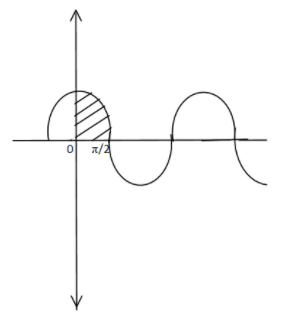
So this is the graph of $\cos x$ and we need to find the $\int\limits_0^{\dfrac{\pi }{2}} {\cos x dx} $ that means that we need to find the area which is shaded or the curve of the $\cos x$ from $0$ to $\dfrac{\pi }{2}$
Now we know that integration of \[\cos x\] gives $\sin x$ and we know the formula that
$\int\limits_a^b {\cos nx} = \left[ {\dfrac{{\sin x}}{n}} \right]_a^b$
$\int\limits_a^b {\cos nx} = \left[ {\dfrac{{\sin nb}}{n} - \dfrac{{\sin na}}{n}} \right]$
So in this question, we are given:
$\int\limits_0^{\dfrac{\pi }{2}} {\cos x dx} $
Now we know that
$\int {\cos nxdx} = \left[ {\dfrac{{\sin nx}}{n}} \right]$ and here $n = 1$
So we get $\int\limits_0^{\dfrac{\pi }{2}} {\cos x} = \left[ {\sin x} \right]_0^{\dfrac{\pi }{2}}$
Here$\dfrac{\pi }{2}$ is the upper limit and $0$ is the lower limit.
So upon putting we get
$\int\limits_0^{\dfrac{\pi }{2}} {\cos x} = \left[ {\sin \dfrac{\pi }{2} - \sin 0} \right]$
We know that $\sin 0 = 0,\sin 90 = 1$
We get that
$\int\limits_0^{\dfrac{\pi }{2}} {\cos x} = \left[ {\sin \dfrac{\pi }{2} - \sin 0} \right] = 1$
Note: We should know that if $\dfrac{{df(x)}}{{dx}} = g(x)$, then $\int {g(x)dx} $ gives $f(x)$ or vice-versa similarly.
$\int {\cos x} dx$ gives $\sin x$. So $\dfrac{{d\sin x}} {{dx}} = \cos x$
Complete step-by-step answer:
We know that integration represents the area under the curve, here we are given to find the integral of the curve $\cos x$ in the limit from $0$ to $\dfrac{\pi }{2}$.
So now let us see by the graph what we need to find.
So this is the graph of $\cos x$ and we need to find the $\int\limits_0^{\dfrac{\pi }{2}} {\cos x dx} $ that means that we need to find the area which is shaded or the curve of the $\cos x$ from $0$ to $\dfrac{\pi }{2}$
Now we know that integration of \[\cos x\] gives $\sin x$ and we know the formula that
$\int\limits_a^b {\cos nx} = \left[ {\dfrac{{\sin x}}{n}} \right]_a^b$
$\int\limits_a^b {\cos nx} = \left[ {\dfrac{{\sin nb}}{n} - \dfrac{{\sin na}}{n}} \right]$
So in this question, we are given:
$\int\limits_0^{\dfrac{\pi }{2}} {\cos x dx} $
Now we know that
$\int {\cos nxdx} = \left[ {\dfrac{{\sin nx}}{n}} \right]$ and here $n = 1$
So we get $\int\limits_0^{\dfrac{\pi }{2}} {\cos x} = \left[ {\sin x} \right]_0^{\dfrac{\pi }{2}}$
Here$\dfrac{\pi }{2}$ is the upper limit and $0$ is the lower limit.
So upon putting we get
$\int\limits_0^{\dfrac{\pi }{2}} {\cos x} = \left[ {\sin \dfrac{\pi }{2} - \sin 0} \right]$
We know that $\sin 0 = 0,\sin 90 = 1$
We get that
$\int\limits_0^{\dfrac{\pi }{2}} {\cos x} = \left[ {\sin \dfrac{\pi }{2} - \sin 0} \right] = 1$
Note: We should know that if $\dfrac{{df(x)}}{{dx}} = g(x)$, then $\int {g(x)dx} $ gives $f(x)$ or vice-versa similarly.
$\int {\cos x} dx$ gives $\sin x$. So $\dfrac{{d\sin x}} {{dx}} = \cos x$
Recently Updated Pages
Master Class 11 English: Engaging Questions & Answers for Success

Master Class 11 Social Science: Engaging Questions & Answers for Success
Master Class 11 Maths: Engaging Questions & Answers for Success
Master Class 11 Biology: Engaging Questions & Answers for Success
Master Class 11 Physics: Engaging Questions & Answers for Success
Master Class 11 Chemistry: Engaging Questions & Answers for Success
Trending doubts
One Metric ton is equal to kg A 10000 B 1000 C 100 class 11 physics CBSE
What is cell theory Who formulated it class 11 biology CBSE
Phyllotaxy is the arrangement of ALeaflets BLeaves class 11 biology CBSE
Difference Between Prokaryotic Cells and Eukaryotic Cells
The symbiotic association of fungi and algae is called class 11 biology CBSE
Cell theory was formulated by A Schleiden and Schwann class 11 biology CBSE