




Evaluate \[\tan \left( {{{\sec }^{ - 1}}\left( {\sqrt {1 + {x^2}} } \right)} \right)\].
(A) $ \dfrac{1}{x} $
(B) $ x $
(C) $ \dfrac{1}{{\sqrt {1 + {x^2}} }} $
(D) $ \dfrac{x}{{\sqrt {1 + {x^2}} }} $
Answer
 Verified
535.8k+ views
Hint: In the given problem, we are required to calculate the tangent of an angle whose secant is given to us. Such problems require basic knowledge of trigonometric ratios and formulae. Besides this, knowledge of concepts of inverse trigonometry is extremely essential to answer these questions correctly. We must know the principal value branches of all the inverse trigonometric functions.
Complete step-by-step answer:
So, In the given problem, we have to find the value of \[\tan \left( {{{\sec }^{ - 1}}\left( {\sqrt {1 + {x^2}} } \right)} \right)\].
Hence, we have to find the tangent of the angle whose secant is given to us as \[\tan \left( {{{\sec }^{ - 1}}\left( {\sqrt {1 + {x^2}} } \right)} \right)\].
Let us assume $ \theta $ to be the concerned angle.
Then, $ \theta = {\sec ^{ - 1}}\left( {\sqrt {1 + {x^2}} } \right) $
Taking secant on both sides of the equation, we get
$ \Rightarrow \sec \theta = \sqrt {1 + {x^2}} $
To evaluate the value of the required expression, we must keep in mind the formulae of basic trigonometric ratios.
We know that, $ \tan \theta = \dfrac{{Perpendicular}}{{Base}} $ and $ \sec \theta = \dfrac{{Hypotenuse}}{{Base}} $ .
So, $ \sec \theta = \dfrac{{Hypotenuse}}{{Base}} = \sqrt {1 + {x^2}} $
Let the length of the base be $ 1 $ .
Then, length of hypotenuse $ = \sqrt {1 + {x^2}} $ .
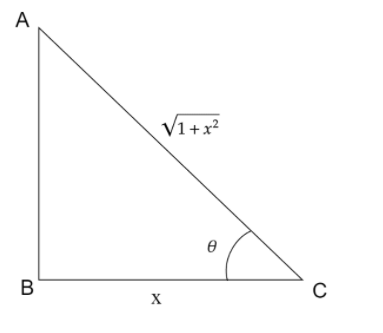
Now, applying Pythagoras Theorem,
$ {\left( {Hypotenuse} \right)^2} = {\left( {Base} \right)^2} + {\left( {Perpendicular} \right)^2} $
$ \Rightarrow {\left( {\sqrt {1 + {x^2}} } \right)^2} = {\left( 1 \right)^2} + {\left( {Perpendicular} \right)^2} $
$ \Rightarrow 1 + {x^2} = 1 + {\left( {Perpendicular} \right)^2} $
Subtracting one from both the sides of the equation. So, we get,
$ \Rightarrow {x^2} = {\left( {Perpendicular} \right)^2} $
$ \Rightarrow \left( {Perpendicular} \right) = x $
So, we get, $ \left( {Perpendicular} \right) = x $
Hence, $ \tan \theta = \dfrac{{Perpendicular}}{{Base}} = \dfrac{x}{{\sqrt {1 + {x^2}} }} $
So, the value of\[\tan \left( {{{\sec }^{ - 1}}\left( {\sqrt {1 + {x^2}} } \right)} \right)\] is $ \dfrac{x}{{\sqrt {1 + {x^2}} }} $ .
So, the correct answer is option (D).
So, the correct answer is “Option D”.
Note: The given problem can also be solved by use of some basic trigonometric identities such as $ {\sec ^2}\left( \theta \right) = {\tan ^2}\left( \theta \right) + 1 $ .
We have, $ \sec \theta = \sqrt {1 + {x^2}} $
So, $ {\sec ^2}\theta = 1 + {x^2} $
Using $ {\sec ^2}\left( \theta \right) = {\tan ^2}\left( \theta \right) + 1 $ , we get,
$ \Rightarrow {\tan ^2}\theta + 1 = 1 + {x^2} $
Finding value of tangent function,
$ \Rightarrow {\tan ^2}\theta = {x^2} $
Taking square root on both sides,
$ \Rightarrow \tan \theta = x $
This method also provides exposure to the applications of trigonometric identities in various mathematical questions. We should remember all the trigonometric formulae and identities in order to solve such questions. One should know about the principal branches of all the inverse trigonometric functions. Care should be taken while doing the calculations so as to be sure of the final answer.
Complete step-by-step answer:
So, In the given problem, we have to find the value of \[\tan \left( {{{\sec }^{ - 1}}\left( {\sqrt {1 + {x^2}} } \right)} \right)\].
Hence, we have to find the tangent of the angle whose secant is given to us as \[\tan \left( {{{\sec }^{ - 1}}\left( {\sqrt {1 + {x^2}} } \right)} \right)\].
Let us assume $ \theta $ to be the concerned angle.
Then, $ \theta = {\sec ^{ - 1}}\left( {\sqrt {1 + {x^2}} } \right) $
Taking secant on both sides of the equation, we get
$ \Rightarrow \sec \theta = \sqrt {1 + {x^2}} $
To evaluate the value of the required expression, we must keep in mind the formulae of basic trigonometric ratios.
We know that, $ \tan \theta = \dfrac{{Perpendicular}}{{Base}} $ and $ \sec \theta = \dfrac{{Hypotenuse}}{{Base}} $ .
So, $ \sec \theta = \dfrac{{Hypotenuse}}{{Base}} = \sqrt {1 + {x^2}} $
Let the length of the base be $ 1 $ .
Then, length of hypotenuse $ = \sqrt {1 + {x^2}} $ .
Now, applying Pythagoras Theorem,
$ {\left( {Hypotenuse} \right)^2} = {\left( {Base} \right)^2} + {\left( {Perpendicular} \right)^2} $
$ \Rightarrow {\left( {\sqrt {1 + {x^2}} } \right)^2} = {\left( 1 \right)^2} + {\left( {Perpendicular} \right)^2} $
$ \Rightarrow 1 + {x^2} = 1 + {\left( {Perpendicular} \right)^2} $
Subtracting one from both the sides of the equation. So, we get,
$ \Rightarrow {x^2} = {\left( {Perpendicular} \right)^2} $
$ \Rightarrow \left( {Perpendicular} \right) = x $
So, we get, $ \left( {Perpendicular} \right) = x $
Hence, $ \tan \theta = \dfrac{{Perpendicular}}{{Base}} = \dfrac{x}{{\sqrt {1 + {x^2}} }} $
So, the value of\[\tan \left( {{{\sec }^{ - 1}}\left( {\sqrt {1 + {x^2}} } \right)} \right)\] is $ \dfrac{x}{{\sqrt {1 + {x^2}} }} $ .
So, the correct answer is option (D).
So, the correct answer is “Option D”.
Note: The given problem can also be solved by use of some basic trigonometric identities such as $ {\sec ^2}\left( \theta \right) = {\tan ^2}\left( \theta \right) + 1 $ .
We have, $ \sec \theta = \sqrt {1 + {x^2}} $
So, $ {\sec ^2}\theta = 1 + {x^2} $
Using $ {\sec ^2}\left( \theta \right) = {\tan ^2}\left( \theta \right) + 1 $ , we get,
$ \Rightarrow {\tan ^2}\theta + 1 = 1 + {x^2} $
Finding value of tangent function,
$ \Rightarrow {\tan ^2}\theta = {x^2} $
Taking square root on both sides,
$ \Rightarrow \tan \theta = x $
This method also provides exposure to the applications of trigonometric identities in various mathematical questions. We should remember all the trigonometric formulae and identities in order to solve such questions. One should know about the principal branches of all the inverse trigonometric functions. Care should be taken while doing the calculations so as to be sure of the final answer.
Recently Updated Pages
Master Class 12 Economics: Engaging Questions & Answers for Success

Master Class 12 English: Engaging Questions & Answers for Success
Master Class 12 Social Science: Engaging Questions & Answers for Success
Master Class 12 Maths: Engaging Questions & Answers for Success
Master Class 12 Physics: Engaging Questions & Answers for Success
Master Class 11 Social Science: Engaging Questions & Answers for Success
Trending doubts
Find the value of the expression given below sin 30circ class 11 maths CBSE
Draw a diagram of a plant cell and label at least eight class 11 biology CBSE
Name the Largest and the Smallest Cell in the Human Body ?
Draw a diagram showing the external features of fish class 11 biology CBSE
What organs are located on the left side of your body class 11 biology CBSE
Difference between physical and chemical change class 11 chemistry CBSE