




How do you evaluate \[\tan \left( {\dfrac{{ - 7\pi }}{4}} \right)?\]
Answer
 Verified
558.9k+ views
Hint:We need to know the trigonometric table values and basic definitions \[\tan \theta \] . We need to know the value of \[\cos \left( {\dfrac{{ - 7\pi }}{4}} \right)\] and \[\sin \left( {\dfrac{{ - 7\pi }}{4}} \right)\] .
This question involves the operation of addition/ subtraction/ multiplication/ division. Also, we need to know the degree value of \[\pi \] terms. By having the value of \[\sin \theta \] and \[\cos \theta \] we can easily find out the value of \[\tan \theta \] .
Complete step by step solution:
The given question is shown below
\[\tan \left( {\dfrac{{ - 7\pi }}{4}} \right) = ?\] \[ \to \left( 1 \right)\]
To solve the above equation we need to know the basic definition \[\tan \theta \] .
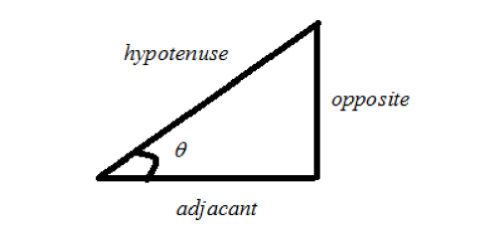
The above figure is used to define the \[\tan \theta \] according to the position of \[\theta
\] .
So, we get
\[\tan \theta =
\dfrac{{opposite}}{{adjacant}} \to \left( 2
\right)\]
Also, we get the definition for \[\sin \theta
\] and \[\cos \theta \] from the figure mentioned above.
We get,
\[\sin \theta = \dfrac{{opposite}}{{hypotenuse}}\] \[ \to \left( 3 \right)\]
And,
\[\cos \theta = \dfrac{{adjacant}}{{hypotenuse}}\] \[ \to \left( 4 \right)\]
Let’s divide the equation \[\left( 3 \right)\] by the equation \[\left( 4 \right)\] we get,
\[\dfrac{{\sin \theta }}{{\cos \theta }} = \dfrac{{\left( {\dfrac{{opposite}}{{hypotenuse}}}
\right)}}{{\left( {\dfrac{{adjacant}}{{hypotenuse}}} \right)}}\]
The above equation can also be written as,
\[\dfrac{{\sin \theta }}{{\cos \theta }} = \dfrac{{opposite}}{{hypotenuse}} \times
\dfrac{{hypotenuse}}{{adjacant}}\]
\[\dfrac{{\sin \theta }}{{\cos \theta }} = \dfrac{{opposite}}{{adjacant}} \to \left( 5 \right)\]
By comparing the equation \[\left( 5 \right)\] and \[\left( 2 \right)\] , we get
\[
\left( 2 \right) \to \tan \theta = \dfrac{{opposite}}{{adjacant}} \\
\left( 5 \right) \to \dfrac{{\sin \theta }}{{\cos \theta }} = \dfrac{{opposite}}{{adjacant}} \\
\]
So,
\[\tan \theta = \dfrac{{\sin \theta }}{{\cos \theta }} \to \left( 6 \right)\]
We know that the value \[\theta \] is \[\left( {\dfrac{{ - 7\pi }}{4}} \right)\] (Given in the question).
From the trigonometric table value,
\[
\sin \left( {\dfrac{\pi }{4}} \right) = \dfrac{1}{{\sqrt 2 }} \\
\cos \left( {\dfrac{\pi }{4}} \right) = \dfrac{1}{{\sqrt 2 }} \\
\]
So, \[\sin \left( {\dfrac{\pi }{4}} \right) = \cos \left( {\dfrac{\pi }{4}} \right)\]
From the above equations, we get,
\[\sin \left( {\dfrac{{ - 7\pi }}{4}} \right) = \cos \left( {\dfrac{{ - 7\pi }}{4}} \right)\] \[ \to \left( 7
\right)\]
Let’s substitute the above equation in the equation \[\left( 6 \right)\] , we get
\[\tan \theta = \dfrac{{\sin \theta }}{{\cos \theta }}\]
\[\tan \left( {\dfrac{{ - 7\pi }}{4}} \right) = \dfrac{{\left( {\sin \dfrac{{ - 7\pi }}{4}} \right)}}{{\left(
{\cos \dfrac{{ - 7\pi }}{4}} \right)}}\]
\[\tan \left( {\dfrac{{ - 7\pi }}{4}} \right) = 1\]
So, the final answer is,
The value of \[\tan \left( {\dfrac{{ - 7\pi }}{4}} \right)\] is \[1\] .
Note: In these types of questions we would remember the trigonometric table values and basic definitions of \[\sin \theta ,\cos \theta \] and \[\tan \theta \] .Note that when \[\dfrac{\pi }{4}\] is involved in \[\theta \] value, the value of \[\tan \theta \] is always \[1\] . When we have the fraction term in the denominator, the fraction term of the denominator will come to the position of the numerator. If we have a fraction term in the numerator, the denominator of the fraction term will come to the position of the denominator as follows,
\[\dfrac{{\left( {\dfrac{x}{y}} \right)}}{{\left( {\dfrac{z}{l}} \right)}} = \left( {\dfrac{x}{y} \times
\dfrac{l}{z}} \right)\]
This question involves the operation of addition/ subtraction/ multiplication/ division. Also, we need to know the degree value of \[\pi \] terms. By having the value of \[\sin \theta \] and \[\cos \theta \] we can easily find out the value of \[\tan \theta \] .
Complete step by step solution:
The given question is shown below
\[\tan \left( {\dfrac{{ - 7\pi }}{4}} \right) = ?\] \[ \to \left( 1 \right)\]
To solve the above equation we need to know the basic definition \[\tan \theta \] .
The above figure is used to define the \[\tan \theta \] according to the position of \[\theta
\] .
So, we get
\[\tan \theta =
\dfrac{{opposite}}{{adjacant}} \to \left( 2
\right)\]
Also, we get the definition for \[\sin \theta
\] and \[\cos \theta \] from the figure mentioned above.
We get,
\[\sin \theta = \dfrac{{opposite}}{{hypotenuse}}\] \[ \to \left( 3 \right)\]
And,
\[\cos \theta = \dfrac{{adjacant}}{{hypotenuse}}\] \[ \to \left( 4 \right)\]
Let’s divide the equation \[\left( 3 \right)\] by the equation \[\left( 4 \right)\] we get,
\[\dfrac{{\sin \theta }}{{\cos \theta }} = \dfrac{{\left( {\dfrac{{opposite}}{{hypotenuse}}}
\right)}}{{\left( {\dfrac{{adjacant}}{{hypotenuse}}} \right)}}\]
The above equation can also be written as,
\[\dfrac{{\sin \theta }}{{\cos \theta }} = \dfrac{{opposite}}{{hypotenuse}} \times
\dfrac{{hypotenuse}}{{adjacant}}\]
\[\dfrac{{\sin \theta }}{{\cos \theta }} = \dfrac{{opposite}}{{adjacant}} \to \left( 5 \right)\]
By comparing the equation \[\left( 5 \right)\] and \[\left( 2 \right)\] , we get
\[
\left( 2 \right) \to \tan \theta = \dfrac{{opposite}}{{adjacant}} \\
\left( 5 \right) \to \dfrac{{\sin \theta }}{{\cos \theta }} = \dfrac{{opposite}}{{adjacant}} \\
\]
So,
\[\tan \theta = \dfrac{{\sin \theta }}{{\cos \theta }} \to \left( 6 \right)\]
We know that the value \[\theta \] is \[\left( {\dfrac{{ - 7\pi }}{4}} \right)\] (Given in the question).
From the trigonometric table value,
\[
\sin \left( {\dfrac{\pi }{4}} \right) = \dfrac{1}{{\sqrt 2 }} \\
\cos \left( {\dfrac{\pi }{4}} \right) = \dfrac{1}{{\sqrt 2 }} \\
\]
So, \[\sin \left( {\dfrac{\pi }{4}} \right) = \cos \left( {\dfrac{\pi }{4}} \right)\]
From the above equations, we get,
\[\sin \left( {\dfrac{{ - 7\pi }}{4}} \right) = \cos \left( {\dfrac{{ - 7\pi }}{4}} \right)\] \[ \to \left( 7
\right)\]
Let’s substitute the above equation in the equation \[\left( 6 \right)\] , we get
\[\tan \theta = \dfrac{{\sin \theta }}{{\cos \theta }}\]
\[\tan \left( {\dfrac{{ - 7\pi }}{4}} \right) = \dfrac{{\left( {\sin \dfrac{{ - 7\pi }}{4}} \right)}}{{\left(
{\cos \dfrac{{ - 7\pi }}{4}} \right)}}\]
\[\tan \left( {\dfrac{{ - 7\pi }}{4}} \right) = 1\]
So, the final answer is,
The value of \[\tan \left( {\dfrac{{ - 7\pi }}{4}} \right)\] is \[1\] .
Note: In these types of questions we would remember the trigonometric table values and basic definitions of \[\sin \theta ,\cos \theta \] and \[\tan \theta \] .Note that when \[\dfrac{\pi }{4}\] is involved in \[\theta \] value, the value of \[\tan \theta \] is always \[1\] . When we have the fraction term in the denominator, the fraction term of the denominator will come to the position of the numerator. If we have a fraction term in the numerator, the denominator of the fraction term will come to the position of the denominator as follows,
\[\dfrac{{\left( {\dfrac{x}{y}} \right)}}{{\left( {\dfrac{z}{l}} \right)}} = \left( {\dfrac{x}{y} \times
\dfrac{l}{z}} \right)\]
Recently Updated Pages
Master Class 11 Business Studies: Engaging Questions & Answers for Success

Master Class 11 Computer Science: Engaging Questions & Answers for Success
Master Class 11 Economics: Engaging Questions & Answers for Success
Master Class 11 Social Science: Engaging Questions & Answers for Success
Master Class 11 Chemistry: Engaging Questions & Answers for Success
Master Class 11 English: Engaging Questions & Answers for Success
Trending doubts
One Metric ton is equal to kg A 10000 B 1000 C 100 class 11 physics CBSE
Discuss the various forms of bacteria class 11 biology CBSE
Draw a diagram of a plant cell and label at least eight class 11 biology CBSE
State the laws of reflection of light
Explain zero factorial class 11 maths CBSE
10 examples of friction in our daily life