




How do you evaluate $\sin \left( {\dfrac{\pi }{2}} \right)$?
Answer
 Verified
504k+ views
Hint: Before evaluating the values of trigonometric functions we must be familiar with the concept of unit circle. The unit circle is a circle of unit radius that is its radius is $1$ . It is centered at the origin of the Cartesian coordinate system and we use the unit circle to identify the values of the standard trigonometric functions as the angle $\theta $ varies between ${0^0}{\text{ to 36}}{{\text{0}}^0}{\text{ }}\left( {0{\text{ to 2}}\pi {\text{ radians}}} \right)$ .
Complete step by step solution:
The unit circle in the Cartesian plane is shown below:
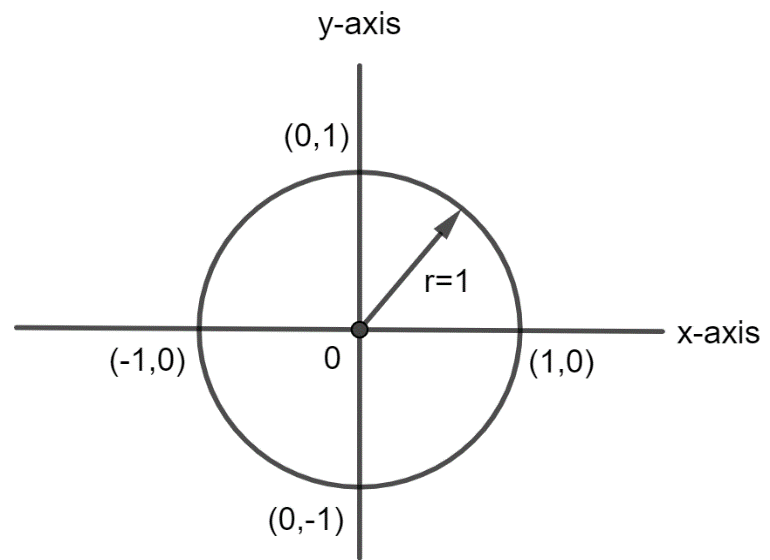
Figure $\left( 1 \right)$ : The unit circle
We know that for any right -angled triangle, sine function is defined as the ratio of length of perpendicular side to the length of the hypotenuse side i.e. $\sin \theta = \dfrac{{{\text{Opposite}}}}{{{\text{Hypotenuse}}}}$ .
Let us draw a right angle triangle within the unit circle which is shown below in figure $\left( 2 \right)$ ;
In the right angle triangle OBA ; the value of sine function can be defined as ;
$ \Rightarrow \sin \theta = \dfrac{{{\text{AB}}}}{{{\text{OB}}}} = {\text{AB }}\left( {\because {\text{OB = r = 1}}} \right)$
$\therefore \sin \theta = {\text{AB }}......\left( 1 \right)$
Similarly, we can calculate the value of cosine function, we know that for right-angled triangle the cosine function is defined as the ratio of length of adjacent side to the length of the hypotenuse side i.e. $\cos \theta = \dfrac{{{\text{Adjacent}}}}{{{\text{Hypotenuse}}}}$ . In the right angle triangle OBA ; the value of cosine function can be defined as;
$ \Rightarrow \cos \theta = \dfrac{{{\text{OA}}}}{{{\text{OB}}}} = {\text{OA }}\left( {\because {\text{OB = r = 1}}} \right)$
$\therefore \cos \theta = {\text{OA }}......\left( 2 \right)$
From the above equations, it can be concluded that the vertical axis i.e. y-axis in the Cartesian plane can be represented as $\sin \theta $ and the horizontal axis i.e. the x-axis can be represented as $\cos \theta $ . Therefore the coordinates $\left( {x,y} \right)$ become $\left( {\cos \theta ,\sin \theta } \right)$ .
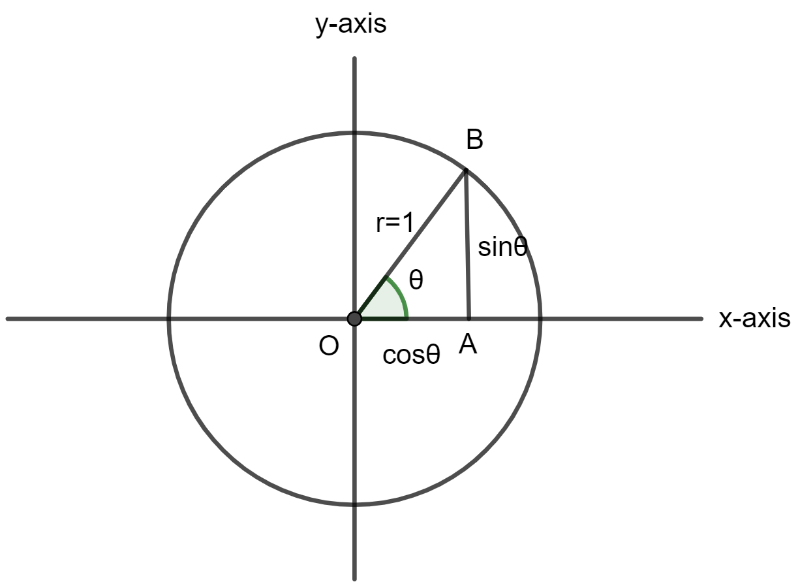
Figure $\left( 2 \right)$ : The right-angled triangle inside the unit circle
According to the question, we have to calculate the value of $\sin \left( {\dfrac{\pi }{2}} \right)$ ;
From figure $\left( 3 \right)$ , as we increase the value of angle $\theta $ the magnitude of opposite (perpendicular) side will increase and the magnitude of adjacent side (base) will decrease. When the value of $\theta $ becomes $\dfrac{\pi }{2}{\text{ i}}{\text{.e}}{\text{. 9}}{{\text{0}}^0}$ , the adjacent side will get vanished and the opposite side of the right-angled triangle will coincide with the hypotenuse side. This means that ;
$ \Rightarrow {\text{Opposite side = Hypotenuse side}}$
From the definition of sine function, we know that;
$ \Rightarrow \sin \left( {\dfrac{\pi }{2}} \right) = \dfrac{{{\text{Opposite}}}}{{{\text{Hypotenuse}}}} = 1$ ( as both becomes equal at $\theta = \dfrac{\pi }{2}$ )
Hence, $\sin \theta = \sin \left( {\dfrac{\pi }{2}} \right) = 1$ .
Therefore, the value of $\sin \left( {\dfrac{\pi }{2}} \right)$ is $1$ .
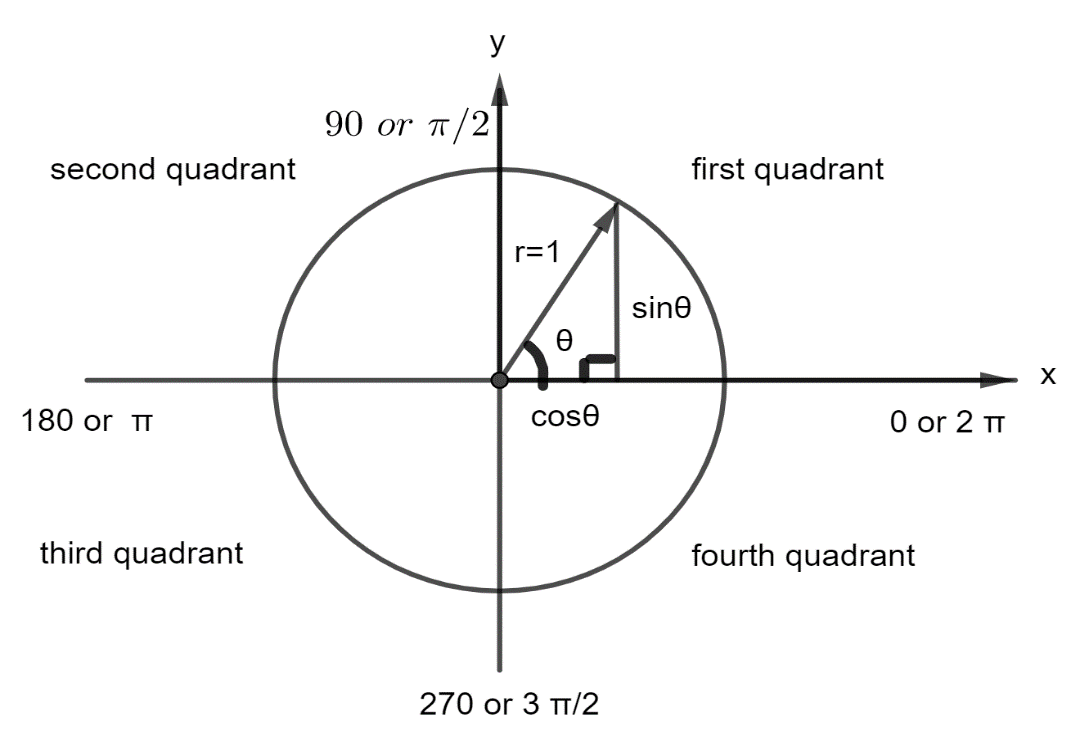
Figure $\left( 3 \right)$ : The quadrant system
Note:
Using the quadrant system shown in figure $\left( 3 \right)$ , we can calculate any value for the functions. Notice that other trigonometric function’s values can be easily derived from sine and cosine function values. Some of the important results for sine and cosine values are: $\left( 1 \right)\sin {0^0},\sin \pi ,\sin 2\pi ,\sin 3\pi ,.... = 0$ . $\left( 2 \right)\sin \dfrac{\pi }{2},\sin \dfrac{{5\pi }}{2},\sin \dfrac{{9\pi }}{2},....... = 1$ .$\left( 3 \right)\sin \dfrac{{3\pi }}{2},\sin \dfrac{{7\pi }}{2},\sin \dfrac{{11\pi }}{2},...... = - 1$ . $\left( 4 \right)\cos \dfrac{\pi }{2},\cos \dfrac{{3\pi }}{2},\cos \dfrac{{5\pi }}{2},\cos \dfrac{{7\pi }}{2},........ = 0$ .$\left( 5 \right)\cos {0^0},\cos 2\pi ,\cos 4\pi ,...... = 1$ . $\left( 6 \right)\cos \pi ,\cos 3\pi ,\cos 5\pi ,....... = - 1$.
Complete step by step solution:
The unit circle in the Cartesian plane is shown below:
Figure $\left( 1 \right)$ : The unit circle
We know that for any right -angled triangle, sine function is defined as the ratio of length of perpendicular side to the length of the hypotenuse side i.e. $\sin \theta = \dfrac{{{\text{Opposite}}}}{{{\text{Hypotenuse}}}}$ .
Let us draw a right angle triangle within the unit circle which is shown below in figure $\left( 2 \right)$ ;
In the right angle triangle OBA ; the value of sine function can be defined as ;
$ \Rightarrow \sin \theta = \dfrac{{{\text{AB}}}}{{{\text{OB}}}} = {\text{AB }}\left( {\because {\text{OB = r = 1}}} \right)$
$\therefore \sin \theta = {\text{AB }}......\left( 1 \right)$
Similarly, we can calculate the value of cosine function, we know that for right-angled triangle the cosine function is defined as the ratio of length of adjacent side to the length of the hypotenuse side i.e. $\cos \theta = \dfrac{{{\text{Adjacent}}}}{{{\text{Hypotenuse}}}}$ . In the right angle triangle OBA ; the value of cosine function can be defined as;
$ \Rightarrow \cos \theta = \dfrac{{{\text{OA}}}}{{{\text{OB}}}} = {\text{OA }}\left( {\because {\text{OB = r = 1}}} \right)$
$\therefore \cos \theta = {\text{OA }}......\left( 2 \right)$
From the above equations, it can be concluded that the vertical axis i.e. y-axis in the Cartesian plane can be represented as $\sin \theta $ and the horizontal axis i.e. the x-axis can be represented as $\cos \theta $ . Therefore the coordinates $\left( {x,y} \right)$ become $\left( {\cos \theta ,\sin \theta } \right)$ .
Figure $\left( 2 \right)$ : The right-angled triangle inside the unit circle
According to the question, we have to calculate the value of $\sin \left( {\dfrac{\pi }{2}} \right)$ ;
From figure $\left( 3 \right)$ , as we increase the value of angle $\theta $ the magnitude of opposite (perpendicular) side will increase and the magnitude of adjacent side (base) will decrease. When the value of $\theta $ becomes $\dfrac{\pi }{2}{\text{ i}}{\text{.e}}{\text{. 9}}{{\text{0}}^0}$ , the adjacent side will get vanished and the opposite side of the right-angled triangle will coincide with the hypotenuse side. This means that ;
$ \Rightarrow {\text{Opposite side = Hypotenuse side}}$
From the definition of sine function, we know that;
$ \Rightarrow \sin \left( {\dfrac{\pi }{2}} \right) = \dfrac{{{\text{Opposite}}}}{{{\text{Hypotenuse}}}} = 1$ ( as both becomes equal at $\theta = \dfrac{\pi }{2}$ )
Hence, $\sin \theta = \sin \left( {\dfrac{\pi }{2}} \right) = 1$ .
Therefore, the value of $\sin \left( {\dfrac{\pi }{2}} \right)$ is $1$ .
Figure $\left( 3 \right)$ : The quadrant system
Note:
Using the quadrant system shown in figure $\left( 3 \right)$ , we can calculate any value for the functions. Notice that other trigonometric function’s values can be easily derived from sine and cosine function values. Some of the important results for sine and cosine values are: $\left( 1 \right)\sin {0^0},\sin \pi ,\sin 2\pi ,\sin 3\pi ,.... = 0$ . $\left( 2 \right)\sin \dfrac{\pi }{2},\sin \dfrac{{5\pi }}{2},\sin \dfrac{{9\pi }}{2},....... = 1$ .$\left( 3 \right)\sin \dfrac{{3\pi }}{2},\sin \dfrac{{7\pi }}{2},\sin \dfrac{{11\pi }}{2},...... = - 1$ . $\left( 4 \right)\cos \dfrac{\pi }{2},\cos \dfrac{{3\pi }}{2},\cos \dfrac{{5\pi }}{2},\cos \dfrac{{7\pi }}{2},........ = 0$ .$\left( 5 \right)\cos {0^0},\cos 2\pi ,\cos 4\pi ,...... = 1$ . $\left( 6 \right)\cos \pi ,\cos 3\pi ,\cos 5\pi ,....... = - 1$.
Recently Updated Pages
Master Class 10 Computer Science: Engaging Questions & Answers for Success

Master Class 10 General Knowledge: Engaging Questions & Answers for Success
Master Class 10 English: Engaging Questions & Answers for Success
Master Class 10 Social Science: Engaging Questions & Answers for Success
Master Class 10 Maths: Engaging Questions & Answers for Success
Master Class 10 Science: Engaging Questions & Answers for Success
Trending doubts
What is the median of the first 10 natural numbers class 10 maths CBSE
Which women's tennis player has 24 Grand Slam singles titles?
Who is the Brand Ambassador of Incredible India?
Why is there a time difference of about 5 hours between class 10 social science CBSE
Write a letter to the principal requesting him to grant class 10 english CBSE
A moving boat is observed from the top of a 150 m high class 10 maths CBSE