




How do you evaluate $\sin \left( {\dfrac{{\left( {3\pi} \right)}}{2}} \right)$ ?
Answer
 Verified
536.7k+ views
Hint: First, we need to analyze the given information so that we can able to solve the problem.Generally, in Mathematics, the trigonometric Identities are useful whenever trigonometric functions are involved in an expression or an equation and these identities are useful whenever expressions involving trigonometric functions need to be simplified.Here we are asked to calculate $\sin \left( {\dfrac{{\left( {3\pi} \right)}}{2}} \right)$
We need to apply the appropriate trigonometric identities to obtain the required answer.
Formula to be used:
The trigonometric identity that is used to solve the given problem is as follows.
$\sin \left( {270 + \theta } \right) = - \cos \theta $
Complete step by step answer:
Here we are asked to calculate $\sin \left( {\dfrac{{\left( {3\pi} \right)}}{2}} \right)$
Now we are asked to calculate $\sin \left( {\dfrac{{\left( {3\pi} \right)}}{2}} \right)$
We all know that the value of $\pi $ is ${180^\circ }$
Thus, we have
$\sin \left( {\dfrac{{\left( {3\pi} \right)}}{2}} \right) = \sin \left( {\dfrac{{\left( {3 \times {{180}^\circ }} \right)}}{2}} \right)$
$ \Rightarrow \sin \left( {\dfrac{{\left( {3\pi} \right)}}{2}} \right) = \sin \left( {3 \times {{90}^\circ }} \right)$
$ \Rightarrow \sin \left( {\dfrac{{\left( {3\pi} \right)}}{2}} \right) = \sin \left( {{{270}^\circ }} \right)$
$ \Rightarrow \sin \left( {\dfrac{{\left( {3\pi} \right)}}{2}} \right) = \sin \left( {{{270}^\circ } + 0} \right)$
The trigonometric identity that is used to solve the given problem is as follows.
$\sin \left( {270 + \theta } \right) = - \cos \theta $
$ \Rightarrow \sin \left( {\dfrac{{\left( {3\pi} \right)}}{2}} \right) = \sin \left({{ {270}^\circ } + 0} \right)$
$ \Rightarrow \sin \left( {\dfrac{{\left( {3\pi} \right)}}{2}} \right) = - \cos 0$
$ \Rightarrow \sin \left( {\dfrac{{\left( {3\pi} \right)}}{2}} \right) = - 1$
Hence, $\sin \left( {\dfrac{{\left( {3\pi} \right)}}{2}} \right) = - 1$
Note:
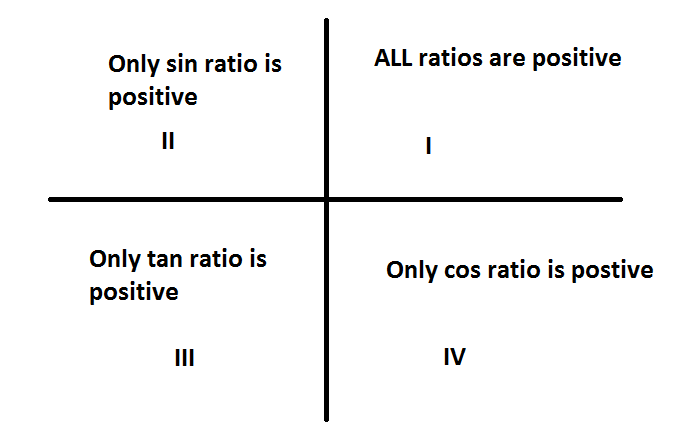
Here in the first quadrant, all ratios are positive. In the second quadrant, only sine is positive, and in the third quadrant, only the tangent ratio is positive. And in the fourth quadrant, only the cosine ratio is positive.
When we are given $\sin \left( {270 + \theta } \right)$ , we need to understand $\sin 270$ is in between the third and fourth quadrant and $\sin \left( {270 + \theta } \right)$ is in the fourth quadrant. In the fourth quadrant, only the cos ratio is positive and sin is negative. That’s why we got minus sign in this trigonometric identity $\sin \left( {270 + \theta } \right) = - \cos \theta $
We need to apply the appropriate trigonometric identities to obtain the required answer.
Formula to be used:
The trigonometric identity that is used to solve the given problem is as follows.
$\sin \left( {270 + \theta } \right) = - \cos \theta $
Complete step by step answer:
Here we are asked to calculate $\sin \left( {\dfrac{{\left( {3\pi} \right)}}{2}} \right)$
Now we are asked to calculate $\sin \left( {\dfrac{{\left( {3\pi} \right)}}{2}} \right)$
We all know that the value of $\pi $ is ${180^\circ }$
Thus, we have
$\sin \left( {\dfrac{{\left( {3\pi} \right)}}{2}} \right) = \sin \left( {\dfrac{{\left( {3 \times {{180}^\circ }} \right)}}{2}} \right)$
$ \Rightarrow \sin \left( {\dfrac{{\left( {3\pi} \right)}}{2}} \right) = \sin \left( {3 \times {{90}^\circ }} \right)$
$ \Rightarrow \sin \left( {\dfrac{{\left( {3\pi} \right)}}{2}} \right) = \sin \left( {{{270}^\circ }} \right)$
$ \Rightarrow \sin \left( {\dfrac{{\left( {3\pi} \right)}}{2}} \right) = \sin \left( {{{270}^\circ } + 0} \right)$
The trigonometric identity that is used to solve the given problem is as follows.
$\sin \left( {270 + \theta } \right) = - \cos \theta $
$ \Rightarrow \sin \left( {\dfrac{{\left( {3\pi} \right)}}{2}} \right) = \sin \left({{ {270}^\circ } + 0} \right)$
$ \Rightarrow \sin \left( {\dfrac{{\left( {3\pi} \right)}}{2}} \right) = - \cos 0$
$ \Rightarrow \sin \left( {\dfrac{{\left( {3\pi} \right)}}{2}} \right) = - 1$
Hence, $\sin \left( {\dfrac{{\left( {3\pi} \right)}}{2}} \right) = - 1$
Note:
Here in the first quadrant, all ratios are positive. In the second quadrant, only sine is positive, and in the third quadrant, only the tangent ratio is positive. And in the fourth quadrant, only the cosine ratio is positive.
When we are given $\sin \left( {270 + \theta } \right)$ , we need to understand $\sin 270$ is in between the third and fourth quadrant and $\sin \left( {270 + \theta } \right)$ is in the fourth quadrant. In the fourth quadrant, only the cos ratio is positive and sin is negative. That’s why we got minus sign in this trigonometric identity $\sin \left( {270 + \theta } \right) = - \cos \theta $
Recently Updated Pages
Master Class 12 Economics: Engaging Questions & Answers for Success

Master Class 12 English: Engaging Questions & Answers for Success
Master Class 12 Social Science: Engaging Questions & Answers for Success
Master Class 12 Maths: Engaging Questions & Answers for Success
Master Class 12 Physics: Engaging Questions & Answers for Success
Master Class 11 Social Science: Engaging Questions & Answers for Success
Trending doubts
One Metric ton is equal to kg A 10000 B 1000 C 100 class 11 physics CBSE
Difference Between Prokaryotic Cells and Eukaryotic Cells
Two of the body parts which do not appear in MRI are class 11 biology CBSE
1 ton equals to A 100 kg B 1000 kg C 10 kg D 10000 class 11 physics CBSE
Draw a diagram of nephron and explain its structur class 11 biology CBSE
10 examples of friction in our daily life