




How do you evaluate \[\sec \left( {{{\cos }^{ - 1}}\left( {\dfrac{1}{2}} \right)} \right)\] without a calculator?
Answer
 Verified
551.7k+ views
Hint: We are asked to find the value of \[\sec \left( {{{\cos }^{ - 1}}\left( {\dfrac{1}{2}} \right)} \right)\]. There are two trigonometric functions. First find the value of cosine and then use this value to find the value of secant. Recall the relation between cosine and secant function and apply this relation.
Complete step by step solution:
We are asked to evaluate \[\sec \left( {{{\cos }^{ - 1}}\left( {\dfrac{1}{2}} \right)} \right)\] without using calculator.
We have, \[\sec \left( {{{\cos }^{ - 1}}\left( {\dfrac{1}{2}} \right)} \right)\].
Let us take, \[{\cos ^{ - 1}}\left( {\dfrac{1}{2}} \right) = \theta \] ……………....(i)
\[ \Rightarrow \left( {\dfrac{1}{2}} \right) = \cos \theta \]
\[ \Rightarrow \cos \theta = \dfrac{1}{2}\]
We know that secant is inverse of cosine, that is we can write
\[\sec \theta = \dfrac{1}{{\cos \theta }}\]
Putting the value of \[\cos \theta \] we get,
\[\sec \theta = \dfrac{1}{{\left( {\dfrac{1}{2}} \right)}}\]
\[ \Rightarrow \sec \theta = 2\]......................(ii)
Now, putting the value of \[\theta \] from equation (i) we get,
\[\sec \left( {{{\cos }^{ - 1}}\left( {\dfrac{1}{2}} \right)} \right) = 2\]
Therefore, the value of \[\sec \left( {{{\cos }^{ - 1}}\left( {\dfrac{1}{2}} \right)} \right)\] is \[2\]
Alternative method:
Let \[A = \sec \left( {{{\cos }^{ - 1}}\left( {\dfrac{1}{2}} \right)} \right)\].
And let us take, \[{\cos ^{ - 1}}\left( {\dfrac{1}{2}} \right) = \theta \]
\[ \Rightarrow \cos \theta = \dfrac{1}{2}\] …………………(iii)
Cosine of an angle can be written in terms of base and hypotenuse of a right angled triangle that is,
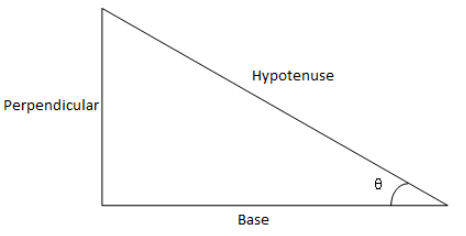
\[\cos \theta = \dfrac{{{\text{Base}}}}{{{\text{Hypotenuse}}}}\] ………………....(iv)
That means cosine of an angle is the ratio of base and hypotenuse of a right angled triangle.
We have,
\[\cos \theta = \dfrac{1}{2}\]
Comparing with equation (iv) we get,
\[\dfrac{{{\text{Base}}}}{{{\text{Hypotenuse}}}} = \dfrac{1}{2}\] ………………(v)
We can write secant as inverse of cosine, that is,
\[\sec \theta = \dfrac{1}{{\cos \theta }}\]
Putting the value of \[\cos \theta \] from equation (iv) we get,
\[\sec \theta = \dfrac{1}{{\left( {\dfrac{{{\text{Base}}}}{{{\text{Hypotenuse}}}}} \right)}}\]
Putting the value of \[\dfrac{{{\text{Base}}}}{{{\text{Hypotenuse}}}}\] from equation (v) we get,
\[\sec \theta = \dfrac{1}{{\left( {\dfrac{1}{2}} \right)}}\]
\[ \therefore \sec \theta = 2\]
Note: There are three main functions in trigonometry, these are sine, cosine and tangent. There are three other trigonometric functions which can be written in terms of the main functions, these are cosecant which is inverse of sine, secant which is inverse of cosine and cotangent which is inverse of tangent. Also, while solving questions related to trigonometry, you should always remember the basic trigonometric identities.
Complete step by step solution:
We are asked to evaluate \[\sec \left( {{{\cos }^{ - 1}}\left( {\dfrac{1}{2}} \right)} \right)\] without using calculator.
We have, \[\sec \left( {{{\cos }^{ - 1}}\left( {\dfrac{1}{2}} \right)} \right)\].
Let us take, \[{\cos ^{ - 1}}\left( {\dfrac{1}{2}} \right) = \theta \] ……………....(i)
\[ \Rightarrow \left( {\dfrac{1}{2}} \right) = \cos \theta \]
\[ \Rightarrow \cos \theta = \dfrac{1}{2}\]
We know that secant is inverse of cosine, that is we can write
\[\sec \theta = \dfrac{1}{{\cos \theta }}\]
Putting the value of \[\cos \theta \] we get,
\[\sec \theta = \dfrac{1}{{\left( {\dfrac{1}{2}} \right)}}\]
\[ \Rightarrow \sec \theta = 2\]......................(ii)
Now, putting the value of \[\theta \] from equation (i) we get,
\[\sec \left( {{{\cos }^{ - 1}}\left( {\dfrac{1}{2}} \right)} \right) = 2\]
Therefore, the value of \[\sec \left( {{{\cos }^{ - 1}}\left( {\dfrac{1}{2}} \right)} \right)\] is \[2\]
Alternative method:
Let \[A = \sec \left( {{{\cos }^{ - 1}}\left( {\dfrac{1}{2}} \right)} \right)\].
And let us take, \[{\cos ^{ - 1}}\left( {\dfrac{1}{2}} \right) = \theta \]
\[ \Rightarrow \cos \theta = \dfrac{1}{2}\] …………………(iii)
Cosine of an angle can be written in terms of base and hypotenuse of a right angled triangle that is,
\[\cos \theta = \dfrac{{{\text{Base}}}}{{{\text{Hypotenuse}}}}\] ………………....(iv)
That means cosine of an angle is the ratio of base and hypotenuse of a right angled triangle.
We have,
\[\cos \theta = \dfrac{1}{2}\]
Comparing with equation (iv) we get,
\[\dfrac{{{\text{Base}}}}{{{\text{Hypotenuse}}}} = \dfrac{1}{2}\] ………………(v)
We can write secant as inverse of cosine, that is,
\[\sec \theta = \dfrac{1}{{\cos \theta }}\]
Putting the value of \[\cos \theta \] from equation (iv) we get,
\[\sec \theta = \dfrac{1}{{\left( {\dfrac{{{\text{Base}}}}{{{\text{Hypotenuse}}}}} \right)}}\]
Putting the value of \[\dfrac{{{\text{Base}}}}{{{\text{Hypotenuse}}}}\] from equation (v) we get,
\[\sec \theta = \dfrac{1}{{\left( {\dfrac{1}{2}} \right)}}\]
\[ \therefore \sec \theta = 2\]
Note: There are three main functions in trigonometry, these are sine, cosine and tangent. There are three other trigonometric functions which can be written in terms of the main functions, these are cosecant which is inverse of sine, secant which is inverse of cosine and cotangent which is inverse of tangent. Also, while solving questions related to trigonometry, you should always remember the basic trigonometric identities.
Recently Updated Pages
Master Class 11 Computer Science: Engaging Questions & Answers for Success

Master Class 11 Business Studies: Engaging Questions & Answers for Success
Master Class 11 Economics: Engaging Questions & Answers for Success
Master Class 11 English: Engaging Questions & Answers for Success
Master Class 11 Maths: Engaging Questions & Answers for Success
Master Class 11 Biology: Engaging Questions & Answers for Success
Trending doubts
One Metric ton is equal to kg A 10000 B 1000 C 100 class 11 physics CBSE
There are 720 permutations of the digits 1 2 3 4 5 class 11 maths CBSE
Discuss the various forms of bacteria class 11 biology CBSE
Draw a diagram of a plant cell and label at least eight class 11 biology CBSE
State the laws of reflection of light
Explain zero factorial class 11 maths CBSE