




Evaluate following trigonometric ratios: \[\]
(i) $\dfrac{\sin {{18}^{\circ }}}{\cos {{72}^{\circ }}}$ \[\]
(ii) $\dfrac{\tan {{26}^{\circ }}}{\tan {{74}^{\circ }}}$\[\]
(iii) $\cos {{48}^{\circ }}-\sin {{72}^{\circ }}$\[\]
(iv) $\operatorname{cosec}{{31}^{\circ }}-\sec {{59}^{\circ }}$\[\]
Answer
 Verified
576k+ views
Hint: We recall the definition of six trigonometric ratios and find the reduction formula where an angle is reflected about the angle vector of ${{45}^{\circ }}$ to get the complementary angle. If the two complementary angles are $\theta ,{{90}^{\circ }}-\theta $ then the reduction formula are given by $\sin \theta =\cos \left( {{90}^{\circ }}-\theta \right)$, $\tan \theta =\cot \left( {{90}^{\circ }}-\theta \right)$ and $\operatorname{cosec}\theta =\sec \left( {{90}^{\circ }}-\theta \right)$. We take the smaller angle in the questions as $\theta $ and use reduction formula.\[\]
Complete step-by-step solution:
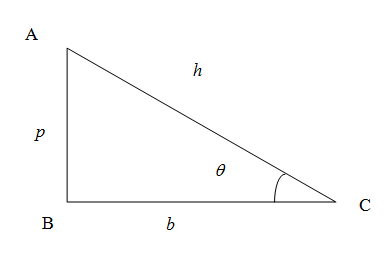
We know that in a right-angled triangle (Here ABC) the side opposite to the right angle (Here $\angle ABC$) is called hypotenuse (here AC) denoted as $h$, the vertical side AB is called perpendicular denoted as $p$ and the horizontal side BC is called the base denoted as $b$.
We know from the trigonometric ratios in a right angled triangle the sine of any angle is given by the ratio of side opposite to the angle to the hypotenuse. In the figure the sine of the angle $\angle ACB=\theta $ is given by
\[\sin \theta =\dfrac{AB}{AC}=\dfrac{p}{h}\]
Similarly the cosine of an angle is the ratio of side adjacent to the angle (excluding hypotenuse) to the hypotenuse. So we have cosine of angle $\theta $
\[\cos \theta =\dfrac{BC}{AC}=\dfrac{b}{h}\]
The tangent of the angle is the ratio of opposite side to the adjacent side (excluding hypotenuse) . So we have tangent of the angle of angle $\theta $
\[\tan \theta =\dfrac{AB}{BC}=\dfrac{p}{b}\]
The reciprocals of sine, cosine and tangent of angle are defined as cosecant, secant and cotangent of the angle which means,
\[\operatorname{cosec}\theta =\dfrac{1}{\sin \theta },\sec \theta =\dfrac{1}{\cos \theta },\cot \theta =\dfrac{1}{\tan \theta }\]
Let us consider the right angled triangle ABC. We have,
\[\begin{align}
& A+B+C={{180}^{\circ }} \\
& \Rightarrow A+C={{180}^{\circ }}-{{90}^{\circ }}=90{}^{\circ } \\
& \Rightarrow A={{90}^{\circ }}-C \\
\end{align}\]
We have taken$\angle ACB=C=\theta $. So we have
\[C=\theta ,A={{90}^{\circ }}-\theta \]
Let us take sine and cosines of angle $C=\theta ,A={{90}^{\circ }}-\theta $.
\[\begin{align}
& \sin \theta =\dfrac{p}{h},\sin \left( {{90}^{\circ }}-\theta \right)=\dfrac{BC}{AC}=\dfrac{b}{h} \\
& \cos \theta =\dfrac{b}{h},\cos \left( {{90}^{\circ }}-\theta \right)=\dfrac{AB}{AC}=\dfrac{p}{h} \\
\end{align}\]
We conclude from above that
\[\sin \theta =\cos \left( {{90}^{\circ }}-\theta \right),\cos \theta =\sin \left( {{90}^{\circ }}-\theta \right)\]
The above identity is called reflection identity also known as reduction formula which reflects complementary trigonometric ratio about an angle vector of ${{45}^{\circ }}$. We can similarly derive the reduction formula for tangent and co-tangent or secant and cosecant as
\[\begin{align}
& \tan \theta =\cot \left( {{90}^{\circ }}-\theta \right),\cot \theta =\tan \left( {{90}^{\circ }}-\theta \right) \\
& \operatorname{cosec}\theta =\sec \left( {{90}^{\circ }}-\theta \right),\sec \theta =\text{cosec}\left( {{90}^{\circ }}-\theta \right) \\
\end{align}\]
Let us now use reduction formulae to solve the question.
(i) We are asked to evaluate the trigonometric expression $\dfrac{\sin {{18}^{\circ }}}{\cos {{72}^{\circ }}}$. Let us take $\theta ={{18}^{\circ }}$and then we have $90{}^{\circ }-\theta ={{90}^{\circ }}-{{18}^{\circ }}={{72}^{\circ }}$. So we use the reduction formula of sine-cosine for complementary angles ${{18}^{\circ }},{{72}^{\circ }}$ to have.
\[\dfrac{\sin {{18}^{\circ }}}{\cos {{72}^{\circ }}}=\dfrac{\sin {{18}^{\circ }}}{\cos \left( {{90}^{\circ }}-{{18}^{\circ }} \right)}=\dfrac{\sin {{18}^{\circ }}}{\sin {{18}^{\circ }}}=1\]
(ii) We are asked to evaluate the trigonometric expression$\dfrac{\tan {{26}^{\circ }}}{\cot {{64}^{\circ }}}$. Let us take $\theta ={{26}^{\circ }}$and then we have$90{}^{\circ }-\theta ={{90}^{\circ }}-{{26}^{\circ }}={{64}^{\circ }}$. So we use the reduction formula of tangent -cotangent for complementary angles ${{26}^{\circ }},{{64}^{\circ }}$ to have.
\[\dfrac{\tan {{26}^{\circ }}}{\cot {{64}^{\circ }}}=\dfrac{\tan {{26}^{\circ }}}{\cot \left( {{90}^{\circ }}-{{26}^{\circ }} \right)}=\dfrac{\tan {{26}^{\circ }}}{\tan {{26}^{\circ }}}=1\]
(iii) We are asked to evaluate the trigonometric expression $\cos {{48}^{\circ }}-\sin {{42}^{\circ }}$. Let us take $\theta ={{42}^{\circ }}$and then we have $90{}^{\circ }-\theta ={{90}^{\circ }}-{{42}^{\circ }}={{48}^{\circ }}$. So we use the reduction formula of sine-cosine for complementary angles ${{48}^{\circ }},{{42}^{\circ }}$ to have.
\[\cos {{48}^{\circ }}-\sin 42=\cos {{48}^{\circ }}-\sin {{\left( 90-48 \right)}^{\circ }}=\cos {{48}^{\circ }}-\cos {{48}^{\circ }}=0\]
(iv) We are asked to evaluate the trigonometric expression $\operatorname{cosec}{{31}^{\circ }}-\sec {{59}^{\circ }}$. Let us take $\theta ={{31}^{\circ }}$and then we have $90{}^{\circ }-\theta ={{90}^{\circ }}-{{31}^{\circ }}={{59}^{\circ }}$. So we use the reduction formula of secant-cosecant for complementary angles ${{31}^{\circ }},{{59}^{\circ }}$ to have
\[\operatorname{cosec}{{31}^{\circ }}-\cot {{59}^{\circ }}=\operatorname{cosec}{{31}^{\circ }}-\cot {{\left( 90-59 \right)}^{\circ }}=\operatorname{cosec}{{31}^{\circ }}-\operatorname{cosec}{{31}^{\circ }}=0\]
Note: We note that we have solved from taking the smaller of complementary angles as $\theta ={{18}^{\circ }},{{26}^{\circ }},{{42}^{\circ }},{{31}^{\circ }}$ and we can also solve taking the larger of complementary angles as$\theta ={{72}^{\circ }},{{64}^{\circ }},{{48}^{\circ }},{{59}^{\circ }}$. If an angle is reflected by the angle vector of ${{90}^{\circ }}$ then we will get its supplementary angle then we will have $\sin \left( {{180}^{\circ }}-\theta \right)=\sin \theta ,\cos \left( {{180}^{\circ }}-\theta \right)=-\cos \theta $ and $\tan \left( {{180}^{\circ }}-\theta \right)=-\tan \theta $.
Complete step-by-step solution:
We know that in a right-angled triangle (Here ABC) the side opposite to the right angle (Here $\angle ABC$) is called hypotenuse (here AC) denoted as $h$, the vertical side AB is called perpendicular denoted as $p$ and the horizontal side BC is called the base denoted as $b$.
We know from the trigonometric ratios in a right angled triangle the sine of any angle is given by the ratio of side opposite to the angle to the hypotenuse. In the figure the sine of the angle $\angle ACB=\theta $ is given by
\[\sin \theta =\dfrac{AB}{AC}=\dfrac{p}{h}\]
Similarly the cosine of an angle is the ratio of side adjacent to the angle (excluding hypotenuse) to the hypotenuse. So we have cosine of angle $\theta $
\[\cos \theta =\dfrac{BC}{AC}=\dfrac{b}{h}\]
The tangent of the angle is the ratio of opposite side to the adjacent side (excluding hypotenuse) . So we have tangent of the angle of angle $\theta $
\[\tan \theta =\dfrac{AB}{BC}=\dfrac{p}{b}\]
The reciprocals of sine, cosine and tangent of angle are defined as cosecant, secant and cotangent of the angle which means,
\[\operatorname{cosec}\theta =\dfrac{1}{\sin \theta },\sec \theta =\dfrac{1}{\cos \theta },\cot \theta =\dfrac{1}{\tan \theta }\]
Let us consider the right angled triangle ABC. We have,
\[\begin{align}
& A+B+C={{180}^{\circ }} \\
& \Rightarrow A+C={{180}^{\circ }}-{{90}^{\circ }}=90{}^{\circ } \\
& \Rightarrow A={{90}^{\circ }}-C \\
\end{align}\]
We have taken$\angle ACB=C=\theta $. So we have
\[C=\theta ,A={{90}^{\circ }}-\theta \]
Let us take sine and cosines of angle $C=\theta ,A={{90}^{\circ }}-\theta $.
\[\begin{align}
& \sin \theta =\dfrac{p}{h},\sin \left( {{90}^{\circ }}-\theta \right)=\dfrac{BC}{AC}=\dfrac{b}{h} \\
& \cos \theta =\dfrac{b}{h},\cos \left( {{90}^{\circ }}-\theta \right)=\dfrac{AB}{AC}=\dfrac{p}{h} \\
\end{align}\]
We conclude from above that
\[\sin \theta =\cos \left( {{90}^{\circ }}-\theta \right),\cos \theta =\sin \left( {{90}^{\circ }}-\theta \right)\]
The above identity is called reflection identity also known as reduction formula which reflects complementary trigonometric ratio about an angle vector of ${{45}^{\circ }}$. We can similarly derive the reduction formula for tangent and co-tangent or secant and cosecant as
\[\begin{align}
& \tan \theta =\cot \left( {{90}^{\circ }}-\theta \right),\cot \theta =\tan \left( {{90}^{\circ }}-\theta \right) \\
& \operatorname{cosec}\theta =\sec \left( {{90}^{\circ }}-\theta \right),\sec \theta =\text{cosec}\left( {{90}^{\circ }}-\theta \right) \\
\end{align}\]
Let us now use reduction formulae to solve the question.
(i) We are asked to evaluate the trigonometric expression $\dfrac{\sin {{18}^{\circ }}}{\cos {{72}^{\circ }}}$. Let us take $\theta ={{18}^{\circ }}$and then we have $90{}^{\circ }-\theta ={{90}^{\circ }}-{{18}^{\circ }}={{72}^{\circ }}$. So we use the reduction formula of sine-cosine for complementary angles ${{18}^{\circ }},{{72}^{\circ }}$ to have.
\[\dfrac{\sin {{18}^{\circ }}}{\cos {{72}^{\circ }}}=\dfrac{\sin {{18}^{\circ }}}{\cos \left( {{90}^{\circ }}-{{18}^{\circ }} \right)}=\dfrac{\sin {{18}^{\circ }}}{\sin {{18}^{\circ }}}=1\]
(ii) We are asked to evaluate the trigonometric expression$\dfrac{\tan {{26}^{\circ }}}{\cot {{64}^{\circ }}}$. Let us take $\theta ={{26}^{\circ }}$and then we have$90{}^{\circ }-\theta ={{90}^{\circ }}-{{26}^{\circ }}={{64}^{\circ }}$. So we use the reduction formula of tangent -cotangent for complementary angles ${{26}^{\circ }},{{64}^{\circ }}$ to have.
\[\dfrac{\tan {{26}^{\circ }}}{\cot {{64}^{\circ }}}=\dfrac{\tan {{26}^{\circ }}}{\cot \left( {{90}^{\circ }}-{{26}^{\circ }} \right)}=\dfrac{\tan {{26}^{\circ }}}{\tan {{26}^{\circ }}}=1\]
(iii) We are asked to evaluate the trigonometric expression $\cos {{48}^{\circ }}-\sin {{42}^{\circ }}$. Let us take $\theta ={{42}^{\circ }}$and then we have $90{}^{\circ }-\theta ={{90}^{\circ }}-{{42}^{\circ }}={{48}^{\circ }}$. So we use the reduction formula of sine-cosine for complementary angles ${{48}^{\circ }},{{42}^{\circ }}$ to have.
\[\cos {{48}^{\circ }}-\sin 42=\cos {{48}^{\circ }}-\sin {{\left( 90-48 \right)}^{\circ }}=\cos {{48}^{\circ }}-\cos {{48}^{\circ }}=0\]
(iv) We are asked to evaluate the trigonometric expression $\operatorname{cosec}{{31}^{\circ }}-\sec {{59}^{\circ }}$. Let us take $\theta ={{31}^{\circ }}$and then we have $90{}^{\circ }-\theta ={{90}^{\circ }}-{{31}^{\circ }}={{59}^{\circ }}$. So we use the reduction formula of secant-cosecant for complementary angles ${{31}^{\circ }},{{59}^{\circ }}$ to have
\[\operatorname{cosec}{{31}^{\circ }}-\cot {{59}^{\circ }}=\operatorname{cosec}{{31}^{\circ }}-\cot {{\left( 90-59 \right)}^{\circ }}=\operatorname{cosec}{{31}^{\circ }}-\operatorname{cosec}{{31}^{\circ }}=0\]
Note: We note that we have solved from taking the smaller of complementary angles as $\theta ={{18}^{\circ }},{{26}^{\circ }},{{42}^{\circ }},{{31}^{\circ }}$ and we can also solve taking the larger of complementary angles as$\theta ={{72}^{\circ }},{{64}^{\circ }},{{48}^{\circ }},{{59}^{\circ }}$. If an angle is reflected by the angle vector of ${{90}^{\circ }}$ then we will get its supplementary angle then we will have $\sin \left( {{180}^{\circ }}-\theta \right)=\sin \theta ,\cos \left( {{180}^{\circ }}-\theta \right)=-\cos \theta $ and $\tan \left( {{180}^{\circ }}-\theta \right)=-\tan \theta $.
Recently Updated Pages
Master Class 10 Computer Science: Engaging Questions & Answers for Success

Master Class 10 General Knowledge: Engaging Questions & Answers for Success
Master Class 10 English: Engaging Questions & Answers for Success
Master Class 10 Social Science: Engaging Questions & Answers for Success
Master Class 10 Maths: Engaging Questions & Answers for Success
Master Class 10 Science: Engaging Questions & Answers for Success
Trending doubts
What is the median of the first 10 natural numbers class 10 maths CBSE
Which women's tennis player has 24 Grand Slam singles titles?
Who is the Brand Ambassador of Incredible India?
Why is there a time difference of about 5 hours between class 10 social science CBSE
Write a letter to the principal requesting him to grant class 10 english CBSE
A moving boat is observed from the top of a 150 m high class 10 maths CBSE