




How do you evaluate $\cot \left( \arctan \left( \dfrac{3}{5} \right) \right)$?
Answer
 Verified
573.3k+ views
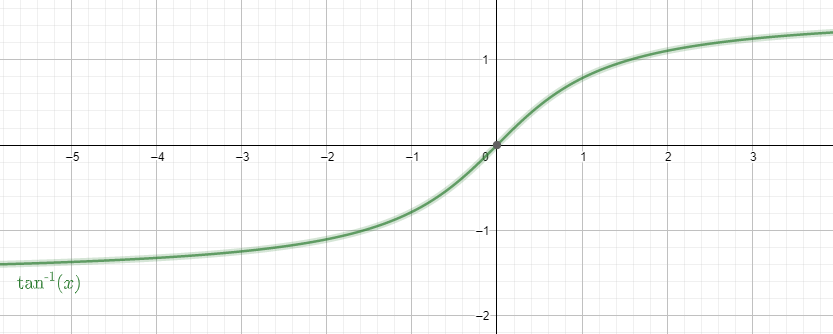
Hint: We explain the function $arc\tan \left( x \right)$. We express the inverse function of tan in the form of $arc\tan \left( x \right)={{\tan }^{-1}}x$. We draw the graph of $arc\tan \left( x \right)$ and the line $x=\dfrac{3}{5}$ to find the intersection point. Thereafter we take the cot ratio of that angle to find the solution.
Complete step by step answer:
The given expression is the inverse function of trigonometric ratio tan.
The arcus function represents the angle which on ratio tan gives the value.
So, $arc\tan \left( x \right)={{\tan }^{-1}}x$. If $arc\tan \left( x \right)=\alpha $ then we can say $\tan \alpha =x$.
Each of the trigonometric functions is periodic in the real part of its argument, running through all its values twice in each interval of $2\pi $.
The general solution for that value where $\tan \alpha =x$ will be $n\pi +\alpha ,n\in \mathbb{Z}$.
But for $arc\tan \left( x \right)$, we won’t find the general solution. We use the principal value. For ratio tan we have $-\dfrac{\pi }{2}\le arc\tan \left( x \right)\le \dfrac{\pi }{2}$.
The graph of the function is
We now place the value of $x=\dfrac{3}{5}$ in the function of $arc\tan \left( x \right)$.
Let the angle be $\theta $ for which $arc\tan \left( \dfrac{3}{5} \right)=\theta $. This gives $\tan \theta =\dfrac{3}{5}$.
For this we take the line of $x=\dfrac{3}{5}$ and see the intersection of the line with the graph $arc\tan \left( x \right)$.
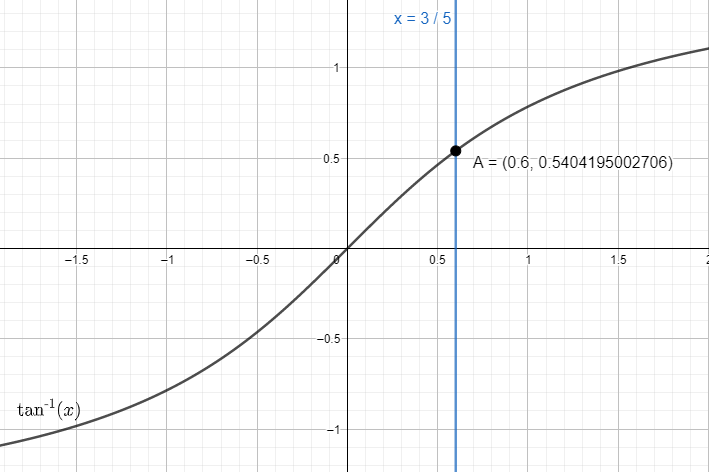
Putting the value in the graph of $arc\tan \left( x \right)$, we get $\theta =30.96$. (approx.)
We get the value of y coordinates as ${{30.96}^{\circ }}$.
Now we take $\cot \left( \arctan \left( \dfrac{3}{5} \right) \right)=\cot \left( {{30.96}^{\circ }} \right)=\dfrac{5}{3}$.
Therefore, the value of $\cot \left( \arctan \left( \dfrac{3}{5} \right) \right)$ is $\dfrac{5}{3}$.
Note: We can also apply the trigonometric identity where $\cot \theta =\dfrac{1}{\tan \theta }$. Also, in the exact solution domain of $-\dfrac{\pi }{2}\le \theta \le \dfrac{\pi }{2}$, $\tan \left( {{\tan }^{-1}}x \right)=x$.using those identities we get
$\cot \left( \arctan \left( \dfrac{3}{5} \right) \right)=\dfrac{1}{\tan \left( {{\tan }^{-1}}\left( \dfrac{3}{5} \right) \right)}=\dfrac{1}{\dfrac{3}{5}}=\dfrac{5}{3}$.
Complete step by step answer:
The given expression is the inverse function of trigonometric ratio tan.
The arcus function represents the angle which on ratio tan gives the value.
So, $arc\tan \left( x \right)={{\tan }^{-1}}x$. If $arc\tan \left( x \right)=\alpha $ then we can say $\tan \alpha =x$.
Each of the trigonometric functions is periodic in the real part of its argument, running through all its values twice in each interval of $2\pi $.
The general solution for that value where $\tan \alpha =x$ will be $n\pi +\alpha ,n\in \mathbb{Z}$.
But for $arc\tan \left( x \right)$, we won’t find the general solution. We use the principal value. For ratio tan we have $-\dfrac{\pi }{2}\le arc\tan \left( x \right)\le \dfrac{\pi }{2}$.
The graph of the function is
We now place the value of $x=\dfrac{3}{5}$ in the function of $arc\tan \left( x \right)$.
Let the angle be $\theta $ for which $arc\tan \left( \dfrac{3}{5} \right)=\theta $. This gives $\tan \theta =\dfrac{3}{5}$.
For this we take the line of $x=\dfrac{3}{5}$ and see the intersection of the line with the graph $arc\tan \left( x \right)$.
Putting the value in the graph of $arc\tan \left( x \right)$, we get $\theta =30.96$. (approx.)
We get the value of y coordinates as ${{30.96}^{\circ }}$.
Now we take $\cot \left( \arctan \left( \dfrac{3}{5} \right) \right)=\cot \left( {{30.96}^{\circ }} \right)=\dfrac{5}{3}$.
Therefore, the value of $\cot \left( \arctan \left( \dfrac{3}{5} \right) \right)$ is $\dfrac{5}{3}$.
Note: We can also apply the trigonometric identity where $\cot \theta =\dfrac{1}{\tan \theta }$. Also, in the exact solution domain of $-\dfrac{\pi }{2}\le \theta \le \dfrac{\pi }{2}$, $\tan \left( {{\tan }^{-1}}x \right)=x$.using those identities we get
$\cot \left( \arctan \left( \dfrac{3}{5} \right) \right)=\dfrac{1}{\tan \left( {{\tan }^{-1}}\left( \dfrac{3}{5} \right) \right)}=\dfrac{1}{\dfrac{3}{5}}=\dfrac{5}{3}$.
Recently Updated Pages
Basicity of sulphurous acid and sulphuric acid are

Master Class 12 English: Engaging Questions & Answers for Success
Master Class 12 Social Science: Engaging Questions & Answers for Success
Master Class 12 Maths: Engaging Questions & Answers for Success
Master Class 12 Economics: Engaging Questions & Answers for Success
Master Class 12 Physics: Engaging Questions & Answers for Success
Trending doubts
Which are the Top 10 Largest Countries of the World?
Draw a labelled sketch of the human eye class 12 physics CBSE
Draw ray diagrams each showing i myopic eye and ii class 12 physics CBSE
Give 10 examples of unisexual and bisexual flowers
Coming together federation is practiced in A India class 12 social science CBSE
Write the formula to find the shortest distance between class 12 maths CBSE