




Evaluate $\cos \left( {{{\tan }^{ - 1}}x} \right) = $
1). $\sqrt {1 + {x^2}} $
2). $\dfrac{1}{{\sqrt {1 + {x^2}} }}$
3). $1 + {x^2}$
4). None of these
Answer
 Verified
532.2k+ views
Hint: In order to solve the given equation, consider ${\tan ^{ - 1}}x$ to be any variable, then using the properties of triangles like Pythagoras theorem and trigonometric ratios like $\tan \theta = \dfrac{{perpendicular}}{{base}}$, find the value of the variable, solve further and get the results.
Formula used:
$\tan \theta = \dfrac{{perpendicular}}{{base}}$
$\cos \theta = \dfrac{{base}}{{hypotenuse}}$
Complete step-by-step solution:
We are given the value $\cos \left( {{{\tan }^{ - 1}}x} \right)$.
Considering the value of ${\tan ^{ - 1}}x$ to be $\theta $ , which can be numerically written as:
${\tan ^{ - 1}}x = \theta $
Multiplying both the sides by $\tan $, we get:
$\tan \left( {{{\tan }^{ - 1}}x} \right) = \tan \theta $ ……………………..(1)
Since, we know that in $\tan \left( {{{\tan }^{ - 1}}x} \right) = \tan \theta $, the $\tan $ will cancel ${\tan ^{ - 1}}x$, so we are left with $\tan \left( {{{\tan }^{ - 1}}x} \right) = x$, So substituting this value in equation (1), we get:
$\tan \left( {{{\tan }^{ - 1}}x} \right) = \tan \theta $
$ \Rightarrow x = \tan \theta $
Which can also be written as:
$ \Rightarrow \tan \theta = x$ …………………………..(2)
From Trigonometric ratios, we know that:
$ \Rightarrow \tan \theta = \dfrac{{perpendicular}}{{base}}$ ……..(3)
Equating equation (2) and equation (3), we get:
$ \Rightarrow x = \dfrac{{perpendicular}}{{base}}$
$x$ can also be written as $\dfrac{x}{1}$, as anything divided by $1$ , gives the same answer:
Therefore,
$ \Rightarrow \dfrac{x}{1} = \dfrac{{perpendicular}}{{base}}$
Drawing a right-angled triangle ABC with perpendicular of $x$ and base to be $1$, perpendicular to each other at B:
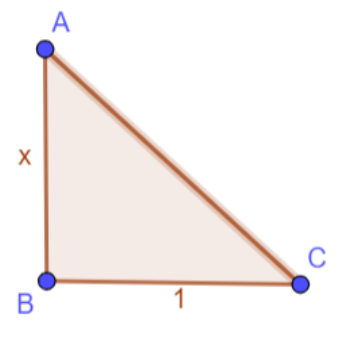
Since, it is a right - angled triangle, so we can apply Pythagoras theorem:
$A{B^2} + B{C^2} = A{C^2}$
Substituting the values, we get:
$ \Rightarrow {x^2} + {1^2} = A{C^2}$
Taking square root both the sides, we get:
$ \Rightarrow \sqrt {{x^2} + {1^2}} = \sqrt {A{C^2}} $
$ \Rightarrow \sqrt {{x^2} + 1} = AC$
$ \Rightarrow AC = \sqrt {{x^2} + 1} $
Therefore, hypotenuse $ = \sqrt {{x^2} + 1} $.
Since, we were given $\cos \left( {{{\tan }^{ - 1}}x} \right)$, and we considered ${\tan ^{ - 1}}x = \theta $, so substituting ${\tan ^{ - 1}}x = \theta $ in $\cos \left( {{{\tan }^{ - 1}}x} \right)$, we get:
$ \Rightarrow \cos \left( {{{\tan }^{ - 1}}x} \right) = \cos \left( \theta \right)$
$ \Rightarrow \cos \left( {{{\tan }^{ - 1}}x} \right) = \cos \theta $ …….(4)
From Trigonometric ratios, we know that $\cos \theta = \dfrac{{base}}{{hypotenuse}}$.
And, we can see from the triangle ABC, base $ = 1$ and hypotenuse $ = \sqrt {{x^2} + 1} $.
Substituting them in $\cos \theta = \dfrac{{base}}{{hypotenuse}}$ , we get:
$\cos \theta = \dfrac{{base}}{{hypotenuse}} = \dfrac{1}{{\sqrt {{x^2} + 1} }}$
$ \Rightarrow \cos \theta = \dfrac{1}{{\sqrt {{x^2} + 1} }}$
Substituting this value in equation (4), we get:
$ \Rightarrow \cos \left( {{{\tan }^{ - 1}}x} \right) = \cos \theta = \dfrac{1}{{\sqrt {{x^2} + 1} }}$
$ \Rightarrow \cos \left( {{{\tan }^{ - 1}}x} \right) = \dfrac{1}{{\sqrt {{x^2} + 1} }}$
Therefore, $\cos \left( {{{\tan }^{ - 1}}x} \right) = \dfrac{1}{{\sqrt {{x^2} + 1} }}$.
Hence, Option 2 is correct.
Note: It’s important to follow the correct steps and solve step by step instead of solving it at once, otherwise it may lead to error. Do not forget to draw the rough diagram of the triangle in order to get the value of the hypotenuse.
Formula used:
$\tan \theta = \dfrac{{perpendicular}}{{base}}$
$\cos \theta = \dfrac{{base}}{{hypotenuse}}$
Complete step-by-step solution:
We are given the value $\cos \left( {{{\tan }^{ - 1}}x} \right)$.
Considering the value of ${\tan ^{ - 1}}x$ to be $\theta $ , which can be numerically written as:
${\tan ^{ - 1}}x = \theta $
Multiplying both the sides by $\tan $, we get:
$\tan \left( {{{\tan }^{ - 1}}x} \right) = \tan \theta $ ……………………..(1)
Since, we know that in $\tan \left( {{{\tan }^{ - 1}}x} \right) = \tan \theta $, the $\tan $ will cancel ${\tan ^{ - 1}}x$, so we are left with $\tan \left( {{{\tan }^{ - 1}}x} \right) = x$, So substituting this value in equation (1), we get:
$\tan \left( {{{\tan }^{ - 1}}x} \right) = \tan \theta $
$ \Rightarrow x = \tan \theta $
Which can also be written as:
$ \Rightarrow \tan \theta = x$ …………………………..(2)
From Trigonometric ratios, we know that:
$ \Rightarrow \tan \theta = \dfrac{{perpendicular}}{{base}}$ ……..(3)
Equating equation (2) and equation (3), we get:
$ \Rightarrow x = \dfrac{{perpendicular}}{{base}}$
$x$ can also be written as $\dfrac{x}{1}$, as anything divided by $1$ , gives the same answer:
Therefore,
$ \Rightarrow \dfrac{x}{1} = \dfrac{{perpendicular}}{{base}}$
Drawing a right-angled triangle ABC with perpendicular of $x$ and base to be $1$, perpendicular to each other at B:
Since, it is a right - angled triangle, so we can apply Pythagoras theorem:
$A{B^2} + B{C^2} = A{C^2}$
Substituting the values, we get:
$ \Rightarrow {x^2} + {1^2} = A{C^2}$
Taking square root both the sides, we get:
$ \Rightarrow \sqrt {{x^2} + {1^2}} = \sqrt {A{C^2}} $
$ \Rightarrow \sqrt {{x^2} + 1} = AC$
$ \Rightarrow AC = \sqrt {{x^2} + 1} $
Therefore, hypotenuse $ = \sqrt {{x^2} + 1} $.
Since, we were given $\cos \left( {{{\tan }^{ - 1}}x} \right)$, and we considered ${\tan ^{ - 1}}x = \theta $, so substituting ${\tan ^{ - 1}}x = \theta $ in $\cos \left( {{{\tan }^{ - 1}}x} \right)$, we get:
$ \Rightarrow \cos \left( {{{\tan }^{ - 1}}x} \right) = \cos \left( \theta \right)$
$ \Rightarrow \cos \left( {{{\tan }^{ - 1}}x} \right) = \cos \theta $ …….(4)
From Trigonometric ratios, we know that $\cos \theta = \dfrac{{base}}{{hypotenuse}}$.
And, we can see from the triangle ABC, base $ = 1$ and hypotenuse $ = \sqrt {{x^2} + 1} $.
Substituting them in $\cos \theta = \dfrac{{base}}{{hypotenuse}}$ , we get:
$\cos \theta = \dfrac{{base}}{{hypotenuse}} = \dfrac{1}{{\sqrt {{x^2} + 1} }}$
$ \Rightarrow \cos \theta = \dfrac{1}{{\sqrt {{x^2} + 1} }}$
Substituting this value in equation (4), we get:
$ \Rightarrow \cos \left( {{{\tan }^{ - 1}}x} \right) = \cos \theta = \dfrac{1}{{\sqrt {{x^2} + 1} }}$
$ \Rightarrow \cos \left( {{{\tan }^{ - 1}}x} \right) = \dfrac{1}{{\sqrt {{x^2} + 1} }}$
Therefore, $\cos \left( {{{\tan }^{ - 1}}x} \right) = \dfrac{1}{{\sqrt {{x^2} + 1} }}$.
Hence, Option 2 is correct.
Note: It’s important to follow the correct steps and solve step by step instead of solving it at once, otherwise it may lead to error. Do not forget to draw the rough diagram of the triangle in order to get the value of the hypotenuse.
Recently Updated Pages
Master Class 12 Economics: Engaging Questions & Answers for Success

Master Class 12 English: Engaging Questions & Answers for Success
Master Class 12 Social Science: Engaging Questions & Answers for Success
Master Class 12 Maths: Engaging Questions & Answers for Success
Master Class 12 Physics: Engaging Questions & Answers for Success
Master Class 12 Business Studies: Engaging Questions & Answers for Success
Trending doubts
Which are the Top 10 Largest Countries of the World?
Draw a labelled sketch of the human eye class 12 physics CBSE
Differentiate between homogeneous and heterogeneous class 12 chemistry CBSE
Why is the cell called the structural and functional class 12 biology CBSE
Draw ray diagrams each showing i myopic eye and ii class 12 physics CBSE
Which is the correct genotypic ratio of mendel dihybrid class 12 biology CBSE