




Why is Euglena called a plant-animal?
Answer
 Verified
618k+ views
Hint: These are unicellular protists that have a whip-like tail. Belongs to the Kingdom Protista and is the only protistan which is known as the link between plant and animal.
Complete answer:
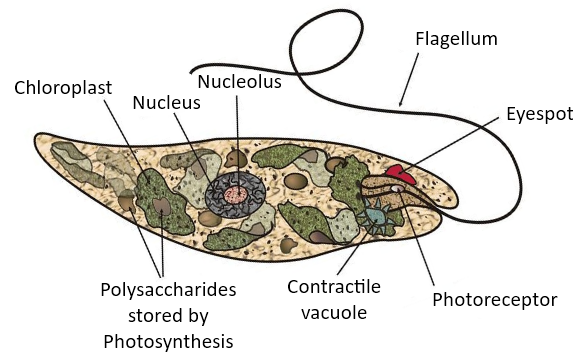
Euglena has the characters of both plants and animals. Euglena carries out photosynthesis as they have chloroplasts within the body of the cell which enables them to feed by autotrophy, like plants. However, they can also take nourishment heterotrophically, like that of animals.
Additional Information: Since Euglena have features that of both plants and animals, by working within the Linnaean two-kingdom system of biological classification, found them difficult to classify. It was a real doubt to the scientists where to place these “unclassifiable” creatures. That led Ernst Haeckel to add a third living kingdom, which is the Kingdom Protista.
The Euglena is unique in that it is both heterotrophic(depends on others for food) and autotrophic(prepares its food).
Now let's look, how it functions.
-When feeding as a heterotroph, Euglena takes in nutrients by osmotrophy and can live without a light on a diet of organic matter.
-When there is sufficient sunlight, it feeds by phototrophy, that is it makes its food with the help of chloroplast containing the pigments chlorophyll a and chlorophyll b to produce sugars by the process Photosynthesis.
Note: Structurally, they do not have a cell wall. Instead of that, they have a thick outer covering, known as a pellicle, that is composed of protein and gives them both strength and flexibility. Euglena shows both the characters of plants and animals, Thus, it is said to be a connecting link between plants and animals.
Complete answer:
Euglena has the characters of both plants and animals. Euglena carries out photosynthesis as they have chloroplasts within the body of the cell which enables them to feed by autotrophy, like plants. However, they can also take nourishment heterotrophically, like that of animals.
Additional Information: Since Euglena have features that of both plants and animals, by working within the Linnaean two-kingdom system of biological classification, found them difficult to classify. It was a real doubt to the scientists where to place these “unclassifiable” creatures. That led Ernst Haeckel to add a third living kingdom, which is the Kingdom Protista.
The Euglena is unique in that it is both heterotrophic(depends on others for food) and autotrophic(prepares its food).
Now let's look, how it functions.
-When feeding as a heterotroph, Euglena takes in nutrients by osmotrophy and can live without a light on a diet of organic matter.
-When there is sufficient sunlight, it feeds by phototrophy, that is it makes its food with the help of chloroplast containing the pigments chlorophyll a and chlorophyll b to produce sugars by the process Photosynthesis.
Note: Structurally, they do not have a cell wall. Instead of that, they have a thick outer covering, known as a pellicle, that is composed of protein and gives them both strength and flexibility. Euglena shows both the characters of plants and animals, Thus, it is said to be a connecting link between plants and animals.
Recently Updated Pages
Master Class 11 English: Engaging Questions & Answers for Success

Master Class 11 Social Science: Engaging Questions & Answers for Success
Master Class 11 Maths: Engaging Questions & Answers for Success
Master Class 11 Biology: Engaging Questions & Answers for Success
Master Class 11 Physics: Engaging Questions & Answers for Success
Master Class 11 Chemistry: Engaging Questions & Answers for Success
Trending doubts
One Metric ton is equal to kg A 10000 B 1000 C 100 class 11 physics CBSE
Difference Between Prokaryotic Cells and Eukaryotic Cells
Two of the body parts which do not appear in MRI are class 11 biology CBSE
Find the value of the expression given below sin 30circ class 11 maths CBSE
Draw a diagram of a plant cell and label at least eight class 11 biology CBSE
10 examples of friction in our daily life