




Ethene on ozonolysis give,
A. Acetaldehyde
B. Formaldehyde
C. Acetone
D. Alcohol
Answer
 Verified
628.5k+ views
Hint: We need to understand the process of ozonolysis and apply this concept to understand the ozonolysis of ethene. Ozone is also known as trioxygen and is a very active allotrope of carbon. The process of cleaving unsaturated bonds in an organic reaction with the help of ozone is known as ozonolysis. It is basically the reaction of alkenes and alkynes with ozone causing oxidative cleaving of the double and triple bonds.
Complete step by step answer:
As we know that ozonolysis is the process of cleaving of double and triple bonds of alkenes and alkynes, we now study the ozonolysis of alkenes only since the given organic compound (ethene) is an alkene.
The ozonolysis process of alkenes works by the oxidative cleavage of the double bond. It breaks both the pi and sigma bonds and also attacks the given alkene to produce an ozonide. Zinc dust is added to keep the oxygen away at intermediate stages since the zinc takes away the extra oxygen to form zinc oxide. The product of this reaction depends on the given type of alkene and the position of the double bond(s).
We can explain the process of ozonolysis by using the simplest compound containing a double bond which is ethene. The reaction is given below:
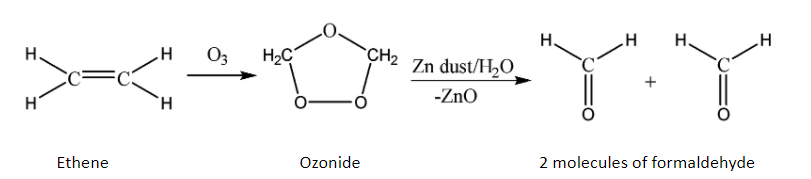
Hence, it can be concluded that ethene undergoes oxidative double bond cleavage when allowed to react with ozone and produces two molecules of formaldehyde.
Therefore, option B is correct.
Note: It must be noted that ozonolysis in organic chemistry is used for the detection of the position of carbon double bonds and triple bonds and hence we can determine the unknown alkene or alkyne. Alkenes on ozonolysis form alcohols, aldehydes, ketones, or carboxylic acids depending on the reactant. On ozonolysis, alkynes give acid anhydrides or diketones and on hydrolysis, the acid anhydride yields two carboxylic acids. Compounds with the functional diazinyl functional group known as azo compounds can also undergo ozonolysis to yield nitrosamines.
Complete step by step answer:
As we know that ozonolysis is the process of cleaving of double and triple bonds of alkenes and alkynes, we now study the ozonolysis of alkenes only since the given organic compound (ethene) is an alkene.
The ozonolysis process of alkenes works by the oxidative cleavage of the double bond. It breaks both the pi and sigma bonds and also attacks the given alkene to produce an ozonide. Zinc dust is added to keep the oxygen away at intermediate stages since the zinc takes away the extra oxygen to form zinc oxide. The product of this reaction depends on the given type of alkene and the position of the double bond(s).
We can explain the process of ozonolysis by using the simplest compound containing a double bond which is ethene. The reaction is given below:
Hence, it can be concluded that ethene undergoes oxidative double bond cleavage when allowed to react with ozone and produces two molecules of formaldehyde.
Therefore, option B is correct.
Note: It must be noted that ozonolysis in organic chemistry is used for the detection of the position of carbon double bonds and triple bonds and hence we can determine the unknown alkene or alkyne. Alkenes on ozonolysis form alcohols, aldehydes, ketones, or carboxylic acids depending on the reactant. On ozonolysis, alkynes give acid anhydrides or diketones and on hydrolysis, the acid anhydride yields two carboxylic acids. Compounds with the functional diazinyl functional group known as azo compounds can also undergo ozonolysis to yield nitrosamines.
Recently Updated Pages
If x a + bt + ct2 where x is in meters and t is in class 11 physics CBSE

A car covers the first half distance between two places class 11 physics CBSE
The resultant of two vectors overrightarrow P and overrightarrow class 11 physics CBSE
Find the value of cos 135 class 11 maths CBSE
A mass M is held in place by an applied force F and class 11 physics CBSE
A solution of glucose in water is labelled as 10 dfracwv class 11 chemistry CBSE
Trending doubts
One Metric ton is equal to kg A 10000 B 1000 C 100 class 11 physics CBSE
Find the value of the expression given below sin 30circ class 11 maths CBSE
What do you mean by retardation What is its SI uni class 11 physics CBSE
Draw a diagram of nephron and explain its structur class 11 biology CBSE
10 examples of friction in our daily life
Difference between physical and chemical change class 11 chemistry CBSE