




How is ethene converted into ethyl magnesium bromide?
Answer
 Verified
561.9k+ views
Hint :A Grignard reagent is an organo-magnesium compound which is very important reagent in chemistry. It can be described by the chemical formula $ R - Mg - X $ , where R refers to an alkyl or aryl group and X refers to a halogen like chlorine or bromine. They are generally produced by reacting an aryl or alkyl halide with magnesium.
Ethyl magnesium bromide is a commercially available chemical, usually present as a solution in diethyl ether or tetrahydrofuran as a solvent.
Complete Step By Step Answer:
Most of the organic chlorides, bromides and iodides react with certain metals to give compounds containing carbon-metal bonds. Such compounds are known as organo-metallic compounds or Grignard reagents. An important class of organo-metallic compounds discovered by Victor Grignard in 1900 is alkyl magnesium halide, $ R - Mg - X $ , referred to as Grignard Reagents. These reagents are obtained by the reaction of haloalkanes or haloarenes with magnesium metal in the presence of dry ether.
For preparing ethyl magnesium bromide we treat ethene with Hydrogen Bromide in the presence of dry ether.
$ C{H_2} = C{H_2}\xrightarrow[{Dry{\text{ }}Ether}]{{HBr}}C{H_3} - C{H_2} - Mg - Br $
The complete mechanism of the reaction is given as below:
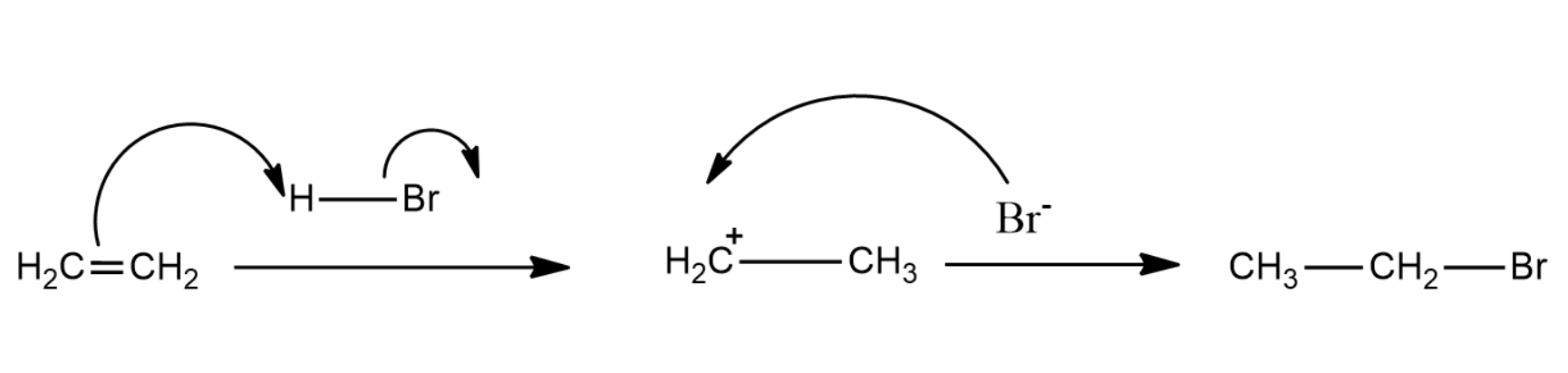
Here the Hydrogen bromide will break the double bond and thus form a carbocation. Bromine ions will react with the carbocation to form ethyl bromide.

The formed ethyl bromide will react with magnesium metal and thus forms ethyl magnesium Bromide.
Note :
Grignard reagents are highly reactive to any source of proton to give hydrocarbons. One of the very best examples of proton sources is water, and in turn convert them to corresponding hydrocarbons. It is therefore absolutely necessary to avoid even traces of moisture from a Grignard reagent. This is why it is absolutely necessary to use dry ether while preparing Grignard reagent.
Ethyl magnesium bromide is a commercially available chemical, usually present as a solution in diethyl ether or tetrahydrofuran as a solvent.
Complete Step By Step Answer:
Most of the organic chlorides, bromides and iodides react with certain metals to give compounds containing carbon-metal bonds. Such compounds are known as organo-metallic compounds or Grignard reagents. An important class of organo-metallic compounds discovered by Victor Grignard in 1900 is alkyl magnesium halide, $ R - Mg - X $ , referred to as Grignard Reagents. These reagents are obtained by the reaction of haloalkanes or haloarenes with magnesium metal in the presence of dry ether.
For preparing ethyl magnesium bromide we treat ethene with Hydrogen Bromide in the presence of dry ether.
$ C{H_2} = C{H_2}\xrightarrow[{Dry{\text{ }}Ether}]{{HBr}}C{H_3} - C{H_2} - Mg - Br $
The complete mechanism of the reaction is given as below:
Here the Hydrogen bromide will break the double bond and thus form a carbocation. Bromine ions will react with the carbocation to form ethyl bromide.
The formed ethyl bromide will react with magnesium metal and thus forms ethyl magnesium Bromide.
Note :
Grignard reagents are highly reactive to any source of proton to give hydrocarbons. One of the very best examples of proton sources is water, and in turn convert them to corresponding hydrocarbons. It is therefore absolutely necessary to avoid even traces of moisture from a Grignard reagent. This is why it is absolutely necessary to use dry ether while preparing Grignard reagent.
Recently Updated Pages
Lysosomes are known as suicidal bags of cell why class 11 biology CBSE

Father s age is three times the sum of the ages of-class-11-maths-CBSE
Give a comparative account of the classes of kingdom class 11 biology CBSE
The ceiling of a long hall is 25m high What is the class 11 physics CBSE
Name the Largest and the Smallest Cell in the Human Body ?
Draw a welllabelled diagram of a plant cell class 11 biology CBSE
Trending doubts
Find the value of the expression given below sin 30circ class 11 maths CBSE
One Metric ton is equal to kg A 10000 B 1000 C 100 class 11 physics CBSE
Two of the body parts which do not appear in MRI are class 11 biology CBSE
10 examples of friction in our daily life
Proton was discovered by A Thomson B Rutherford C Chadwick class 11 chemistry CBSE
10 examples of diffusion in everyday life