




Ethanoic acid reacts with ethanol in the presence of conc. ${H_2}S{O_4}$, so as to form a compound and water. The chemical reaction which takes place is called:
(A) dehydration
(B) hydrogenation
(C) esterification
(D) disproportionation
Answer
 Verified
616.8k+ views
Hint: When primary alcohol is treated with a carboxylic acid in the presence of sulphuric acid a compound which has a sweet smell is formed. The compound produced is called an ester.
Complete step by step solution:
The process of combining ethanoic acid with ethanol to form an ester (RCOOR) and water is called esterification. We can also define it as the chemical reaction resulting in the formation of at least one ester product. Concentrated sulphuric acid is used as a catalyst usually. In some cases, dry hydrogen chloride gas is used as a catalyst but these tend to involve aromatic esters.
The esterification reaction is slow and reversible.
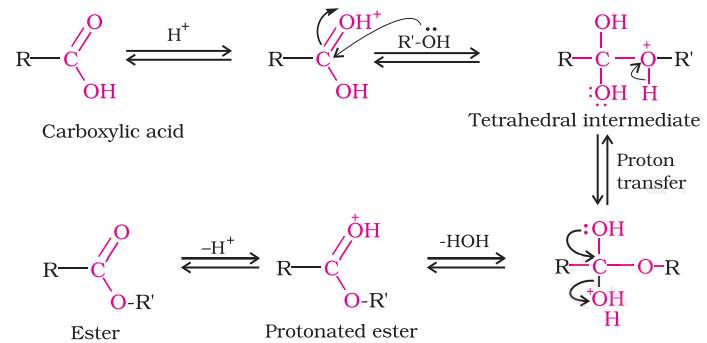
Let us see the mechanism involved in esterification.
The oxygen in the carboxyl group gets protonated to give delocalized carbocation making the carbocation a better electrophile. A proton is transferred to one of the hydroxyl groups. It forms a good leaving group. The oxygen atom of the hydroxyl alcohol group donates a pair of electrons to a carbon atom which makes a $\Pi $ bond by eliminating water. The so formed protonated ester finally loses a proton to give the ester.
So the correct option is (C) esterification.
Note: Esterification can also happen in two other ways. They are from acid anhydride and alcohol; from acid chloride and alcohol. Ester and water are the products in all three processes. Do not confuse it with disproportionation reaction, as in a disproportionation reaction, a compound with intermediate oxidation state converts into two compounds, one with higher oxidation and other with lower. But here, two compounds combine to give an ester.
Complete step by step solution:
The process of combining ethanoic acid with ethanol to form an ester (RCOOR) and water is called esterification. We can also define it as the chemical reaction resulting in the formation of at least one ester product. Concentrated sulphuric acid is used as a catalyst usually. In some cases, dry hydrogen chloride gas is used as a catalyst but these tend to involve aromatic esters.
The esterification reaction is slow and reversible.
Let us see the mechanism involved in esterification.
The oxygen in the carboxyl group gets protonated to give delocalized carbocation making the carbocation a better electrophile. A proton is transferred to one of the hydroxyl groups. It forms a good leaving group. The oxygen atom of the hydroxyl alcohol group donates a pair of electrons to a carbon atom which makes a $\Pi $ bond by eliminating water. The so formed protonated ester finally loses a proton to give the ester.
So the correct option is (C) esterification.
Note: Esterification can also happen in two other ways. They are from acid anhydride and alcohol; from acid chloride and alcohol. Ester and water are the products in all three processes. Do not confuse it with disproportionation reaction, as in a disproportionation reaction, a compound with intermediate oxidation state converts into two compounds, one with higher oxidation and other with lower. But here, two compounds combine to give an ester.
Recently Updated Pages
Master Class 12 Economics: Engaging Questions & Answers for Success

Master Class 12 English: Engaging Questions & Answers for Success
Master Class 12 Social Science: Engaging Questions & Answers for Success
Master Class 12 Maths: Engaging Questions & Answers for Success
Master Class 12 Physics: Engaging Questions & Answers for Success
Master Class 9 General Knowledge: Engaging Questions & Answers for Success
Trending doubts
Which are the Top 10 Largest Countries of the World?
Draw a labelled sketch of the human eye class 12 physics CBSE
Differentiate between homogeneous and heterogeneous class 12 chemistry CBSE
Why is the cell called the structural and functional class 12 biology CBSE
Draw ray diagrams each showing i myopic eye and ii class 12 physics CBSE
Which is the correct genotypic ratio of mendel dihybrid class 12 biology CBSE