




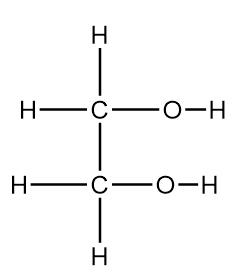
Ethane-1,2-diol has the given structure. Without breaking the $C - C$ bond, there are five possible oxidation products. What is the total number of aldehyde groups and carboxylic acid groups in these five products?
A. $ - CHO:3;\; - COOH:3$
B. $ - CHO:3;\; - COOH:4$
C. $ - CHO:4;\; - COOH:3$
D. $ - CHO:4;\; - COOH:4$
Answer
 Verified
560.7k+ views
Hint: In organic chemistry, the oxidation and reduction of compounds is described on the basis of addition and removal of hydrogen and oxygen atoms. During a reaction, if addition of oxygen atoms or removal of hydrogen atoms takes place then it is said to be oxidation reaction while if addition of hydrogen atoms or removal of oxygen atoms takes place then it is said to be reduction reaction
Complete answer:
For oxidizing alcohols, various oxidizing reagents can be used like chromic acid $\left( {{H_2}Cr{O_4}} \right)$, pyridinium chlorochromate (PCC), potassium dichromate $\left( {{K_2}C{r_2}{O_7}} \right)$, etc. Ethane-1,2-diol which is also known as ethylene glycol is an odourless, sweet tasting viscous liquid and oxidized to form various products. The possible oxidation products without cleavage of carbon-carbon single bond are as follows:
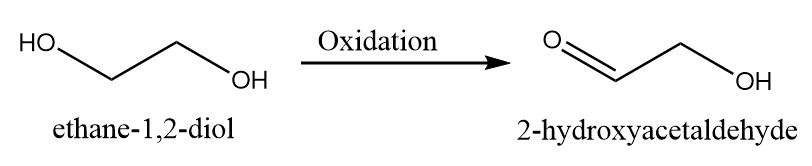
1. When only one hydroxyl group is oxidized to aldehyde group:
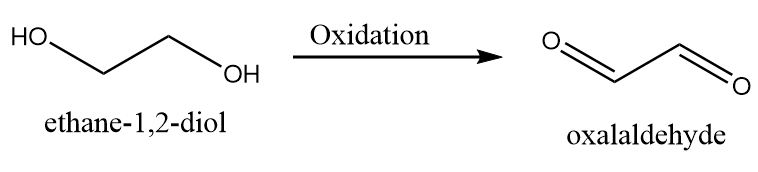
2. When both the hydroxyl groups are oxidized to aldehyde group:
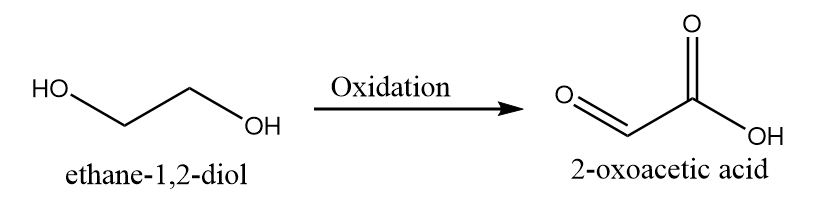
3. When one hydroxyl group is oxidized to aldehyde while other is oxidized to carboxylic acid:
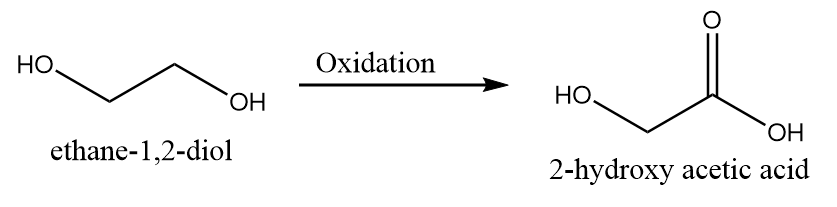
4. When only one hydroxyl group is oxidized to carboxylic acid group:
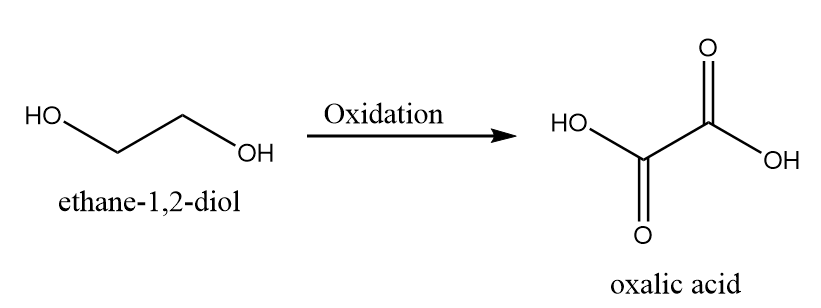
5. When both the hydroxyl groups are oxidized to carboxylic acid group:
Hence, the total four aldehyde groups and four carboxylic acid groups are formed in the possible oxidation product.
Thus, option (D) is the correct answer.
Note:
It is important to note that in ethylene glycol, both the hydroxyl groups are attached to primary carbon atoms. That’s why the groups are oxidized to the aldehyde group. If in case, the hydroxyl group is attached to a secondary carbon atom, then it will be oxidized to the ketonic group.
Complete answer:
For oxidizing alcohols, various oxidizing reagents can be used like chromic acid $\left( {{H_2}Cr{O_4}} \right)$, pyridinium chlorochromate (PCC), potassium dichromate $\left( {{K_2}C{r_2}{O_7}} \right)$, etc. Ethane-1,2-diol which is also known as ethylene glycol is an odourless, sweet tasting viscous liquid and oxidized to form various products. The possible oxidation products without cleavage of carbon-carbon single bond are as follows:
1. When only one hydroxyl group is oxidized to aldehyde group:
2. When both the hydroxyl groups are oxidized to aldehyde group:
3. When one hydroxyl group is oxidized to aldehyde while other is oxidized to carboxylic acid:
4. When only one hydroxyl group is oxidized to carboxylic acid group:
5. When both the hydroxyl groups are oxidized to carboxylic acid group:
Hence, the total four aldehyde groups and four carboxylic acid groups are formed in the possible oxidation product.
Thus, option (D) is the correct answer.
Note:
It is important to note that in ethylene glycol, both the hydroxyl groups are attached to primary carbon atoms. That’s why the groups are oxidized to the aldehyde group. If in case, the hydroxyl group is attached to a secondary carbon atom, then it will be oxidized to the ketonic group.
Recently Updated Pages
Which of the following graphs shows the variation of class 12 physics CBSE

Draw a labelled diagram of the human male reproductive class 12 biology CBSE
Describe the experiment to compare the emf of two cells class 12 physics CBSE
What is standard hydrogen electrode
What is conventional current and electric current class 12 physics CBSE
2Bromopentane is treated with an alcoholic KOH solution class 12 chemistry CBSE
Trending doubts
A member of Simon commission later became Prime Minister class 12 social science CBSE
What is the Full Form of PVC, PET, HDPE, LDPE, PP and PS ?
Differentiate between internal fertilization and external class 12 biology CBSE
Differentiate between lanthanoids and actinoids class 12 chemistry CBSE
Sketch and label the Malpighian body class 12 biology CBSE
State the principle of an ac generator and explain class 12 physics CBSE