




How do I estimate the area under the graph of \[f\left( x \right){\text{ }} = \;3cos(x)\] from \[x = 0\;\] to \[x = \dfrac{\pi }{2}\] using left and right endpoint methods?
Answer
 Verified
573.3k+ views
Hint: In this question we have found the area of the given trigonometric form. Next, we use left and right endpoint methods and then simplify to arrive at our final answer. And also we are going to draw a graph in complete step by step solution.The area A of the region under the graph of f above the $x = a{\text{ to b}}$ can be found by
\[A = \mathop {\lim }\limits_{n \to \infty } \sum\limits_{i = 1}^n {f({x_i})\Delta x.} \]
Were, ${x_i} = a + i\Delta x$ and $\Delta x = \dfrac{{b - a}}{n}.$
Complete step by step solution:
You'll need a value for n to actually get an answer, but here's the method:
Given,
\[ \Rightarrow f\left( x \right){\text{ }} = \;3cos(x)\], \[x = 0\;\]and \[x = \dfrac{\pi }{2}\]
Find $\Delta x$:
$\Delta x = \dfrac{{b - a}}{n} = \dfrac{{\dfrac{\pi }{2} - 0}}{n} = \dfrac{\pi }{{2n}}$
Find all endpoints: start at a and successively add $\Delta x$ until you get to b:
\[0,\dfrac{\pi }{{2n}},\dfrac{{2\pi }}{{2n}},\dfrac{{3\pi }}{{2n}}, \cdot \cdot \cdot ,\dfrac{{(n - 1)\pi }}{{2n}},\dfrac{{n\pi }}{{2n}} = \dfrac{\pi }{2}\]
Each rectangle has areas base time height, which will be $\Delta x$ times f at an endpoint
To use left endpoints delete the last endpoint, above, because it is not a left endpoint
Rectangle 1 has area \[\Delta xf(0) = \left( {\dfrac{\pi }{{2n}}} \right)3cos(0)\]
Rectangle 2 has area \[\Delta xf\left( {\dfrac{\pi }{{2n}}} \right) = \left( {\dfrac{\pi }{{2n}}} \right)3cos\left( {\dfrac{\pi }{{2n}}} \right)\]
Rectangle 3 has area \[\Delta xf\left( {\dfrac{{2\pi }}{{2n}}} \right) = \left( {\dfrac{\pi }{{2n}}} \right)3cos\left( {\dfrac{{2\pi }}{{2n}}} \right)\]
Rectangle 4 has area \[\Delta xf\left( {\dfrac{{3\pi }}{{2n}}} \right) = \left( {\dfrac{\pi }{{2n}}} \right)3cos\left( {\dfrac{{3\pi }}{{2n}}} \right)\]
And so on up to
Rectangle n has area\[\Delta xf\left( {\dfrac{{\left( {n - 1} \right)\pi }}{{2n}}} \right) = \left( {\dfrac{\pi }{{2n}}} \right)3cos\left( {\dfrac{{\left( {n - 1} \right)\pi }}{{2n}}} \right)\]
Do the arithmetic and add the areas.
For right endpoints delete the case \[x = 0\;\]and add the case \[x = \dfrac{\pi }{2}\]
\[\left( {\dfrac{\pi }{{2n}}} \right)3cos\left( {\dfrac{\pi }{{2n}}} \right) + \left( {\dfrac{\pi }{{2n}}} \right)3cos\left( {\dfrac{{2\pi }}{{2n}}} \right) + \left( {\dfrac{\pi }{{2n}}} \right)3cos\left( {\dfrac{{3\pi }}{{2n}}} \right) + ... + \left( {\dfrac{\pi }{2}} \right)3cos\left( {\dfrac{\pi }{{2n}}} \right)\]
You can divide the range 0 to \[\dfrac{\pi }{2}\]into a few rectangular strips and using left and right edges (endpoints) multiplied by the width of each strip calculate a minimum and a maximum area.
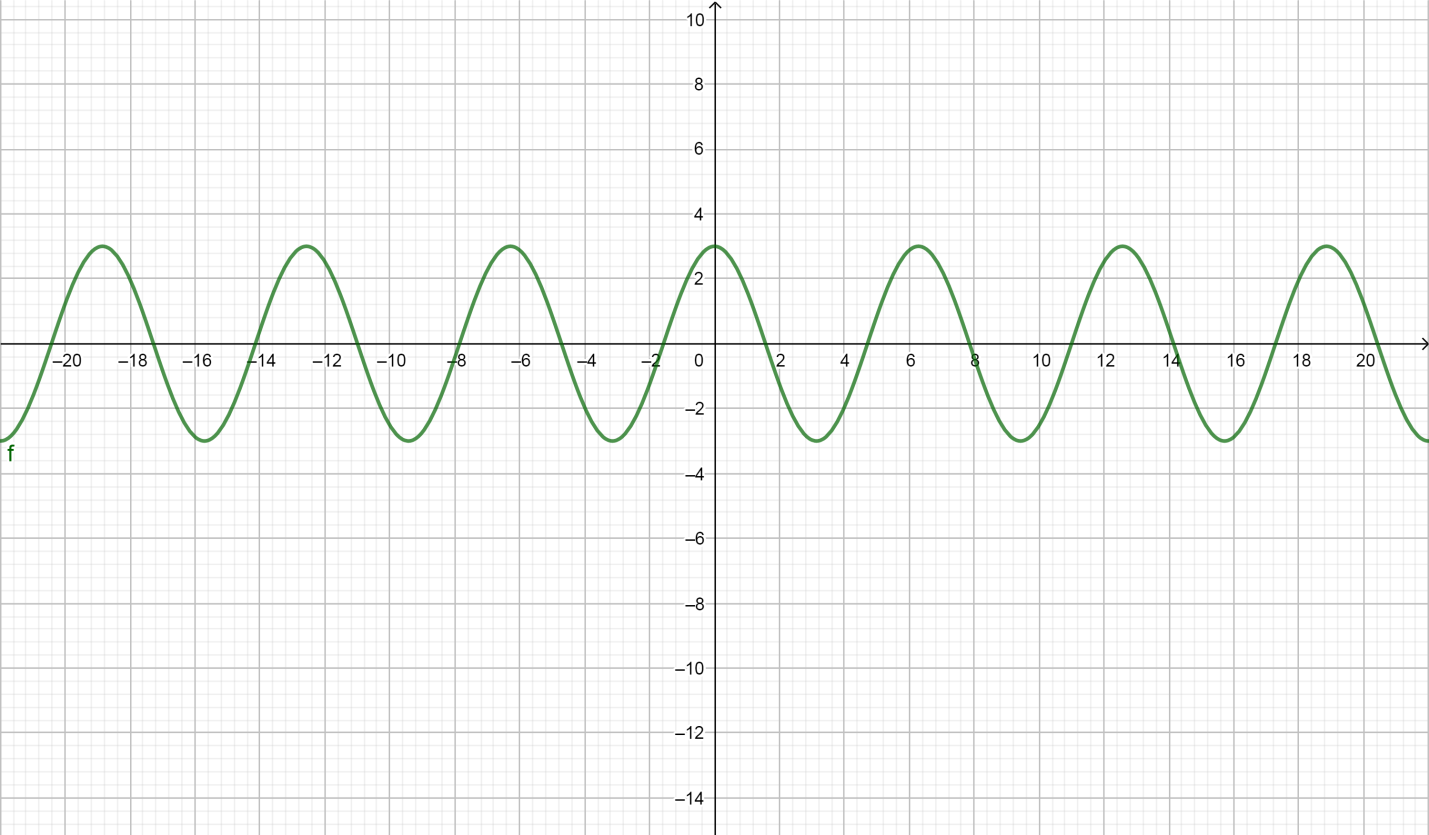
This is the required graph.
Note: We have to mind that, Rectangular integration is a numerical integration technique that approximates the integral of a function with a rectangle. It uses rectangles to approximate the area under the curve. Rectangles would be used to approximate the integral; each smaller rectangle has the width of the smaller interval.
The rectangle method (also called the midpoint rule) is the simple method in mathematics used to compute an approximation of a definite integral.
\[A = \mathop {\lim }\limits_{n \to \infty } \sum\limits_{i = 1}^n {f({x_i})\Delta x.} \]
Were, ${x_i} = a + i\Delta x$ and $\Delta x = \dfrac{{b - a}}{n}.$
Complete step by step solution:
You'll need a value for n to actually get an answer, but here's the method:
Given,
\[ \Rightarrow f\left( x \right){\text{ }} = \;3cos(x)\], \[x = 0\;\]and \[x = \dfrac{\pi }{2}\]
Find $\Delta x$:
$\Delta x = \dfrac{{b - a}}{n} = \dfrac{{\dfrac{\pi }{2} - 0}}{n} = \dfrac{\pi }{{2n}}$
Find all endpoints: start at a and successively add $\Delta x$ until you get to b:
\[0,\dfrac{\pi }{{2n}},\dfrac{{2\pi }}{{2n}},\dfrac{{3\pi }}{{2n}}, \cdot \cdot \cdot ,\dfrac{{(n - 1)\pi }}{{2n}},\dfrac{{n\pi }}{{2n}} = \dfrac{\pi }{2}\]
Each rectangle has areas base time height, which will be $\Delta x$ times f at an endpoint
To use left endpoints delete the last endpoint, above, because it is not a left endpoint
Rectangle 1 has area \[\Delta xf(0) = \left( {\dfrac{\pi }{{2n}}} \right)3cos(0)\]
Rectangle 2 has area \[\Delta xf\left( {\dfrac{\pi }{{2n}}} \right) = \left( {\dfrac{\pi }{{2n}}} \right)3cos\left( {\dfrac{\pi }{{2n}}} \right)\]
Rectangle 3 has area \[\Delta xf\left( {\dfrac{{2\pi }}{{2n}}} \right) = \left( {\dfrac{\pi }{{2n}}} \right)3cos\left( {\dfrac{{2\pi }}{{2n}}} \right)\]
Rectangle 4 has area \[\Delta xf\left( {\dfrac{{3\pi }}{{2n}}} \right) = \left( {\dfrac{\pi }{{2n}}} \right)3cos\left( {\dfrac{{3\pi }}{{2n}}} \right)\]
And so on up to
Rectangle n has area\[\Delta xf\left( {\dfrac{{\left( {n - 1} \right)\pi }}{{2n}}} \right) = \left( {\dfrac{\pi }{{2n}}} \right)3cos\left( {\dfrac{{\left( {n - 1} \right)\pi }}{{2n}}} \right)\]
Do the arithmetic and add the areas.
For right endpoints delete the case \[x = 0\;\]and add the case \[x = \dfrac{\pi }{2}\]
\[\left( {\dfrac{\pi }{{2n}}} \right)3cos\left( {\dfrac{\pi }{{2n}}} \right) + \left( {\dfrac{\pi }{{2n}}} \right)3cos\left( {\dfrac{{2\pi }}{{2n}}} \right) + \left( {\dfrac{\pi }{{2n}}} \right)3cos\left( {\dfrac{{3\pi }}{{2n}}} \right) + ... + \left( {\dfrac{\pi }{2}} \right)3cos\left( {\dfrac{\pi }{{2n}}} \right)\]
You can divide the range 0 to \[\dfrac{\pi }{2}\]into a few rectangular strips and using left and right edges (endpoints) multiplied by the width of each strip calculate a minimum and a maximum area.
This is the required graph.
Note: We have to mind that, Rectangular integration is a numerical integration technique that approximates the integral of a function with a rectangle. It uses rectangles to approximate the area under the curve. Rectangles would be used to approximate the integral; each smaller rectangle has the width of the smaller interval.
The rectangle method (also called the midpoint rule) is the simple method in mathematics used to compute an approximation of a definite integral.
Recently Updated Pages
Master Class 11 Social Science: Engaging Questions & Answers for Success

Master Class 11 Physics: Engaging Questions & Answers for Success
Master Class 11 Maths: Engaging Questions & Answers for Success
Master Class 11 Economics: Engaging Questions & Answers for Success
Master Class 11 Computer Science: Engaging Questions & Answers for Success
Master Class 11 Chemistry: Engaging Questions & Answers for Success
Trending doubts
One Metric ton is equal to kg A 10000 B 1000 C 100 class 11 physics CBSE
There are 720 permutations of the digits 1 2 3 4 5 class 11 maths CBSE
1 Quintal is equal to a 110 kg b 10 kg c 100kg d 1000 class 11 physics CBSE
State and prove Bernoullis theorem class 11 physics CBSE
Difference Between Prokaryotic Cells and Eukaryotic Cells
Discuss the various forms of bacteria class 11 biology CBSE