




Establish the formula for the capacity of spherical capacitors.
Answer
 Verified
642.3k+ views
Hint: Capacitance is found by dividing electric charge with voltage by that formula \[C = \dfrac{q}{V}\]
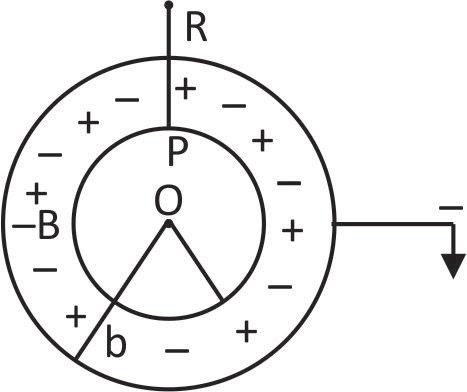
Complete step by step solution:
A and B are two \[\infty \]-centric hollow spheres separated by a dielectric medium between them: B is connected to earth. +q charge is given to A and therefore –q charge is included in B in its inner surface. The q charge on the outer surface of B goes to earth.
Radius of A and B be a and b
The potential of A is V = Due to on charge A + induced (–q) of B.
\[V = \dfrac{q}{{4\pi {\varepsilon _0}Ka}} + \dfrac{{ - q}}{{4\pi \varepsilon ab}}\]
\[V = \dfrac{q}{{4\pi {\varepsilon _0}K}}\left[ {\dfrac{1}{a} - \dfrac{1}{b}} \right]\]
\[V = \dfrac{q}{{4\pi {\varepsilon _0}K}}\left[ {\dfrac{{b - a}}{{ab}}} \right]\]
We know,
\[C = \dfrac{q}{v} = C = \dfrac{{\dfrac{q}{q}}}{{4\pi {\varepsilon _0}K}}\left[ {\dfrac{{b - a}}{{ab}}} \right]\]
\[C = 4\pi {\varepsilon _0}K\left[ {\dfrac{{ab}}{{b - a}}} \right]\]
Farad if K = 1 in air or in vacuum
\[C = \dfrac{{4\pi {\varepsilon _0}ab}}{{b - a}}farad\]
Note: The capacitance for spherical conductors can be obtained by evaluating the voltage difference between the conductors for a given charge. It depends on the inner and outer radius of each sphere.
Complete step by step solution:
A and B are two \[\infty \]-centric hollow spheres separated by a dielectric medium between them: B is connected to earth. +q charge is given to A and therefore –q charge is included in B in its inner surface. The q charge on the outer surface of B goes to earth.
Radius of A and B be a and b
The potential of A is V = Due to on charge A + induced (–q) of B.
\[V = \dfrac{q}{{4\pi {\varepsilon _0}Ka}} + \dfrac{{ - q}}{{4\pi \varepsilon ab}}\]
\[V = \dfrac{q}{{4\pi {\varepsilon _0}K}}\left[ {\dfrac{1}{a} - \dfrac{1}{b}} \right]\]
\[V = \dfrac{q}{{4\pi {\varepsilon _0}K}}\left[ {\dfrac{{b - a}}{{ab}}} \right]\]
We know,
\[C = \dfrac{q}{v} = C = \dfrac{{\dfrac{q}{q}}}{{4\pi {\varepsilon _0}K}}\left[ {\dfrac{{b - a}}{{ab}}} \right]\]
\[C = 4\pi {\varepsilon _0}K\left[ {\dfrac{{ab}}{{b - a}}} \right]\]
Farad if K = 1 in air or in vacuum
\[C = \dfrac{{4\pi {\varepsilon _0}ab}}{{b - a}}farad\]
Note: The capacitance for spherical conductors can be obtained by evaluating the voltage difference between the conductors for a given charge. It depends on the inner and outer radius of each sphere.
Recently Updated Pages
Basicity of sulphurous acid and sulphuric acid are

Master Class 11 English: Engaging Questions & Answers for Success
Master Class 11 Physics: Engaging Questions & Answers for Success
Master Class 11 Computer Science: Engaging Questions & Answers for Success
Master Class 11 Chemistry: Engaging Questions & Answers for Success
Master Class 11 Social Science: Engaging Questions & Answers for Success
Trending doubts
Difference Between Prokaryotic Cells and Eukaryotic Cells
Two of the body parts which do not appear in MRI are class 11 biology CBSE
One Metric ton is equal to kg A 10000 B 1000 C 100 class 11 physics CBSE
10 examples of friction in our daily life
Draw a diagram of nephron and explain its structur class 11 biology CBSE
What will happen if the mucus is not secreted by the class 11 biology CBSE