




Equivalent resistance between A and B in Fig. is,
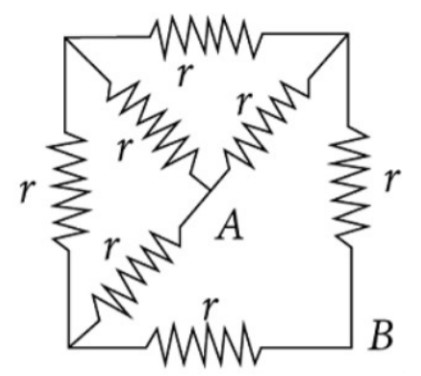
A. $8r/7$
B. $7r/8$
C. $3r/4$
D. $r$
Answer
 Verified
584.4k+ views
Hint: First, in order to find the equivalent resistance, the circuit, a network analysis has to be
done and Kirchoff’s current law has to be applied. The current passing through each resistor has
to be identified and based on that the equivalent resistance can be calculated.
Given, the resistance in each resistor is r.
Let us first connect the battery from node A and B in the circuit as shown in Fig.1,
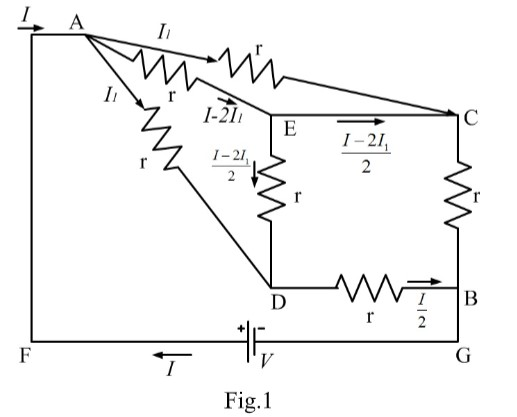
Let voltage from battery is V and the total current flowing is I. A, B, C, D, E, F, G be the nodes
in the circuit. At node A, the current I get divided as shown in Fig.1.
The equivalent resistance is given as,
${R_{eq}} = V/I$ ….…(1)
In the current path, ACEA applying KCL,
$\begin{array}{l}{I_1}r = \dfrac{{I - 2{I_1}}}{2}r + (I - 2{I_1})r\\ \Rightarrow 3I =
8{I_1}\end{array}$ ….…(2)
In the path, FACBGF,
$V = {I_1}r + \dfrac{I}{2}r$ ….…(3)
Substituting the value of I 1 from equation (2) in equation (3),
$\begin{array}{l}V = \dfrac{3}{8}Ir + \dfrac{I}{2}r = \dfrac{7}{8}Ir\\ \Rightarrow
\dfrac{V}{I} = \dfrac{7}{8}r\end{array}$ ….…(4)
Substituting value of V/I in equation (1),
${R_{eq}} = \dfrac{V}{I} = \dfrac{7}{8}r$
Hence, the correct answer is (B).
Note: In the solution, the students can calculate equivalent resistance by initially drawing the
circuit diagram and draw the current flow in each path by connecting a source to the terminals A
and B. The current at each branch or through each resistor has to be obtained. By applying
Kirchoff’s current law, the equation in terms of current and by using Kirchoff’s voltage law the
equation in terms of voltage can be obtained. Once the individual current through each path is
obtained the net current can be obtained and from this the equivalent resistance is obtained.
done and Kirchoff’s current law has to be applied. The current passing through each resistor has
to be identified and based on that the equivalent resistance can be calculated.
Given, the resistance in each resistor is r.
Let us first connect the battery from node A and B in the circuit as shown in Fig.1,
Let voltage from battery is V and the total current flowing is I. A, B, C, D, E, F, G be the nodes
in the circuit. At node A, the current I get divided as shown in Fig.1.
The equivalent resistance is given as,
${R_{eq}} = V/I$ ….…(1)
In the current path, ACEA applying KCL,
$\begin{array}{l}{I_1}r = \dfrac{{I - 2{I_1}}}{2}r + (I - 2{I_1})r\\ \Rightarrow 3I =
8{I_1}\end{array}$ ….…(2)
In the path, FACBGF,
$V = {I_1}r + \dfrac{I}{2}r$ ….…(3)
Substituting the value of I 1 from equation (2) in equation (3),
$\begin{array}{l}V = \dfrac{3}{8}Ir + \dfrac{I}{2}r = \dfrac{7}{8}Ir\\ \Rightarrow
\dfrac{V}{I} = \dfrac{7}{8}r\end{array}$ ….…(4)
Substituting value of V/I in equation (1),
${R_{eq}} = \dfrac{V}{I} = \dfrac{7}{8}r$
Hence, the correct answer is (B).
Note: In the solution, the students can calculate equivalent resistance by initially drawing the
circuit diagram and draw the current flow in each path by connecting a source to the terminals A
and B. The current at each branch or through each resistor has to be obtained. By applying
Kirchoff’s current law, the equation in terms of current and by using Kirchoff’s voltage law the
equation in terms of voltage can be obtained. Once the individual current through each path is
obtained the net current can be obtained and from this the equivalent resistance is obtained.
Recently Updated Pages
Master Class 10 Computer Science: Engaging Questions & Answers for Success

Master Class 10 General Knowledge: Engaging Questions & Answers for Success
Master Class 10 English: Engaging Questions & Answers for Success
Master Class 10 Social Science: Engaging Questions & Answers for Success
Master Class 10 Maths: Engaging Questions & Answers for Success
Master Class 10 Science: Engaging Questions & Answers for Success
Trending doubts
What is the median of the first 10 natural numbers class 10 maths CBSE
Which women's tennis player has 24 Grand Slam singles titles?
Who is the Brand Ambassador of Incredible India?
Why is there a time difference of about 5 hours between class 10 social science CBSE
Write a letter to the principal requesting him to grant class 10 english CBSE
A moving boat is observed from the top of a 150 m high class 10 maths CBSE