




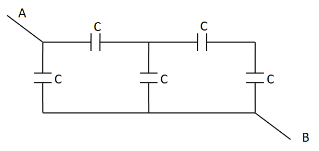
What is the equivalent capacitance of the system of capacitors between A & B?
(A) $ \dfrac{7}{2}C $
(B) $ 1.6C $
(C) $ C $
(D) None
Answer
 Verified
585.6k+ views
Hint: To solve this question, we need to imagine a battery across the points where the equivalent capacitance is required. Then, identifying the series and parallel combinations, apply the suitable formulae for the equivalent capacitance.
Formula Used: The formulae used in this solution are
$\Rightarrow \dfrac{1}{{{C_s}}} = \dfrac{1}{{{C_1}}} + \dfrac{1}{{{C_2}}} +........... $
$\Rightarrow {C_p} = {C_1} + {C_2} +........... $
Where $ {C_s} $ is the equivalent series capacitance, and $ {C_p} $ is the equivalent parallel capacitance of the capacitances $ {C_1} $, $ {C_2} $.
Complete step by step answer
In the given circuit diagram, the rightmost two capacitances are connected in series combination. So there equivalent capacitance is
$\Rightarrow \dfrac{1}{{{C_1}}} = \dfrac{1}{C} + \dfrac{1}{C} $
$ \Rightarrow \dfrac{1}{{{C_1}}} = \dfrac{2}{C} $
Taking the reciprocal, we get
$\Rightarrow {C_1} = \dfrac{C}{2} $
So the given circuit diagram can be redrawn as

Now, as we can see in the above figure, the rightmost two capacitances are arranged in parallel combination. So their equivalent capacitance becomes
$\Rightarrow {C_2} = C + \dfrac{C}{2} $
$ \Rightarrow {C_2} = \dfrac{{3C}}{2} $
So the above circuit reduces to
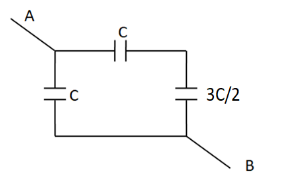
Now, the rightmost two capacitors of capacitances $ C $ and $ \dfrac{{3C}}{2} $ are in series combination. So their equivalent capacitance becomes
$\Rightarrow \dfrac{1}{{{C_3}}} = \dfrac{1}{C} + \dfrac{2}{{3C}} $
$ \Rightarrow \dfrac{1}{{{C_3}}} = \dfrac{5}{{3C}} $
Taking the reciprocal, we get
$\Rightarrow {C_3} = \dfrac{{3C}}{5} $
So the above circuit reduces to
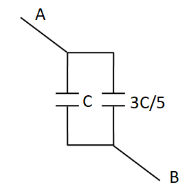
Finally, as we can observe in the above circuit diagram, the two capacitances are arranged in parallel combination. So the equivalent capacitance across A and B becomes
$\Rightarrow {C_4} = C + \dfrac{{3C}}{5} $
$ \Rightarrow {C_4} = \dfrac{{8C}}{5} = 1.6C $
Thus the equivalent capacitance between A and B is equal to $ 1.6C $.
Hence, the correct answer is option B.
Note
We should not get confused between the formula of the series and equivalent combinations of resistance and that of the capacitances. The reciprocal relation is valid for the series combination for capacitance and for the parallel combination of the resistances. And the direct addition is valid for the parallel combination for capacitance and for the series combination of the resistances.
Formula Used: The formulae used in this solution are
$\Rightarrow \dfrac{1}{{{C_s}}} = \dfrac{1}{{{C_1}}} + \dfrac{1}{{{C_2}}} +........... $
$\Rightarrow {C_p} = {C_1} + {C_2} +........... $
Where $ {C_s} $ is the equivalent series capacitance, and $ {C_p} $ is the equivalent parallel capacitance of the capacitances $ {C_1} $, $ {C_2} $.
Complete step by step answer
In the given circuit diagram, the rightmost two capacitances are connected in series combination. So there equivalent capacitance is
$\Rightarrow \dfrac{1}{{{C_1}}} = \dfrac{1}{C} + \dfrac{1}{C} $
$ \Rightarrow \dfrac{1}{{{C_1}}} = \dfrac{2}{C} $
Taking the reciprocal, we get
$\Rightarrow {C_1} = \dfrac{C}{2} $
So the given circuit diagram can be redrawn as
Now, as we can see in the above figure, the rightmost two capacitances are arranged in parallel combination. So their equivalent capacitance becomes
$\Rightarrow {C_2} = C + \dfrac{C}{2} $
$ \Rightarrow {C_2} = \dfrac{{3C}}{2} $
So the above circuit reduces to
Now, the rightmost two capacitors of capacitances $ C $ and $ \dfrac{{3C}}{2} $ are in series combination. So their equivalent capacitance becomes
$\Rightarrow \dfrac{1}{{{C_3}}} = \dfrac{1}{C} + \dfrac{2}{{3C}} $
$ \Rightarrow \dfrac{1}{{{C_3}}} = \dfrac{5}{{3C}} $
Taking the reciprocal, we get
$\Rightarrow {C_3} = \dfrac{{3C}}{5} $
So the above circuit reduces to
Finally, as we can observe in the above circuit diagram, the two capacitances are arranged in parallel combination. So the equivalent capacitance across A and B becomes
$\Rightarrow {C_4} = C + \dfrac{{3C}}{5} $
$ \Rightarrow {C_4} = \dfrac{{8C}}{5} = 1.6C $
Thus the equivalent capacitance between A and B is equal to $ 1.6C $.
Hence, the correct answer is option B.
Note
We should not get confused between the formula of the series and equivalent combinations of resistance and that of the capacitances. The reciprocal relation is valid for the series combination for capacitance and for the parallel combination of the resistances. And the direct addition is valid for the parallel combination for capacitance and for the series combination of the resistances.
Recently Updated Pages
Master Class 11 Social Science: Engaging Questions & Answers for Success

Master Class 11 Physics: Engaging Questions & Answers for Success
Master Class 11 Maths: Engaging Questions & Answers for Success
Master Class 11 Economics: Engaging Questions & Answers for Success
Master Class 11 Computer Science: Engaging Questions & Answers for Success
Master Class 11 Chemistry: Engaging Questions & Answers for Success
Trending doubts
One Metric ton is equal to kg A 10000 B 1000 C 100 class 11 physics CBSE
There are 720 permutations of the digits 1 2 3 4 5 class 11 maths CBSE
1 Quintal is equal to a 110 kg b 10 kg c 100kg d 1000 class 11 physics CBSE
State and prove Bernoullis theorem class 11 physics CBSE
Difference Between Prokaryotic Cells and Eukaryotic Cells
Which among the following are examples of coming together class 11 social science CBSE