




What is the equivalent angle of one radian?
(A) ${53.3^ \circ }$
(B) ${54.3^ \circ }$
(C) ${57.3^ \circ }$
(D) ${55.3^ \circ }$
Answer
 Verified
584.4k+ views
Hint: In order to calculate the angle of any object we have two methods. They are degrees and radians. Radian is one to express an angle. Radian is denoted by the symbol $rad$ which is the S.I. unit for calculating angle of a circle.
Complete step by step solution:
The calculation of radian of a mean angle circle can be explained as the proportion of the distance of the curve of a mean angle circle specific by the angle to that of the distance of the radius of the circle. In order to fully grasp the concept of radian let’s assume a circle of radius of $r$ , mean angle $\theta $ and the specific curve distance $l$. According to the mean angle circle radian is expressed as;
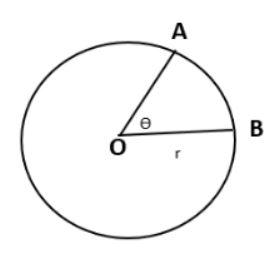
$\theta = \dfrac{l}{r}$
We can constitute $\theta $ as one radian, when $l = r$ ;
$\theta = \dfrac{r}{r}$
$\theta = 1$
For the calculation of one radian in degree;
Let us consider a semicircle where the mean angle is ${180^ \circ }$ . the number of radians that are required to replace the mean angle of the semicircle is more or less equal to $3.14$ $\pi $. Where $\pi $ can be explained as the proportion of the diameter of the circle is divided to the circumference of the circle.
Since $\pi $ is a radian equal to ${180^ \circ }$ we can say that;
$1$ radian $ = \dfrac{{{{180}^ \circ }}}{\pi } = {57.3^ \circ }$
Therefore, one radian is equivalent to ${57.3^ \circ }$
Hence, the option (C), ${57.3^ \circ }$ is the correct answer.
Note: In order to convert to degree to radian the formula is multiply the angle by $\dfrac{\pi }{{{{180}^ \circ }}}$ and in order to convert to radian to degree the formula is multiply the angle by $\dfrac{{{{180}^ \circ }}}{\pi }$ . While solving this problem make sure to draw the diagram of the mean circle and mark the necessary details, it will be helpful in determining the angle.
Complete step by step solution:
The calculation of radian of a mean angle circle can be explained as the proportion of the distance of the curve of a mean angle circle specific by the angle to that of the distance of the radius of the circle. In order to fully grasp the concept of radian let’s assume a circle of radius of $r$ , mean angle $\theta $ and the specific curve distance $l$. According to the mean angle circle radian is expressed as;
$\theta = \dfrac{l}{r}$
We can constitute $\theta $ as one radian, when $l = r$ ;
$\theta = \dfrac{r}{r}$
$\theta = 1$
For the calculation of one radian in degree;
Let us consider a semicircle where the mean angle is ${180^ \circ }$ . the number of radians that are required to replace the mean angle of the semicircle is more or less equal to $3.14$ $\pi $. Where $\pi $ can be explained as the proportion of the diameter of the circle is divided to the circumference of the circle.
Since $\pi $ is a radian equal to ${180^ \circ }$ we can say that;
$1$ radian $ = \dfrac{{{{180}^ \circ }}}{\pi } = {57.3^ \circ }$
Therefore, one radian is equivalent to ${57.3^ \circ }$
Hence, the option (C), ${57.3^ \circ }$ is the correct answer.
Note: In order to convert to degree to radian the formula is multiply the angle by $\dfrac{\pi }{{{{180}^ \circ }}}$ and in order to convert to radian to degree the formula is multiply the angle by $\dfrac{{{{180}^ \circ }}}{\pi }$ . While solving this problem make sure to draw the diagram of the mean circle and mark the necessary details, it will be helpful in determining the angle.
Recently Updated Pages
Master Class 11 Computer Science: Engaging Questions & Answers for Success

Master Class 11 Business Studies: Engaging Questions & Answers for Success
Master Class 11 Economics: Engaging Questions & Answers for Success
Master Class 11 English: Engaging Questions & Answers for Success
Master Class 11 Maths: Engaging Questions & Answers for Success
Master Class 11 Biology: Engaging Questions & Answers for Success
Trending doubts
One Metric ton is equal to kg A 10000 B 1000 C 100 class 11 physics CBSE
There are 720 permutations of the digits 1 2 3 4 5 class 11 maths CBSE
Discuss the various forms of bacteria class 11 biology CBSE
Draw a diagram of a plant cell and label at least eight class 11 biology CBSE
State the laws of reflection of light
Explain zero factorial class 11 maths CBSE