




When is equilibrium reached in diffusion?
Answer
 Verified
557.7k+ views
Hint: Chemical equilibrium is defined as the state where both the reactants and the products are present in equal concentration and thereby don’t have any tendency to change with time, and no observable change is found in the properties of the system. We will understand diffusion further in the question.
Complete Step By Step Answer:
Molecular diffusion also known as diffusion is the motion of particles (liquids as well as gases) at a temperature above the absolute zero. The rate of diffusion depends on the temperature, viscosity of the fluids, size of the particles, etc. The diffusion results in the uniform distribution of molecules upon mixing of materials. Once the mixing is uniform, it achieves a state of dynamic equilibrium. In this phase molecules are still in motion, but the external net forces acting on the particles are absent. This gradually led to uniform mixing.
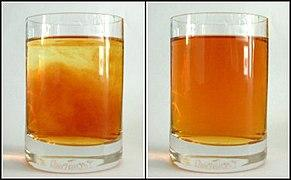
The simple example of diffusion is dispersion of dye in water. When one drop of dye is initially put in water contained in a beaker, it slowly spreads throughout the entire beaker, until no part of the water is left colorless. This is the stage where we say that the dye has been uniformly mixed in the container. The image below shows the process of diffusion of dye. Once the water is uniformly colored, we say that the state of equilibrium has been achieved.
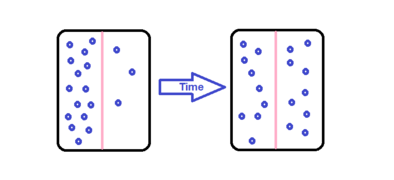
Diffusion also occurs across membranes. In the image shown below there are unequal concentrations of substance on either side of the semi permeable membrane given by the pink line. The concentration on either side of the pink line is different. If the molecules are small in size, the molecules tend to cross the membrane into a region with low concentration. The molecules can move in all directions, but major movement is found from the high concentrated region to low concentrated region. Eventually, the concentration on the lower side increases and a stage is reached where concentration is equal on both the sides. This state is known as the Diffusion Equilibrium. At this stage the molecules move back and forth at the same rate.
Note:
Osmosis is also a type of diffusion only but it is only limited to the liquid substances. Osmosis is the process of movement of solute particles from a higher concentration to a lower concentration through a semipermeable membrane. Water moves in and out of the cells by osmosis only.
Complete Step By Step Answer:
Molecular diffusion also known as diffusion is the motion of particles (liquids as well as gases) at a temperature above the absolute zero. The rate of diffusion depends on the temperature, viscosity of the fluids, size of the particles, etc. The diffusion results in the uniform distribution of molecules upon mixing of materials. Once the mixing is uniform, it achieves a state of dynamic equilibrium. In this phase molecules are still in motion, but the external net forces acting on the particles are absent. This gradually led to uniform mixing.
The simple example of diffusion is dispersion of dye in water. When one drop of dye is initially put in water contained in a beaker, it slowly spreads throughout the entire beaker, until no part of the water is left colorless. This is the stage where we say that the dye has been uniformly mixed in the container. The image below shows the process of diffusion of dye. Once the water is uniformly colored, we say that the state of equilibrium has been achieved.
Diffusion also occurs across membranes. In the image shown below there are unequal concentrations of substance on either side of the semi permeable membrane given by the pink line. The concentration on either side of the pink line is different. If the molecules are small in size, the molecules tend to cross the membrane into a region with low concentration. The molecules can move in all directions, but major movement is found from the high concentrated region to low concentrated region. Eventually, the concentration on the lower side increases and a stage is reached where concentration is equal on both the sides. This state is known as the Diffusion Equilibrium. At this stage the molecules move back and forth at the same rate.
Note:
Osmosis is also a type of diffusion only but it is only limited to the liquid substances. Osmosis is the process of movement of solute particles from a higher concentration to a lower concentration through a semipermeable membrane. Water moves in and out of the cells by osmosis only.
Recently Updated Pages
If x a + bt + ct2 where x is in meters and t is in class 11 physics CBSE

A car covers the first half distance between two places class 11 physics CBSE
The resultant of two vectors overrightarrow P and overrightarrow class 11 physics CBSE
Find the value of cos 135 class 11 maths CBSE
A mass M is held in place by an applied force F and class 11 physics CBSE
A solution of glucose in water is labelled as 10 dfracwv class 11 chemistry CBSE
Trending doubts
One Metric ton is equal to kg A 10000 B 1000 C 100 class 11 physics CBSE
Find the value of the expression given below sin 30circ class 11 maths CBSE
What do you mean by retardation What is its SI uni class 11 physics CBSE
Draw a diagram of nephron and explain its structur class 11 biology CBSE
10 examples of friction in our daily life
Difference between physical and chemical change class 11 chemistry CBSE