




Epiphytes like Vanda, develop a special layer of absorptive tissue velamen consisting of 4 or 5 layers of long polygonal cells. Velamen is formed in
(a)Prop roots
(b)Stem
(c)Clinging roots
(d)Hanging roots
Answer
 Verified
622.8k+ views
Hint: They are generally found in the family of orchids and grow by hanging from the other trees which helps in the process of absorption of water in the plants and also prevents water loss.
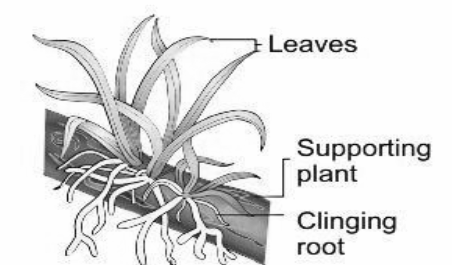
The genus Vanda belongs to the Orchidaceae which is commonly called an orchid family. They mostly consist of the epiphytic roots that are hygroscopic. These roots have special tissue called Velamen which helps in absorption, these roots are called hanging roots.
Complete answer
> The plants of orchids are epiphytic thus possess a very large aerial root system.
> Epiphytic roots absorb water, present in the form of moisture, and from the air with the help of velamen present in them.
> Epiphytic roots are of various types, they are:
- Climbing roots: They develop on those plants which have weak stems and require support for climbing. They are called aerial roots as they are above the ground.
- Prop roots: they develop from the upper part of the stem and grows down into the soil for the plant to stand erect.
- Hanging roots: They are the water-absorbing roots having special tissue called velamen. This tissue is spongy in texture and helps in absorbing the moisture around it.
So, the correct answer is ‘Hanging roots’.
Aerial absorbing roots (Velamen)
Note: Epiphytic plants are non-parasitic plants that, although grows on other plants but do not get their requirements from them instead they get the nutrition by absorbing the moisture from the air and the water while parasitic plants are those who derive their nutrition from the host plants on which they are living.
The genus Vanda belongs to the Orchidaceae which is commonly called an orchid family. They mostly consist of the epiphytic roots that are hygroscopic. These roots have special tissue called Velamen which helps in absorption, these roots are called hanging roots.
Complete answer
> The plants of orchids are epiphytic thus possess a very large aerial root system.
> Epiphytic roots absorb water, present in the form of moisture, and from the air with the help of velamen present in them.
> Epiphytic roots are of various types, they are:
- Climbing roots: They develop on those plants which have weak stems and require support for climbing. They are called aerial roots as they are above the ground.
- Prop roots: they develop from the upper part of the stem and grows down into the soil for the plant to stand erect.
- Hanging roots: They are the water-absorbing roots having special tissue called velamen. This tissue is spongy in texture and helps in absorbing the moisture around it.
So, the correct answer is ‘Hanging roots’.
Aerial absorbing roots (Velamen)
Note: Epiphytic plants are non-parasitic plants that, although grows on other plants but do not get their requirements from them instead they get the nutrition by absorbing the moisture from the air and the water while parasitic plants are those who derive their nutrition from the host plants on which they are living.
Recently Updated Pages
Master Class 11 English: Engaging Questions & Answers for Success

Master Class 11 Social Science: Engaging Questions & Answers for Success
Master Class 11 Maths: Engaging Questions & Answers for Success
Master Class 11 Biology: Engaging Questions & Answers for Success
Master Class 11 Physics: Engaging Questions & Answers for Success
Master Class 11 Chemistry: Engaging Questions & Answers for Success
Trending doubts
One Metric ton is equal to kg A 10000 B 1000 C 100 class 11 physics CBSE
Difference Between Prokaryotic Cells and Eukaryotic Cells
Find the value of the expression given below sin 30circ class 11 maths CBSE
Two of the body parts which do not appear in MRI are class 11 biology CBSE
Draw a diagram of a plant cell and label at least eight class 11 biology CBSE
10 examples of friction in our daily life