




Epipetalous stamens are seen in-
A) Thespesia
B) Datura
C) Male flower of Ricinus
D) Ravenala
Answer
 Verified
642.6k+ views
Hint: The attachment of androecium with petals in several flowers is called epipetalous arrangement. It is a morphological character.
Complete answer:
The stamens are the male reproductive organ of a flower, they produce pollen grains. Stamens collectively form the androecium. The stamens can be present in a dainty manner along with different whorls of the flower.
On the basis of whorl they are attached with, they are of two types-
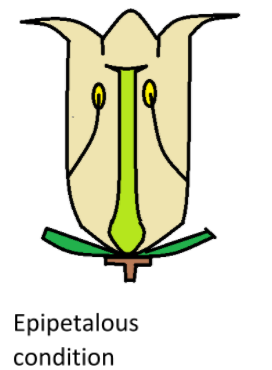
i) Epipetalous- when the stamens are attached to the petals. Example- brinjal.
ii) Epiphyllous- when the stamen is attached to the perianth. Example- lily.
In Datura, the stamens are attached to the petals. Therefore the attachment is called epipetalous.
Additional information :Terms related to placement of androecium-
i) Monadelphous: present in one bunch.
ii) Diadelphous: present in two bundles.
iii) Polyadelphous: present in more than two bundles.
iii) Didymous: two equal pairs of stamens.
iv) Didynamous: a long pair and a shorter pair of stamens.
v) Tetradynamous: present as a set of six stamens with four long and two shorter ones.
vi) Exserted: stamens extend beyond the corolla.
vii) Included: stamens does not extend beyond the corolla.
viii) Spiral: present in a spiral manner.
ix) Whorled: series of one or more discrete whorls.
Thus, the correct answer is option ‘B’ i.e, Datura
Note:
i) Diplostemonous: In two whorls, the outer ones present alternatively with the petals, while the inner one in the opposite direction.
ii) Haplostemenous: Having a single series of stamens, alternative to the petals and equal to the number of petals.
iii) Obdiplostemonous: In two whorls, having twice the number of stamens to that of petals.
Complete answer:
The stamens are the male reproductive organ of a flower, they produce pollen grains. Stamens collectively form the androecium. The stamens can be present in a dainty manner along with different whorls of the flower.
On the basis of whorl they are attached with, they are of two types-
i) Epipetalous- when the stamens are attached to the petals. Example- brinjal.
ii) Epiphyllous- when the stamen is attached to the perianth. Example- lily.
In Datura, the stamens are attached to the petals. Therefore the attachment is called epipetalous.
Additional information :Terms related to placement of androecium-
i) Monadelphous: present in one bunch.
ii) Diadelphous: present in two bundles.
iii) Polyadelphous: present in more than two bundles.
iii) Didymous: two equal pairs of stamens.
iv) Didynamous: a long pair and a shorter pair of stamens.
v) Tetradynamous: present as a set of six stamens with four long and two shorter ones.
vi) Exserted: stamens extend beyond the corolla.
vii) Included: stamens does not extend beyond the corolla.
viii) Spiral: present in a spiral manner.
ix) Whorled: series of one or more discrete whorls.
Thus, the correct answer is option ‘B’ i.e, Datura
Note:
i) Diplostemonous: In two whorls, the outer ones present alternatively with the petals, while the inner one in the opposite direction.
ii) Haplostemenous: Having a single series of stamens, alternative to the petals and equal to the number of petals.
iii) Obdiplostemonous: In two whorls, having twice the number of stamens to that of petals.
Recently Updated Pages
Which will be the least stable resonating structure class 11 chemistry CBSE

How many 5 digit telephone numbers can be construc-class-11-maths-CBSE
How do you find the angle of the resultant vector class 11 physics CBSE
Draw labelled diagram of the following i Gram seed class 11 biology CBSE
1 Quintal is equal to a 110 kg b 10 kg c 100kg d 1000 class 11 physics CBSE
What is the need and importance of classification class 11 biology CBSE
Trending doubts
Find the value of the expression given below sin 30circ class 11 maths CBSE
One Metric ton is equal to kg A 10000 B 1000 C 100 class 11 physics CBSE
10 examples of friction in our daily life
Draw a diagram of a plant cell and label at least eight class 11 biology CBSE
Difference between physical and chemical change class 11 chemistry CBSE
Proton was discovered by A Thomson B Rutherford C Chadwick class 11 chemistry CBSE