




Ephyra is a young stage of
(a) Obelia
(b) Sea anemone
(c) Physalia
(d) Auralia
Answer
 Verified
516.9k+ views
Hint: It occurs mostly in the case of the marine organisms that belong to the family of the jellyfish. The Ephyra is the young stage of development in these organisms. This organism belongs to the phylum cnidaria.
Complete answer
A jellyfish is a medusa form of certain members of phylum Cnidaria. Jellyfish are also called Aurelia and belong to the phylum Cnidaria. They are free-living umbrella-shaped animals. They are present in the marine water. They have a defense mechanism in the form of the tentacles that are present on their body to help in the protection of the organism by acting as the stinging cells. Their life cycle includes the small larva called planula that is attached to the polyp of the organism and from there it develops to form an ephyra. The medusa stage larvae from the ephyrae in the case of the Aurelia and later develop into the mature adult medusa that is capable of reproducing sexually.
Additional information
Obelia also belongs to the phylum Cnidaria that is commonly known as the sea fur and is marine in habitat. It has two stages of the life cycle, one is a sexual stage called the medusa stage while the asexual is called the polyp stage. They have a tiny larva called planula that attaches to poly and then reproduces asexually and results in the formation of the medusa stage which is free living.
Sea anemones are the marine animals that are called Adamsia. Their life-cycle consists of the planula larva which forms the juvenile stage then later develops into the adult larva. They are in a symbiotic relationship with the hermit crab and undergo reproduction asexually. Physalia is also known as the ‘man of war’ which is marine in nature and generally floats near the surface of the water. Their life cycle involves colonies made up of several polyps.
So, the correct answer is ‘Aurelia’.
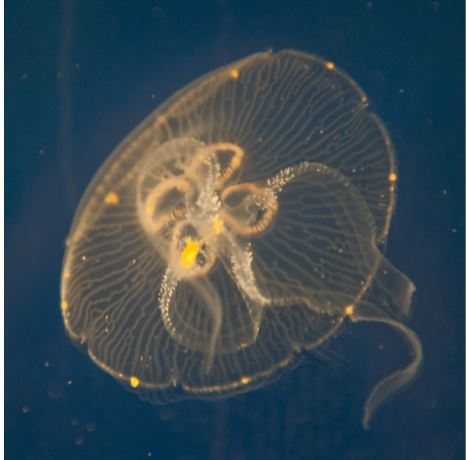
Fig: Aurelia
Note:
Aurelia is also known as the moon jellies. The Aurelia are found to be having various shapes, sizes, structures, etc but generally, their body’s diameter ranges from 5-38 centimeters having an average width of 18 cm and length of eight cm. The polyps of these jellyfish can grow to 1.6 centimeters tall and their ephyrae, the larval sort of the jellyfish, have a mean diameter of 0.4 centimeters.
Complete answer
A jellyfish is a medusa form of certain members of phylum Cnidaria. Jellyfish are also called Aurelia and belong to the phylum Cnidaria. They are free-living umbrella-shaped animals. They are present in the marine water. They have a defense mechanism in the form of the tentacles that are present on their body to help in the protection of the organism by acting as the stinging cells. Their life cycle includes the small larva called planula that is attached to the polyp of the organism and from there it develops to form an ephyra. The medusa stage larvae from the ephyrae in the case of the Aurelia and later develop into the mature adult medusa that is capable of reproducing sexually.
Additional information
Obelia also belongs to the phylum Cnidaria that is commonly known as the sea fur and is marine in habitat. It has two stages of the life cycle, one is a sexual stage called the medusa stage while the asexual is called the polyp stage. They have a tiny larva called planula that attaches to poly and then reproduces asexually and results in the formation of the medusa stage which is free living.
Sea anemones are the marine animals that are called Adamsia. Their life-cycle consists of the planula larva which forms the juvenile stage then later develops into the adult larva. They are in a symbiotic relationship with the hermit crab and undergo reproduction asexually. Physalia is also known as the ‘man of war’ which is marine in nature and generally floats near the surface of the water. Their life cycle involves colonies made up of several polyps.
So, the correct answer is ‘Aurelia’.
Fig: Aurelia
Note:
Aurelia is also known as the moon jellies. The Aurelia are found to be having various shapes, sizes, structures, etc but generally, their body’s diameter ranges from 5-38 centimeters having an average width of 18 cm and length of eight cm. The polyps of these jellyfish can grow to 1.6 centimeters tall and their ephyrae, the larval sort of the jellyfish, have a mean diameter of 0.4 centimeters.
Recently Updated Pages
Master Class 11 Computer Science: Engaging Questions & Answers for Success

Master Class 11 Business Studies: Engaging Questions & Answers for Success
Master Class 11 Economics: Engaging Questions & Answers for Success
Master Class 11 English: Engaging Questions & Answers for Success
Master Class 11 Maths: Engaging Questions & Answers for Success
Master Class 11 Biology: Engaging Questions & Answers for Success
Trending doubts
One Metric ton is equal to kg A 10000 B 1000 C 100 class 11 physics CBSE
There are 720 permutations of the digits 1 2 3 4 5 class 11 maths CBSE
Discuss the various forms of bacteria class 11 biology CBSE
Draw a diagram of a plant cell and label at least eight class 11 biology CBSE
State the laws of reflection of light
10 examples of friction in our daily life