




Entomophily is pollination by
(a) Water
(b) Animals
(c) Air
(d) Insects
Answer
 Verified
658.5k+ views
Hint: Pollination is the process of transfer of pollen grains from the male of a flower to the female stigma.
Complete answer:
If the pollinating agents are insects then it is called entomophily. Insects like bees, butterflies, moths, wasps, flies, ants, and beetles are reported to be responsible for the pollination of many plant species. In Salvia, the pollinating agents are insects and there is a special mechanism called a lever mechanism or turn pipe mechanism. The lever present in the plant causes the stamens to move and the pollen to be deposited on the pollinator who visits for nectar. The lever returns to its original position after the pollinator leaves the flower.
- Pollination is important because it leads to the production of fruits and seeds which in turn can create more plants.
- Pollinators receive nectar and/or pollen rewards from the flowers like sugary nectar provides pollinators with carbohydrates while pollen offers proteins, fats, vitamins, and necessary phytochemicals.
- The offspring produced is usually healthy, viable, and stronger.
- Two types of pollination- The transfer of pollen from another plant to the flower of another plant is known as cross- pollination. The pollination of a flower by pollen from the same flower or another flower on the same plant is known as self- pollination.
- In plants, after pollination, fertilization occurs when haploid gametes (pollen grain and egg) by certain agents meet to create a diploid zygote, leading to an embryo.
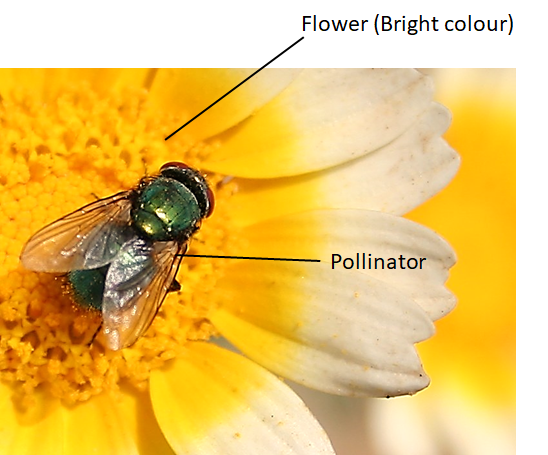
So, the correct answer is ‘Insects’.
Note:
- Elements such as animals (insects, birds, and bats, etc.), water, wind, and even plants themselves are pollinating agents.
- Pollination by the agency of ants is called myrmecophily, pollination by the agency of bats is called chiropterophily, and pollination by the agency of birds is called ornithophily.
Complete answer:
If the pollinating agents are insects then it is called entomophily. Insects like bees, butterflies, moths, wasps, flies, ants, and beetles are reported to be responsible for the pollination of many plant species. In Salvia, the pollinating agents are insects and there is a special mechanism called a lever mechanism or turn pipe mechanism. The lever present in the plant causes the stamens to move and the pollen to be deposited on the pollinator who visits for nectar. The lever returns to its original position after the pollinator leaves the flower.
- Pollination is important because it leads to the production of fruits and seeds which in turn can create more plants.
- Pollinators receive nectar and/or pollen rewards from the flowers like sugary nectar provides pollinators with carbohydrates while pollen offers proteins, fats, vitamins, and necessary phytochemicals.
- The offspring produced is usually healthy, viable, and stronger.
- Two types of pollination- The transfer of pollen from another plant to the flower of another plant is known as cross- pollination. The pollination of a flower by pollen from the same flower or another flower on the same plant is known as self- pollination.
- In plants, after pollination, fertilization occurs when haploid gametes (pollen grain and egg) by certain agents meet to create a diploid zygote, leading to an embryo.
So, the correct answer is ‘Insects’.
Note:
- Elements such as animals (insects, birds, and bats, etc.), water, wind, and even plants themselves are pollinating agents.
- Pollination by the agency of ants is called myrmecophily, pollination by the agency of bats is called chiropterophily, and pollination by the agency of birds is called ornithophily.
Recently Updated Pages
What is BLO What is the full form of BLO class 8 social science CBSE

Explain the Treaty of Vienna of 1815 class 10 social science CBSE
10 examples of friction in our daily life
Draw a diagram of nephron and explain its structur class 11 biology CBSE
Write structures of the following compounds i 2 Chloro3methylpentane class 11 chemistry CBSE
A Paragraph on Pollution in about 100-150 Words
Trending doubts
Draw a labelled sketch of the human eye class 12 physics CBSE
Which are the Top 10 Largest Countries of the World?
Differentiate between homogeneous and heterogeneous class 12 chemistry CBSE
Draw ray diagrams each showing i myopic eye and ii class 12 physics CBSE
Which is the correct genotypic ratio of mendel dihybrid class 12 biology CBSE
What is the Full Form of PVC, PET, HDPE, LDPE, PP and PS ?