




Enlist different organs of the foregut of a cockroach.
Answer
 Verified
590.4k+ views
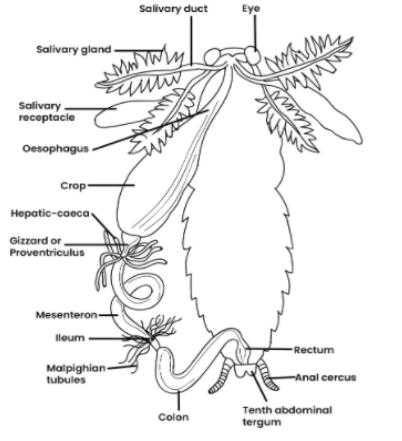
Hint: In the cockroach, the food canal is made of foregut, midgut, and hindgut. Foregut has the following components:
1. The Mouth
2. Pharynx
3. Crop or oesophagus
4. Gizzard
5. Pair of Salivary glands
Complete answer:
The mouth- These mouthparts allow the cockroach to bite and chew on the hard stuff, eat soft stuff, and lap on fluids as well. Labrum, Mandibles, and a pair of first maxillae, labium, and hypopharynx are also included in the mouth sections. The arrangement of each of the mouth elements, Labrum, is as follows: the labrum covers the mouth.
Pharynx- A well-muscular organ called the Pharynx is present behind the mouth, forcing the food into the oesophagus. In sap feeders, the pharynx serves as a sucking pump. A narrow tube that conducts food into crops is the oesophagus. Teeth, like grinding and straining food in a cockroach.
Crop or oesophagus- The oesophagus is a thin, narrow tabular structure followed by a large structure known as a seed, similar to a large sac. The crop is a food supply storage pocket. Crucial point: ... Gizzard is a thin, rounded thick-walled lining structure with muscular chitins.
Gizzard- In the oesophagus, the food enters and then into the seed. ... The food is then transmitted to the Gizzard, which serves as a chamber for grinding. Gast caeca-secreted digestive enzymes act on the food in the stomach.
Pair of salivary glands- The salivary cockroach gland consists of secretory acini with central protein-producing cells and peripheral ion-transporting cells, an extensive duct system, and a pair of reservoirs. Serotonergic and dopaminergic innervation regulates salivation.
Note: The foregut opens into a void, where it temporarily stores undigested food. The mouth opens into a short tubular pharynx that leads to the oesophagus, a narrow tubular passage. Bacteria that the cockroach uses to digest its food are found in the gastric sacks.
1. The Mouth
2. Pharynx
3. Crop or oesophagus
4. Gizzard
5. Pair of Salivary glands
Complete answer:
The mouth- These mouthparts allow the cockroach to bite and chew on the hard stuff, eat soft stuff, and lap on fluids as well. Labrum, Mandibles, and a pair of first maxillae, labium, and hypopharynx are also included in the mouth sections. The arrangement of each of the mouth elements, Labrum, is as follows: the labrum covers the mouth.
Pharynx- A well-muscular organ called the Pharynx is present behind the mouth, forcing the food into the oesophagus. In sap feeders, the pharynx serves as a sucking pump. A narrow tube that conducts food into crops is the oesophagus. Teeth, like grinding and straining food in a cockroach.
Crop or oesophagus- The oesophagus is a thin, narrow tabular structure followed by a large structure known as a seed, similar to a large sac. The crop is a food supply storage pocket. Crucial point: ... Gizzard is a thin, rounded thick-walled lining structure with muscular chitins.
Gizzard- In the oesophagus, the food enters and then into the seed. ... The food is then transmitted to the Gizzard, which serves as a chamber for grinding. Gast caeca-secreted digestive enzymes act on the food in the stomach.
Pair of salivary glands- The salivary cockroach gland consists of secretory acini with central protein-producing cells and peripheral ion-transporting cells, an extensive duct system, and a pair of reservoirs. Serotonergic and dopaminergic innervation regulates salivation.
Note: The foregut opens into a void, where it temporarily stores undigested food. The mouth opens into a short tubular pharynx that leads to the oesophagus, a narrow tubular passage. Bacteria that the cockroach uses to digest its food are found in the gastric sacks.
Recently Updated Pages
Basicity of sulphurous acid and sulphuric acid are

Master Class 11 Business Studies: Engaging Questions & Answers for Success
Master Class 11 Computer Science: Engaging Questions & Answers for Success
Master Class 11 Economics: Engaging Questions & Answers for Success
Master Class 11 Social Science: Engaging Questions & Answers for Success
Master Class 11 English: Engaging Questions & Answers for Success
Trending doubts
One Metric ton is equal to kg A 10000 B 1000 C 100 class 11 physics CBSE
The largest wind power cluster is located in the state class 11 social science CBSE
Explain zero factorial class 11 maths CBSE
State and prove Bernoullis theorem class 11 physics CBSE
Which among the following are examples of coming together class 11 social science CBSE
Can anyone list 10 advantages and disadvantages of friction