




What is the electronic configuration for As?
Answer
 Verified
571.2k+ views
Hint: Arsenic is the element from group 15. It has the atomic number of 33. Arsenic is the element of the p-block. Aufbau proposed the filling of electrons.the filling of electrons takes place in s, p, d, and f orbitals, according to various energy levels.
Complete answer: Electronic configuration of any element tells us the total number of electrons in that atom or the atomic number of that element. Electronic configuration of any element consists of filling the orbital with electrons. The filling of electrons in various orbitals is according to a principle of Aufbau. The filling takes place in s, p, d, and f subshells. These subshells are written along with the number of shells, like 1,2, or 3.
Now, we have been given the element Arsenic, As, with an atomic number of 33. It has 33 electrons, so according to Aufbau, filling will take place as:
As =$1{{s}^{2}}2{{s}^{2}}2{{p}^{6}}3{{s}^{2}}3{{p}^{6}}3{{d}^{10}}4{{s}^{2}}4{{p}^{3}}$ , this is the electronic configuration of As.
It can also be written by writing a noble gas (argon) and then writing the remaining electrons as,
As = [Ar]$3{{d}^{10}}4{{s}^{2}}4{{p}^{3}}$ , argon with 18 electrons is added and remaining electrons are written as it is.
The diagrammatic representation of the Aufbau diagram is as follows:
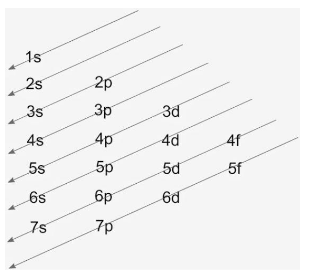
The arrows denote the order of the filling of electrons. s can accommodate 2 electrons, p can have 6, d can have 10, while f can have 14 electrons filled.
Hence, the electronic configuration of arsenic, As is written as $1{{s}^{2}}2{{s}^{2}}2{{p}^{6}}3{{s}^{2}}3{{p}^{6}}3{{d}^{10}}4{{s}^{2}}4{{p}^{3}}$ or [Ar]$3{{d}^{10}}4{{s}^{2}}4{{p}^{3}}$.
Note: Another way to show the electronic configuration is writing it without sub shells (s, p, d, f). It is written showing the electrons in shells of K, L, M, N, that can have 2, 8, 18, 32 electrons respectively. So As will have configuration of As= 2, 8, 18, 5.
Complete answer: Electronic configuration of any element tells us the total number of electrons in that atom or the atomic number of that element. Electronic configuration of any element consists of filling the orbital with electrons. The filling of electrons in various orbitals is according to a principle of Aufbau. The filling takes place in s, p, d, and f subshells. These subshells are written along with the number of shells, like 1,2, or 3.
Now, we have been given the element Arsenic, As, with an atomic number of 33. It has 33 electrons, so according to Aufbau, filling will take place as:
As =$1{{s}^{2}}2{{s}^{2}}2{{p}^{6}}3{{s}^{2}}3{{p}^{6}}3{{d}^{10}}4{{s}^{2}}4{{p}^{3}}$ , this is the electronic configuration of As.
It can also be written by writing a noble gas (argon) and then writing the remaining electrons as,
As = [Ar]$3{{d}^{10}}4{{s}^{2}}4{{p}^{3}}$ , argon with 18 electrons is added and remaining electrons are written as it is.
The diagrammatic representation of the Aufbau diagram is as follows:
The arrows denote the order of the filling of electrons. s can accommodate 2 electrons, p can have 6, d can have 10, while f can have 14 electrons filled.
Hence, the electronic configuration of arsenic, As is written as $1{{s}^{2}}2{{s}^{2}}2{{p}^{6}}3{{s}^{2}}3{{p}^{6}}3{{d}^{10}}4{{s}^{2}}4{{p}^{3}}$ or [Ar]$3{{d}^{10}}4{{s}^{2}}4{{p}^{3}}$.
Note: Another way to show the electronic configuration is writing it without sub shells (s, p, d, f). It is written showing the electrons in shells of K, L, M, N, that can have 2, 8, 18, 32 electrons respectively. So As will have configuration of As= 2, 8, 18, 5.
Recently Updated Pages
Master Class 11 English: Engaging Questions & Answers for Success

Master Class 11 Social Science: Engaging Questions & Answers for Success
Master Class 11 Maths: Engaging Questions & Answers for Success
Master Class 11 Biology: Engaging Questions & Answers for Success
Master Class 11 Physics: Engaging Questions & Answers for Success
Master Class 11 Chemistry: Engaging Questions & Answers for Success
Trending doubts
One Metric ton is equal to kg A 10000 B 1000 C 100 class 11 physics CBSE
Difference Between Prokaryotic Cells and Eukaryotic Cells
1 ton equals to A 100 kg B 1000 kg C 10 kg D 10000 class 11 physics CBSE
Find the value of the expression given below sin 30circ class 11 maths CBSE
Two of the body parts which do not appear in MRI are class 11 biology CBSE
Draw a diagram of a plant cell and label at least eight class 11 biology CBSE