




When an electron in hydrogen atom revolves in stationary orbit, it
(A). Does not radiate light thought its velocity changes
(B). Does not radiate light and velocity remains unchanged
(C). Radiates light but its velocity is unchanged
(D). Radiates light with the change of energy
Answer
 Verified
622.2k+ views
Hint: First we need to draw a visual diagram of the electron that is moving in the hydrogen atom, then consider all the energy state velocity of the electron radiation of energy or light, then after we figure out all the points we need to compare it with the options to find the correct option.
Complete step-by-step answer:
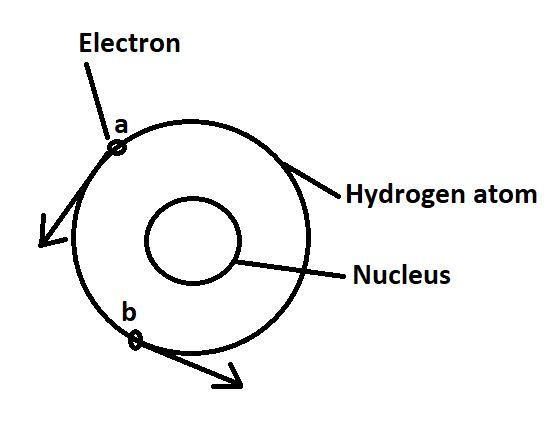
Here in the diagram we see a hydrogen atom with a nucleus in the middle, we have an electron at point ‘a’, and the same electron changes position and goes to point b.
Now if we consider that the velocity of the electron revolving in the orbit of the atom is V.
Now from the diagram we can see that the direction of the velocity will change hence the velocity will also change.
Now the electron in the orbit will not get excited and change its orbit or can get accelerated hence it cannot produce energy in any of the following cases.
And as the energy is constant it cannot produce light also.
So in option A we see, the electron does not radiate light thought its velocity changes,
This option is correct as the electron is not radiating light and its velocity also changes.
In the second option, the electron does not radiate light and velocity remains unchanged,
As the velocity is a vector quantity its direction changes so the velocity changes but the magnitude remains the same. So this option is also incorrect.
In the third option, the electron radiates light but its velocity is unchanged,
We have already figured out that it does not produce any kind of energy as it is not getting excited or accelerated so this option is also incorrect.
In the fourth option, the electron radiates light with the change of energy,
From the explanation of option 3 we can say that this is also incorrect.
Therefore the correct option is A.
Note: The velocity is a vector quantity hence it changes when it changes its direction, but the magnitude of the velocity is the same, that is it remains constant, it does not depend on the direction of the electron. We know that the electron is stationary hence we can say that it does not jump from one orbit to another.
Complete step-by-step answer:
Here in the diagram we see a hydrogen atom with a nucleus in the middle, we have an electron at point ‘a’, and the same electron changes position and goes to point b.
Now if we consider that the velocity of the electron revolving in the orbit of the atom is V.
Now from the diagram we can see that the direction of the velocity will change hence the velocity will also change.
Now the electron in the orbit will not get excited and change its orbit or can get accelerated hence it cannot produce energy in any of the following cases.
And as the energy is constant it cannot produce light also.
So in option A we see, the electron does not radiate light thought its velocity changes,
This option is correct as the electron is not radiating light and its velocity also changes.
In the second option, the electron does not radiate light and velocity remains unchanged,
As the velocity is a vector quantity its direction changes so the velocity changes but the magnitude remains the same. So this option is also incorrect.
In the third option, the electron radiates light but its velocity is unchanged,
We have already figured out that it does not produce any kind of energy as it is not getting excited or accelerated so this option is also incorrect.
In the fourth option, the electron radiates light with the change of energy,
From the explanation of option 3 we can say that this is also incorrect.
Therefore the correct option is A.
Note: The velocity is a vector quantity hence it changes when it changes its direction, but the magnitude of the velocity is the same, that is it remains constant, it does not depend on the direction of the electron. We know that the electron is stationary hence we can say that it does not jump from one orbit to another.
Recently Updated Pages
Master Class 11 Social Science: Engaging Questions & Answers for Success

Master Class 11 English: Engaging Questions & Answers for Success
Master Class 11 Maths: Engaging Questions & Answers for Success
Master Class 11 Chemistry: Engaging Questions & Answers for Success
Master Class 11 Biology: Engaging Questions & Answers for Success
Master Class 11 Physics: Engaging Questions & Answers for Success
Trending doubts
One Metric ton is equal to kg A 10000 B 1000 C 100 class 11 physics CBSE
Difference Between Prokaryotic Cells and Eukaryotic Cells
Draw a diagram of a plant cell and label at least eight class 11 biology CBSE
Two of the body parts which do not appear in MRI are class 11 biology CBSE
Which gas is abundant in air class 11 chemistry CBSE
10 examples of friction in our daily life