




When an elastic material with Young’s modulus Y is subjected to stretching stress S, elastic energy stored per unit volume of the material is
$\begin{align}
& a)\dfrac{YS}{2} \\
& b)\dfrac{{{S}^{2}}Y}{2} \\
& c)\dfrac{{{S}^{2}}}{2Y} \\
& d)\dfrac{S}{2Y} \\
\end{align}$
Answer
 Verified
655.5k+ views
Hint: When an elastic material is subjected to stretching stress, the work done in stretching it is stored in the form of potential energy in the wire. Let us say we extend the wire of length L, area of cross section A and Young’s modulus Y by $\Delta L$(change in length), Then the required force is $F=\dfrac{Y.A.\Delta L}{L}...(1)$. From this expression we can see that the force acting is a variable force. Hence we need to integrate the required work done by the above action of force.
Complete answer:
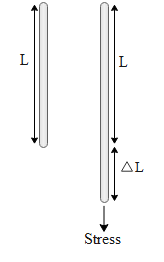
In the above diagram we can see that the wire of length L gets extended to a final length of $L+\Delta L$. From the beginning let us say we start to extend the wire and we extend it to a length x from the initial length L. Furthermore we want to extend it by a small length dx. The work done in doing so is given by,
$E=F.dx,\text{where F is the is applied force}$. Substituting equation 1 for F and integrating the work done for extending the wire we get,
$\begin{align}
& E=\int\limits_{0}^{\Delta L}{\left( \dfrac{Y.A.x}{L} \right)}dx \\
& \Rightarrow E=\dfrac{YA}{L}\int\limits_{0}^{\Delta L}{x}dx \\
& \Rightarrow E=\dfrac{YA}{L}\left[ \dfrac{{{x}^{2}}}{2} \right]_{0}^{\Delta L} \\
& \Rightarrow E=\dfrac{YA}{2L}\left[ \Delta {{L}^{2}}-0 \right] \\
& \Rightarrow E=\dfrac{YA\Delta {{L}^{2}}}{2L} \\
\end{align}$
Multiplying and dividing by L the above equation we get,
$E=\dfrac{YA{{\left( \Delta L \right)}^{2}}L}{2{{L}^{2}}}$
The term $\dfrac{\Delta L}{L}$ is the strain in the material and the term AL represents the volume (V)of the material.
Hence the above equation becomes,
$\begin{align}
& E=\dfrac{Y\left( AL \right)}{2}{{\left( \dfrac{\Delta L}{L} \right)}^{2}} \\
& E=\dfrac{YV{{\left( strain \right)}^{2}}}{2}....(2) \\
\end{align}$
The Young’s modulus for a wire is given by stress (S) by strain i.e. $Y=\dfrac{S}{strain}$hence substituting for strain in equation 2 we get,
$\begin{align}
& E=\dfrac{YV}{2}{{\left( \dfrac{S}{Y} \right)}^{2}} \\
& E=\dfrac{V{{S}^{2}}}{2Y}\text{ hence energy per unit volume is,} \\
& \dfrac{E}{V}=\dfrac{{{S}^{2}}}{2Y} \\
\end{align}$
So, the correct answer is “Option C”.
Note:
The above condition is analogous to potential energy of a spring. As we extend the spring the force required is directly proportional to the length of extension. If we still want to extend it further more and more force is required to extend any further.
Complete answer:
In the above diagram we can see that the wire of length L gets extended to a final length of $L+\Delta L$. From the beginning let us say we start to extend the wire and we extend it to a length x from the initial length L. Furthermore we want to extend it by a small length dx. The work done in doing so is given by,
$E=F.dx,\text{where F is the is applied force}$. Substituting equation 1 for F and integrating the work done for extending the wire we get,
$\begin{align}
& E=\int\limits_{0}^{\Delta L}{\left( \dfrac{Y.A.x}{L} \right)}dx \\
& \Rightarrow E=\dfrac{YA}{L}\int\limits_{0}^{\Delta L}{x}dx \\
& \Rightarrow E=\dfrac{YA}{L}\left[ \dfrac{{{x}^{2}}}{2} \right]_{0}^{\Delta L} \\
& \Rightarrow E=\dfrac{YA}{2L}\left[ \Delta {{L}^{2}}-0 \right] \\
& \Rightarrow E=\dfrac{YA\Delta {{L}^{2}}}{2L} \\
\end{align}$
Multiplying and dividing by L the above equation we get,
$E=\dfrac{YA{{\left( \Delta L \right)}^{2}}L}{2{{L}^{2}}}$
The term $\dfrac{\Delta L}{L}$ is the strain in the material and the term AL represents the volume (V)of the material.
Hence the above equation becomes,
$\begin{align}
& E=\dfrac{Y\left( AL \right)}{2}{{\left( \dfrac{\Delta L}{L} \right)}^{2}} \\
& E=\dfrac{YV{{\left( strain \right)}^{2}}}{2}....(2) \\
\end{align}$
The Young’s modulus for a wire is given by stress (S) by strain i.e. $Y=\dfrac{S}{strain}$hence substituting for strain in equation 2 we get,
$\begin{align}
& E=\dfrac{YV}{2}{{\left( \dfrac{S}{Y} \right)}^{2}} \\
& E=\dfrac{V{{S}^{2}}}{2Y}\text{ hence energy per unit volume is,} \\
& \dfrac{E}{V}=\dfrac{{{S}^{2}}}{2Y} \\
\end{align}$
So, the correct answer is “Option C”.
Note:
The above condition is analogous to potential energy of a spring. As we extend the spring the force required is directly proportional to the length of extension. If we still want to extend it further more and more force is required to extend any further.
Recently Updated Pages
Write structures of the following compounds i 2 Chloro3methylpentane class 11 chemistry CBSE

What is BLO What is the full form of BLO class 8 social science CBSE
Explain the Treaty of Vienna of 1815 class 10 social science CBSE
A Paragraph on Pollution in about 100-150 Words
XIX+XXX A 49 B 51 C 55 D 44 class 5 maths CBSE
If x a + bt + ct2 where x is in meters and t is in class 11 physics CBSE
Trending doubts
One Metric ton is equal to kg A 10000 B 1000 C 100 class 11 physics CBSE
Find the value of the expression given below sin 30circ class 11 maths CBSE
What do you mean by retardation What is its SI uni class 11 physics CBSE
Draw a diagram of nephron and explain its structur class 11 biology CBSE
10 examples of friction in our daily life
Difference between physical and chemical change class 11 chemistry CBSE