




What is the effect of friction on mass?
Answer
 Verified
543.6k+ views
Hint: The answer to this question lies in how we interpret this question. It can have two different meanings. The first one is does friction bring about any change in the mass of an object and second, what is the effect of friction on the body which has a certain mass when the body is moving or at rest. We shall answer both the questions to provide a proper explanation.
Complete answer:
Let us suppose a stationary block of mass ‘m’ is kept on the floor as shown in the following diagram:
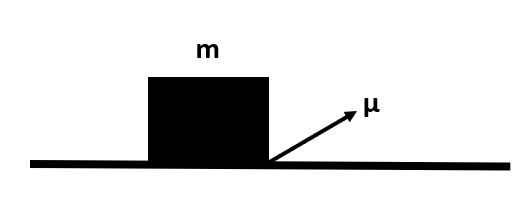
Then, the force of friction on the block can be written as:
$\begin{align}
& \Rightarrow f=\mu N \\
& \Rightarrow f=\mu mg \\
\end{align}$
Where,
‘$\mu $’ is the coefficient of friction between the block and the surface. And.
‘g’ is the acceleration due to gravity.
Here, we can see that the force of friction does not bring about any change in the mass of the block. Thus, the mass of an object is independent of how much frictional force it experiences.
Now, in our second case let us say that the same block has an initial speed of ‘v’, such that the situation now is:
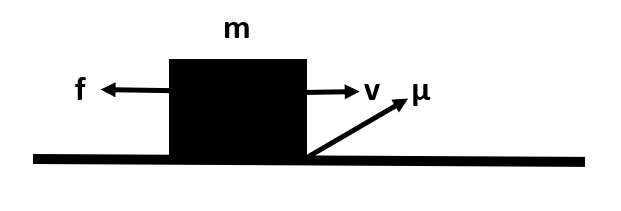
Now, in this case the frictional force is away from the direction of motion, so it will oppose the motion of the block. And thus, after some time, the mass of the block will come to a halt.
Hence, we can say that mass is unaffected by frictional force but the characteristics of a mass like, its speed and acceleration are affected (reduced) by friction.
Note:
The mass of an object changes under only one situation. This happens when the object travels at speeds comparable to the speed of light. It is explained by the relativistic mass equation. If the rest mass is ‘${{m}_{o}}$’, the speed of light is ‘c’ and the speed of object is ‘v’, then its relativistic mass (m) is given by: $m=\dfrac{{{m}_{0}}}{\sqrt{1-\dfrac{{{v}^{2}}}{{{c}^{2}}}}}$.
Complete answer:
Let us suppose a stationary block of mass ‘m’ is kept on the floor as shown in the following diagram:
Then, the force of friction on the block can be written as:
$\begin{align}
& \Rightarrow f=\mu N \\
& \Rightarrow f=\mu mg \\
\end{align}$
Where,
‘$\mu $’ is the coefficient of friction between the block and the surface. And.
‘g’ is the acceleration due to gravity.
Here, we can see that the force of friction does not bring about any change in the mass of the block. Thus, the mass of an object is independent of how much frictional force it experiences.
Now, in our second case let us say that the same block has an initial speed of ‘v’, such that the situation now is:
Now, in this case the frictional force is away from the direction of motion, so it will oppose the motion of the block. And thus, after some time, the mass of the block will come to a halt.
Hence, we can say that mass is unaffected by frictional force but the characteristics of a mass like, its speed and acceleration are affected (reduced) by friction.
Note:
The mass of an object changes under only one situation. This happens when the object travels at speeds comparable to the speed of light. It is explained by the relativistic mass equation. If the rest mass is ‘${{m}_{o}}$’, the speed of light is ‘c’ and the speed of object is ‘v’, then its relativistic mass (m) is given by: $m=\dfrac{{{m}_{0}}}{\sqrt{1-\dfrac{{{v}^{2}}}{{{c}^{2}}}}}$.
Recently Updated Pages
Master Class 11 Social Science: Engaging Questions & Answers for Success

Master Class 11 Physics: Engaging Questions & Answers for Success
Master Class 11 Maths: Engaging Questions & Answers for Success
Master Class 11 Economics: Engaging Questions & Answers for Success
Master Class 11 Computer Science: Engaging Questions & Answers for Success
Master Class 11 Chemistry: Engaging Questions & Answers for Success
Trending doubts
One Metric ton is equal to kg A 10000 B 1000 C 100 class 11 physics CBSE
There are 720 permutations of the digits 1 2 3 4 5 class 11 maths CBSE
1 Quintal is equal to a 110 kg b 10 kg c 100kg d 1000 class 11 physics CBSE
State and prove Bernoullis theorem class 11 physics CBSE
Difference Between Prokaryotic Cells and Eukaryotic Cells
Which among the following are examples of coming together class 11 social science CBSE